Japan, pt 3: Hiroshima & Kure January 26, 2020

So day three in Japan:

I woke up early that morning in my hotel and digested the news about Kobe Bryant’s helicopter crash, which was all anyone on the Internet was talking about. But I had a lot I wanted to do that day, so I got up and was out of the door by 8. I walked back across the river and into the peace park. It was another bright, clear day, and pretty warm for late January – apparently Hiroshima has a very mild climate. It’s the type of city I wouldn’t mind living in. Lots of water, lots of green, lots of mild temperatures. I went straight to the bomb museum, which is pretty well done. It has lots of really great before and after photos of the city, and since they’re all of the places that you can see in the modern day all around you, it’s very relatable. There’s a ton of artifacts from victims and survivors of the bomb, and of course hundreds of personal stories. It does a good job giving the Japanese perspective.

The museum the night before. The entrance is on the ground floor on the left. The museum is on the second floor, which you wind across and then back again, ending where you began on the left.

However, it is definitely the Japanese perspective. There’s no mention at all made of how the United States and Japan came to be at war, or of the atrocities Japanese soldiers had done and were continuing to do throughout Asia, or of the Japanese’ fanatical determination not to surrender in places like Iwo Jima and Okinawa. So, while I do feel sorry for the victims, most of whom were innocent women and children, I don’t regret the bombing still. Had to be done. *

The museum is two floors, and ends with a massive room about the history of nuclear weapons and a nuclear non-proliferation campaign. A lot of good information in there, most of which I already knew. I poked through the gift shop and got some small souvenirs that I could carry with me, some of which I’ll send along to you to remember Hiroshima by. After a couple hours in the museum I went back into the city. 

Today I had a goal: Near Hiroshima is Kure, an old Japanese naval arsenal. That was why Hiroshima was targetted, because it’s such an important naval base, and you can really see why when you’re there. Hiroshima Bay is beautiful, and calm, and a great place to train sailors and keep your navy. Very similar to Pearl Harbor. Today, Kure has a couple of museums – the Yamato museum is dedicated to the Imperial Japanese Navy, and the Japanese Maritime Self-Defense Force Museum next door to the modern Japanese navy. I really wanted to visit both those places. So, I started walking back to the train station.

I walked everywhere I couldn’t take a train. It was about a mile between my hotel, right next to the peace park in downtown Hiroshima, and Hiroshima Station, which is northeast of the old city (right on the edge of the blast zone – soldiers on the steps of the station were killed by the bomb). So it’s about a 40-minute walk through the streets, but I had some sights I wanted to see along the way. Walking is a great way to explore a new place, you really get a feel for everything. Taking a bus or a train leaves you disconnected. So, I walked north, then down into a huge underground shopping area (the same one that connects with the train station, in fact – you can walk underground the entire way if you wanted to), and a few blocks later came to Hiroshima Castle.

Note the boats. The boatmen are quick to offer a ride around the moat.

Hiroshima Castle was built during Japan’s feudal era 400 years ago, when samurai and warlords battled each other for control of the country. It was never besieged, but is a great example of traditional castle architecture. During imperial era it was an army headquarters, and had lots of modern military buildings and bunkers built on the grounds, but most of that was leveled by the bomb and it’s been rebuilt in the classical style since. I walked up to the castle and the moat, fended off a guy trying to sell me a boat ride along hte moat, and went inside. There’s an open space just behind the gates, for gathering troops, and you can go and walk inside the walls. The man behind the desk didn’t trust me to take off my own shoes properly for the polished wooden floors. 

Further inside, in the inner keep, there was some kind of church service or festival – this was Sunday morning, after all. There’s a huge open area inside the castle now that’s mostly gardens. I explored the grounds, eventually making my way to the main building, which is about 5 stories tall. It’s very cramped inside, but it’s been turned into a museum on the history of the castle, samurai, Hiroshima, etc. No pictures allowed, sadly. I got to hold a katana, a traditional samurai sword, which was cool – it weighs about as much as a baseball bat. Not heavy at all. The top floor of the castle is an observation deck and I was able to look out over most of the city. 

Miyajima, the island shrine I visited yesterday, is visible at center in the far distance.

After a few hours at the castle museum, I left by the rear gate headed east for the train station. It was a gorgeous day for a walk, as I dodged streetcars and other traffic along the way. I passed by Hiroshima city garden and decided, what the heck, I’ll duck in for an hour or so and do a quick tour. The garden was designed by a famous imperial landscape artist back in the 1700s, and it was a sight to see. 

But while I was there, a trio of old women suddenly stepped into my path before I could really get started and shoved a piece of paper into my hands. They didn’t speak a word of English and I only know about 5 words of Japanese, but eventually we worked out that they were giving me a gift. They flagged down a young woman walking by with her husband – she had taken English in high school and was pretty good at it. I learned that they wanted me to come to a traditional Japanese tea ceremony with them. We went and waited in a nearby courtyard for a while, then I shuffled in with them and about 100 other people into a tea house. It was crowded, as everyone packed into a room about the size of our kitchen and living room combined. The architecture was traditional – sliding paper walls, tatami mats on the floor, almost no furniture. I sat down in the front row and watched as a woman in a traditional kimono came out and started preparing the tea in front of us. 

They had a bunch of other guys out back making tea by the barrelful, though, and soon enough the wall next to me slid back and a guy started passing me tea cups to pass along to people inside. Everyone got a cup and some rice cake. The tea was thick, sludgy, and green, and looked really strange, but it tasted amazing. Best cup of tea I’ve ever had, in fact. During the ceremony, a narrator explained the significance of all the ritual, but it was entirely in Japanese so I have no idea what anything meant. The whole affair took about two hours, then we all shuffled out. I thanked the women, took a picture with the woman and her husband who had been my interpreter, and then finally took my walk around the garden, which is gorgeous. You’d really like it, Dad – it’s the sort of place you’d really have fun designing and taking care of. Winding paths, landscaped bushes and trees, water features and quirky bridges, sculpted hills, lanterns, shrines, tons of koi fish in the pond. It was wonderful. Finally, about 2 in the afternoon, way behind schedule, I headed back out for the train station.

The ride down to Kure was pleasant, right along the bay. We passed fishing ships and docks, markets, boat sheds,  marinas – all the things you need to support life on the water. We rolled into Kure itself not an hour later, which just had a little 2-platform station (Hiroshima Station has more than 24 platforms). Lots of signs pointed me straight to the Yamato museum, and I took an elevated skybridge direct from the train station through a department store and to the museum. Outside the museum there’s a massive life-sized deck replicating half the Yamato (the largest battleship ever built, quite a bit larger than our Iowa class), and across the street at the JMSDF Museum there’s an old submarine. I had lots of fun poking around the replica, which has children and dogs playing around it, then went inside. 

Inside, the museum’s centerpiece is a massive 1:20 model of Yamato, but it has tons of rooms dedicated to the history of the Japanese navy. There was an exhibit on Yamato and Musashi’s last voyages (the two sister ships were the biggest battleships ever built, specifically designed to be able to beat anything the Americans could send through the Panama canal. Musashi was sunk at Leyte Gulf, Yamato at Okinawa, both by carrier planes. Oops), dozens of models of famous Japanese warships, and a room with a real Zero, midget submarine, and human torpedo inside. I spent hours wandering around looking at all the ships…just a bit too long, in fact. At 4:40 I went across the street (after buying some more souvenirs, including a shirt, from the shop) to the JMSDF museum…to find out that its last admission was at 4:30. Bummer. 

kureyamato.jpg
The Wind Rises is a great animated movie about the creation of the Zero.
kurezero.jpg
Isn’t she beautiful? Look at the people for scale. The secondary batteries at the center of the ship are all shielded, because the blast from the main guns was so powerful. Instant way to recognize the Yamato.

So instead I went on an adventure. I ate dinner at a little restaurant in the department store, then hit the streets of Kure. I read that there’s great views of the city at night from the mountains outside town, so as the sun was setting I started walking. The further I got from the train station, the less busy the streets got, and the smaller the buildings. Soon, as it was getting dark I was off the beaten path and into little neighborboods, with narrow, winding streets and traditional Japanese homes all around me. I kept having to duck off the road to avoid traffic, since there was no sidewalk. And I was constantly going up, up, and up as I climbed the mountains that are everywhere in Japan. Soon, the last house was behind me, and even the last streetlight. By now it was full dark and I could barely see the road, but I was walking next to a good-sized creek that let me know I was on the right path. My main worry was getting hit by a car in the darkness, but there was seriously nothing out there. Finally, at about 7, I made it to a good sized ridge and could turn and look back at the city, which lay below me all lit up. I could see a good ways out to sea, too, which was, of course, mostly dark.

It was a fun exploration, but it was late and I was tired, so I walked the long, long way back into the neighborhoods and wound through them until I made it back to the main roads, then back to the train station and home to Hiroshima. I got there about 9, then walked some more (past the castle at night now) and hit my hotel by 10, where I was pretty quickly asleep. It was my last night in Hiroshima – the destination for Monday was Osaka. 

But first I planned to go back to Kure and hit the museum that I missed. I’d never get another chance, so why not? 

* This text is drawn from an email to my father, who had asked me to give up an update in email form on what I’d been up. We’ve talked WW2 and the Bomb many times, so I’m skipping over the argument in favor of using atomic weapons. If you want to have that discussion with me, feel free to message me, or better yet, join me over a cup of coffee some day when I’m home and the pandemic is past.

Japan pt 2: Miyajima January 25, 2020

Going to try to get through Hiroshima today.

So, the second day of my Japan trip, I got up, showered, and packed up all my belongings – never returning to Hakata again, probably. After breakfast in the kitchen, I headed out into the streets. It was still early Saturday morning and everything was quiet, but the temples were busy because of the lunar holiday. As I walked through the streets, I met up with the girl from Taiwan from the night before – the English teacher. We walked together on our way to the train station, but I never thought to get her name or her contact information. Oh, well.

haktatemple.jpg

The train station was crowded with travelers, like before. Thousands of people hurrying every which way. I had a Japan Rail Pass, which is a special program by the Japanese government. You buy it before you arrive in the country (you can’t purchase it within Japan!), and then activate it once you arrive – it grants you unlimited rides on all JR rail lines, which reach damn near the entire country and includes the bullet train. I found the JR office and a worker helped walk me through completing my application to activate the pass. I waited in line about 20 minutes in the ticket office (again, hundreds of people queuing up for more than a dozen separate ticket desks), then got a ticket for the next bullet train to Hiroshima. 

I had to weave through the crowds to get to the platforms. It got pretty routine since it was something I would do dozens of times during my stay in the country – I just walked up to the single manned gate, flashed my pass at the guard, and then waltzed on to whatever train I wanted. At first it was very confusing – dozens of platforms, with destinations and times announced in Japanese and English, trains coming and going every few minutes, hundreds of people chattering, the station PA coming on periodically, and of course the sound of trains roaring in. I found what I thought was the right place to wait on the platform, and two trains later I filed on to the shinkansen, which is what they call the bullet train.

The cars were very wide and had really nice seats. I was seated next to a businessman of some kind, but in the future I wouldn’t get a reserved seat and would just pick my own (with the rail pass I didn’t actually need a ticket – I could just walk on!). Within five minutes of the train arriving we departed. 

It was a smooth ride – you barely feel like you’re moving, but then you look out the window and the countryside is whipping by at 120 miles an hour. The seats are mostly like an airplane, again, with tray tables, recliners, chargers, etc. I looked out at Kyushu one last time (I thought about going south to Nagasaki, but it was out of the way), then we dove into a tunnel to go under the strait and arrive on Honshu, Japan’s main island. We stopped in one or two towns like Kagoshima, but within an hour and a half of leaving Hakata I was in Hiroshima, 200 miles away. 

I didn’t get to see too much of the city at first – just outside Hiroshima there’s a famous shrine, Itsukushima. It has a torii gate floating on the water in Hiroshima Bay, you see pictures of it all the time. I wanted to head over there and visit that first before I went into the city. I had booked two nights at the hotel here, so I had plenty of time to explore. So, I left the bullet train, wove through the station again, and found the local lines. Then I got onto a much smaller train, more of a subway car, and we headed out across hte city. 

Hiroshima is a beautiful city with lots of water. There’s a river that empties into the sea right at the city, and the city is built on dozens of small islands on the river delta. It’s mostly small homes and businesses with not too many big buildings apart from downtown, and the day was really clear and cool (it got a little more damp later in the day, but nothing too bad). At the end of the line, pretty much everyone got out and walked a block down the street to the ferry to Miyajima Island, which is where the shrine was. I made it just as a ferry was getting ready to depart and hurried on board. It was a big, open boat – two decks, lots of seats, no walls. The island was visible just a short way across the water. It was a short ride, just like 20 minutes, and then we pulled into the dock.

The island is overrun with tourists, and deer. Deer everyhwere, and they walk right up to you expecting to be fed. There’s a little town wedged between the sea and lots of forested hills that make up most of the island – it’s a sacred island in Shintoism so not much development is allowed, which makes it very quiet and peaceful despite the crowds. Just about everyone was walking along the seaside path towards the shrine. There were people from every country and of all ages visiting. I joined them, patted some deer, took lots of pictures, and explored the shrine (which is built right above the water), which still had working monks performing religious ceremonies. I explored the back alleys of the town and ate lunch at a tiny Japanese restaurant run by a nice old woman, went to an aquarium where I saw all kinds of fish native to the Inland Sea and petted a seal, and waded in the shallow water all the way out to the famous torii gate (which was currently covered up for maintenance). A Spanish woman had me take her picture there, and then she took mine in exchange. After a few hours, I headed back to the ferry to go to town and find my hotel.

Back in the train station, it was again really busy and confusing. I wound up in an underground shopping mall trying to find my way out, where there was a sort of concert going on at a public space, but I eventually amde it out onto the streets as the sun was setting. I crossed three rivers and just took in the sites, but eventually I found the Bomb Dome – ground zero from when we wiped out the city 75 years ago. It sits across the river from an ancient district of Hiroshima’s that was totally wiped out in the bombing and today is the Peace Memorial Park. The park has lots of trees and wide paths, and many monuments to the atomic bombing, including the national bomb museum (closed at the moment, but I’d go there Sunday morning). I walked around the park for a while, which sits on its own island in the center of the city. Just off the north end, the river, which comes down from the mountains to the north, splits in two, and flows around either side of the island. There’s a T-shaped bridge which connects either side of the river and the island – that was the point that Enola Gay aimed for since it’s so distinctive. 

After my walk, I crossed to the far side of the island and a few blocks away hidden in a back alley was my next hotel. It give me a bit more space than the last one, more than I needed, really, so I quickly settled in, then went out to explore. I found a busy shopping district and wandered for a while. It was nice hearing English spoken in the streets – Hiroshima is filled iwth tourists from every nation, so I didn’t stand out for once. But I didn’t want to buy any souvenirs since anything I bought I would have to carry, so I contented myself with people watching and dinner. I headed back home by 9:00, organized all the day’s photos, and went to bed. 

I woke up the next morning to learn that Kobe had died.

Japan, pt 1: Busan and Hakata Port (Jan 23 – 24, 2020)

I have two drafts right now of my Japan trip. One is spiralling more and more out of control with details and blow by blow. In fact, it’s growing unmanageably long, and no one wants to read that. Maybe I’ll finish it someday. Instead, I’ll just share a much shorter, summary version that I wrote in an email updating family on my adventures so far. It’ll serve as content and maybe some day we can have the long form version.

School break was supposed to last to the last week of February, so it was a good time to travel. I spent most of January in the office, watched the Chiefs in the playoffs, didn’t do much, then took off for two weeks to Japan at the Lunar New Year. Japan was pretty great, as you know. 

I took the bus Thursday morning from Gwangju and arrived in Busan late that afternoon. Busan is a thriving, busy city with lots of celebrities and parties and whatnot. I walked along the beach and waterfront most of the evening, then went to my hotel. The next day, after breakfast, I took a bus down to a little island right off the coast of Busan that used to be a hunting preserve for one of the old kings of Korea. There’s a neat lighthouse on the southeastern tip that’s the southeasternmost point in all Korea, and closest to Japan – on a clear day you can see it across the strait. I met a lot of Jehovah’s Witnesses, who were combing the island in force trying to recruit new members. Then I had to hightail it back to Busan to catch my ferry. 

The passenger terminal is a lot like an airport, just with no runways. There’s a lobby and lots of desks with all the various shipping lines, a small cafeteria and coffeeshop, and a small security area. I checked in with about 200 other people who would be on the same voyage. Lots of really intense questions – How long would I be in Japan? Did I have a visa? Where was my passport? Why didn’t I have a return ticket? I was flying out of Tokyo? Where was my ticket? Where would I be staying in Japan? Etc. But I made it through okay, and went through security (not quite as intense as airport security – I could keep my belt and shoes on, at least) and waited at the gate for departure. 

The view from the lobby, looking southeast towards Japan.

The ferry itself is a little boat, not even really a ship – about 150 feet long, two decks, mostly a passenger area with lots of seats, looks like the inside of an airplane. It’s mostly hydrofoil so the hull sits up out of the water. We left Busan early that afternoon and sped across the strait. It took about 3 and a half hours, very smooth. I didn’t get seasick at all. We passed the island of Tsushima (famous battle between Japan and Russia in 1905 there, start of the Japanese Empire) and went into Hakata port on the island of Kyushu. 

The passenger area was nice, with comfy seats and broad aisles. Not very crowded, either. Many people were in masks because of rumors of a new virus coming out of Wuhan in China.

Hakata and Fukoka are a twin city, probably hte largest on the island. The streets were wide and clean, much nicer than Korea, I noticed, and all the people were well dressed. It was early in the evening Friday night, and lots of people were walking home from work. The port itself was again like an airport, but very small – just a customs area, baggage claim (which I skipped – I only brought my backpack to live out of), and a small tourist desk in the lobby. I walked out into the city with only a paper map to find my hotel – no cell service yet until I could change my SIM. But I made it okay (good sense of direction) and enjoyed the mile-long walk through downtown Fukuoka. I also went to Hakata Station, which is a huge train station/shopping mall. There’s dozens of rail lines that gather there, more than ten floors of shopping, restaurants…tehre were thousands of people and so much light and noise that I was really disoriented. I couldn’t find a place to change money, so I instead used my American credit card to withdraw cash for the trip. I also grabbed dinner – ramen noodles – while I was there, then headed back to the hotel. 

Ship’s cats could catch rats and other pests and keep the ship healthy. So, they are good luck for travelers. This Astrocat is for modern day adventurers.

The hotel has a cat dressed like an astronaut outside, for good luck. Makes it really easy to find, too. It’s a capsule hotel, so all you get is a little bunk bed and some space for your personal belongings. Communal bathrooms and shower – very cheap and not at all bad if you don’t mind not having your own room. That night, I went up to the kitchen. It was Chinese New Year, so the hotel staff was celebrating with dumplings for everyone. While I was up there, a group of Chinese students – looked like they were in their early twenties – approached me and asked if they could use my table. They were going to celebrate with sake, you see. I of course let them use it, and they invited me to drink with them, so I did and celebrated the Chinese New Year. They were college students from Beijing, but we had a bunch of other guests come and join us when they saw how much fun we were having. There was a pretty American girl teaching English in Taiwan, another American working in Ulsan in Korea, yet another American who was just roaming around Japan, two Korean sisters from Seoul, and an elderly couple from Taipei in Taiwan. Some people only spoke English, some only spoke Chinese, some only Korean, some only Japanese, so there was lots of translating. I didn’t go to bed until late that night, but had to be up early the next day to catch my train for Hiroshima.

A Face for Radio

“As for you, number 4, you have a wonderful voice. Have you ever thought about doing radio?”

Sixteen-year old me hadn’t. In fact, I hated the sound of my own voice (news to anyone who’s heard me expand on my favorite subjects, but there’s a difference: I don’t enjoy talking just to talk. I love warships and history and religion and philosophy and so I love talking about those things, but it’s the subject I love, not the talking). Like most people, I couldn’t stand to listen to recordings of myself. So when the debate judge mentioned radio to me, it was the first time I”d ever thought about the subject.

I lost the debate, of course. I lost most debates – I simply wasn’t good at convincing people through the absurd and convoluted rules that American policy debate requires (I’m not bitter). I was a good speaker, though – in fact, I was the best in the district at the extemporaneous speaking competition, and probably should have performed better at state (I didn’t try my hardest, a fact which my debate teacher knew when she saw my final scores but didn’t call me on. I was tired of debate and didn’t want to do it next year).

Anyway, after a policy debate the four speakers (two on each team) would be given feedback from the judges, and I was consistently praised for the quality and control of my voice. “You definitely have the face – er, voice – for radio,” I distinctly remember one judge, a well-meaning older man with silver hair and a strong, confident face, saying. The judgment – a face for radio – stuck with me.

But I never did try radio.

Until Saturday, that is. I walked into First Alleyway, a popular expat restaurant in Gwangju. The expat community is pretty small here – it’s like a small village within the large city, about 300 people I’d estimate, give or take. You don’t know everyone, but you know someone who knows just about anyone. So when a new face (like me) shows up, people are naturally curious.

I sat down at the bar for dinner. On the TV, Interstellar was playing. Matthew McConaughey was being battered by massive ocean waves the size of city blocks. The fellow sitting next to me, a portly, bearded man with thinning hair and a friendly face, leaned over and said, “I saw this in the Imax here in town. Those waves on an Imax screen? I thought I was gonna die!” Thus I met Arlo.

Arlo is an Albertan, but fled to Korea a decade ago as a political refugee – a democratic socialist had no place in conservative Alberta. Initially an English teacher, he had gotten his master’s in Economics and now taught at Chonnam University, with a Korean wife and child. As a side hustle, though, he hosted People of Gwangju, an English-language radio program on the local expat radio network. When I mentioned that I taught at Gwangju Science Academy, he perked up. “Well, Brad, you’ve passed the barrier of being sufficiently interested. How would you feel about an interview? I’d make it worth your while.”

So it was that this Friday (about two hours ago) I made m shining radio debut.

I drove out to the station (and by that I mean I took a cab – I don’t miss driving one bit), which sits on a leafy hill overlooking downtown Gwangju. Behind the building a radio antenna leaps into the sky, one of the highest points in the city. I walked inside, past signs reminding me that ALL GUESTS MUST USE HAND SANITIZER BEFORE ENTERING STUDIO, and signed the guestbook (Please write your temperature. Did you bring a mask? Y/N), before being ushered into the studio.

THe production offices were, well, normal, apart from everyone wearing surgical masks (itself never too uncommon in Korea, admittedly). Cubicles and employees at computers, editing, writing, doing the administrative minutia that keeps every operation in, er, operation. Arlo met me, shook my hand (a bold choice in these times of COVID19) and ushered me into the studio. A desk with a pair of microphones and headphones for each of us, the soundproof glass barrier separating us from the production crew (Missy, his producer, studied at UMKC! We shared a mutual joy over the Chiefs’ glory before beginning) – it was a real radio studio!

The interview itself was super easy, barely an inconvenience. I talked about myself, mostly (my favorite subject of all!), coming to Korea, surprises, difficulties. I wish the story were more interesting, but honestly I was just excited to be there. It’s fun to be on the radio! After a brief conversation – barely twenty minutes, which I was told would of course be editted down, I was being thanked for my time and shown the door.

So nothing glorious or glamorous, but still fun. One more thing off the bucket list – appear (what’s the proper word for non-visual media?) on the radio at least once in my life. Between this interview for the English language radio station in a town with perhaps 300 native English speakers, and one of my Tweets getting more than a hundred likes, I’m basically a celebrity now. You can all say you knew me before I got famous, though, so there’s that.

Just a fun story for Friday afternoon.

Brad’s Cleverly Titled Japan Adventure: A prologue

I’m still trying to grapple with Japan and put everything into words. Not really for y’all – to be honest, who wants to read about someone else’s vacation? It’s the dreaded Slideshow, after all. No, this is for me. The better I can write everything down, the better I can remember it and keep it forever. But there’s so much, I’m having a hard time.

This is something I wrote for another place. After I finished, I thought it might also be appreciated here, as sort of a glimpse as to what I’m dealing with:


You asked me how Japan was. I will attempt to answer: Japan was…everything I wanted it to be and more. It’s impossible to fully describe my trip, so let me instead describe one moment for y’all and let it stand for all:

So I bought a JR Rail Pass, which for two weeks grants me unlimited rides on essentially the entire Japanese rail network, from the mighty shinkansen bullet train all the way down to little municipal trains that roam around rural provinces. I could go wherever I wanted, when I wanted, which I used to the fullest extent, exploring the whole length of the country between Hakata port and Tokyo. 

By Wednesday, I’ve been in the country nearly a week, and I’m on the shinkansen. It’s an intimidating thing, when I first tried it – the shinkansen station in every city is massive, with tens of thousands of people hurrying everywhere, a hundred different shops packed in, video advertisements, posters, signs pointing to trains every which way – for a Midwestern boy like me it was all a bit overwhelming. When you reach the platform, the roar of trains coming and going is constant, and the air is filled with announcements in Japanese and English, and people talking to each, too, so it’s an intense experience. Then the train comes barrelling down into the station and between the noise and the speed of it you can just feel the power of this machine. I loved it. But once you board the shinkansen, things change totally – the ride is smooth, the cars are spacious, luxurious, and quiet. The seats are wide and soft, smiling women roam up and down the aisle with drink and snack carts, and unless you look out the window you can hardl tell you’re moving at all. 

So I’m snug in my seat Wednesday afternoon, racing towards evening. Behind me is Kyushu, Hiroshima, Himeji, Osaka, Kyoto – but yet to come is Tokyo. I’m tired from everything I’ve already done – a hundred adventures already – but I’m also excited for my first glimpse of Tokyo, the largest city in the world. Still ready to see some of those iconic Japanese sights like the scramble crossing or Tokyo tower. And the train comes around a bend, and my jaw just drops – in the distance, glowing in the sunset, dozens of miles across a wide valley, I get my first glimpse of Mt. Fuji. 

Now, I’ve heard of Mt. Fuji, of course, and seen the pictures. I thought I was prepared for it. Fellas, let me tell you – I was not prepared. The snow on the volcano flared golden in the sunlight. Clouds skirted along its foothills. The intervening valley between us lay mostly in shadow, except for the lights of Fuji town, just now starting to twinkle in the advancing evening. I just kind of stared, slack-jawed for a while, then dove for my phone – the train is racing along at hundreds of miles an hour and I have bare minutes. It’s not the greatest photo in the world, but it’s all I had time for:

[Image: OHloWDn.jpg]

Now that is a natural wonder of the world. 

My trip was filled with moments like that. I drank sake with a dozen strangers on our hotel roof for Chinese New Year. Didn’t learn their names – no one shared and no one asked. Waded in the tide at Itsukushima Shrine. Got kidnapped by some elderly women in Hiroshima and dragged to a traditional tea ceremony. Toured the Imperial Palace. Met American contractors in a tiny dongatsu joint in Osaka, who were building animatronic robots for a theme park (one guy did Gringotts, in Orlando!). Chased by wild boars at Fushimi Shrine in Kyoto. Had my best gin and tonic ever in the shadow of Tokyo Tower. 

Have you ever had a perfect day? A day where you would change absolutely nothing, because even the smallest alteration would mar the rest? Picture a string of days like that – every day in succession was more perfect than the last. That was Japan.

So yeah, good trip.

February Update

So, Japan was spectacular. In fact, it was the best trip of my life. I took so many pictures and had hundreds of adventures in those 7 days. I’ve been trying to put together some kind of narrative of my trip, but it’s proving difficult for a number of reasons:

  • First, the trip itself was meaningful to me because of a lot of context, without which you cannot really appreciate why it mattered so much. As Dickens put it, the context “must be distinctly understood, or nothing wonderful can come of the story I am going to relate.” Sharing that context without being overly verbose (me? overly verbose? Never!) is a challenge.
  • I don’t want it just to become a vacation slideshow. Those are super boring. No one wants to read a slideshow.
  • The Super Bowl was extremely distracting. I spent probably a solid week mostly consuming Chiefs content instead of doing work.
  • This week, school was meant to start, and I’ve been scrambling to prepare for the semester. Instead, Korea delayed school for two weeks due to the coronavirus.

So, that’s in the works, but it’s tough. Other things I want to work on:

  • I’m working on a good English-language account of the Gwangju Uprising, since it seems to be almost unknown in the United States and finding good resources in a language I can read is tough. So I’ll make my own. That needs to be done by May 18, so I have time.
  • A follow up to my Family posts to bring the story of the Chiefs’ playoff run to its exciting end.
  • Life in Korea under the threat of COVID-19. I’m not dead, and I don’t anticipate dying from this bug (-knock on wood-), but people may be interested in what life is like here at this time.
  • Maaaaaybe if I can persuade my friends a few portraits of them and my shared experiences with them on here. But some of them read this so I have to promise to be kind and only write flattering things (I’m pretty sure I do this anyway).

So yeah. Not dead. Good to write publicly what I want to tackle, since it forces me to deliver later.

Family, Pt 2

The Chiefs have always been Kansas City’s first love. The city has been devotedly loyal to the team even through 25 years of playoff failure, even though it’s 50 years this month since the team was last even in the Super Bowl. No matter to the fans – they’ve kept the faith all this time, even as the team continually let them down.

Two years ago, I remember. Another January evening. Lona and I went out for Mexican food. It was a good meal – I bumped into one of my coworkers at the restaurant, always a joy – and in the background was another Chiefs playoff game. As we filed out, Lona elbowed me and said, “Hey, look! You’re winning!” I glanced over. It was halftime, and the score stood 21-3 in the Chiefs favor. I laughed.

“I’ve seen this movie before,” I said. “There’s a lot of game left. Give ’em time, they’ll let you down.”

By the time we reached home, the game was over, and the Chiefs had lost 22-21, in a game that featured an opposing fumble blown dead because of “forward progress” and the opposing quarterback managed to somehow throw a pass to himself in the end zone. Same old Chiefs. I loved them anyway, because some things are important.

But now…maybe not same old Chiefs.

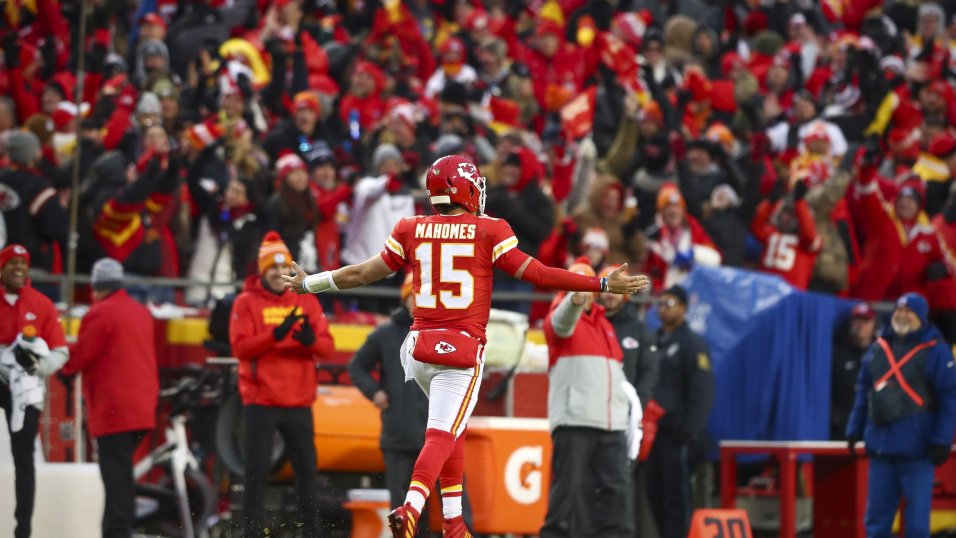
As the entire world knows by now, watching from the sidelines of that failed playoff game was a young man, a 23-year old out of Texas Tech University who had been drafted by the Chiefs at #10 that year. His dad was a major league baseball player, but Patrick Mahomes II’s first love was always football. A few weeks after the game, the Chiefs traded their veteran quarterback Alex Smith (the man behind the helm for both the 2014 and the 2018 defeats, as well as 2 more in the meantime) and said they were all in with Mahomes as the new starter.

Well, we all know what happened next. That fall, Mahomes took the league by storm. He was the second coming of Favre, Montana, Elway, all rolled into one. He could throw passes on one foot, across his body, with either hand, with his eyes closed. He could throw a football 70 yards and place it in a window 6 inches wide.

For the first time in my life, the Chiefs had the best player in all of football. And while the Royals had won, the one thing that my grandfather would have most wanted to see – the one thing that everyone wanted to see – was the Chiefs playing the Super Bowl. With Mahomes under center, suddenly that looked like a real possibility.

The Chiefs stormed to the #1 seed in the AFC last year and home field advantage in the playoffs. They hosted Tom Brady and the New England Patriots in a game at Arrowhead for the right to go to the Super Bowl, a titanic game, the largest in the old stadium’s entire history. It was a brutal slugging match, a back-and-forth affair that came down to the final seconds. I remember, as Brady drove down the field, trailing by 4, with less than two minutes to go, he slung a single ill-considered pass – and a Chiefs defender (Charvarius Ward) came up with the ball. An interception!

For one, brief, shining moment, I thought I’d seen what my grandfather had wanted for his whole life. I thought I’d watched the Chiefs just punch their ticket to the big dance.

Of course, we know what happened. Dee Fords was off-sides. The play was nullified, and the Patriots would go on to win in overtime.

It was a gut punch, a sickening blow right in the stomach, but it was one I’d felt before. Because it had happened to us before – in 2014, when the Royals came up 90 feet short. They had come back the next year. Now the Chiefs would have to, too.

The NFL is not an easy league. It’s been a long, tough road. The Chiefs lost a game to the Colts, and to the Texans, games they should have won. New England won the Super Bowl (again) and looked as unstoppable as ever. The Ravens exploded to completely dominate the league. Meanwhile, the Chiefs struggled, Mahomes was injured, and it looked like any prospect of repeating was slipping away. The low point was when the Chiefs went to Tennessee and were beaten in the closing seconds by the lowly Titans.

I’m sorry, Grandpa. Maybe next year.

But sometimes it’s the little things that make the difference.

The Chiefs quietly put things together. They stopped losing. They went to New England and beat Brady’s Patriots. At the time, it seemed to hardly matter – New England still had a 1-game lead for the bye, and the Ravens had locked up the #1 seed long since. The top 2 seeds are almost always the teams competing for a Super Bowl. The Chiefs, as a #3 seed, would have to beat a wild card team, then go to New England and beat the Patriots again, then go to Baltimore and beat the 14-2 Ravens, just to reach the Super Bowl. A tall order. But the Chiefs kept grinding, kept winning.

I’ll never forget the last week of the season. The Chiefs came in, 11-4, needing to beat the Chargers even to have a chance at a bye. The Patriots were 12-3, simply needing to defeat the lowly Dolphins, a team with only 4 wins, who the Patriots had blown out 42-0 in Miami earlier, a team so terrible legitimate articles were written earlier in the season questioning if the team was the worst of all time.

And as the Chiefs closed in, doing their part, beating the Chargers, a miracle happened.

As time wound down in both games, the Dolphins marched down the field – and took the lead with barely 30 seconds to go.

In Arrowhead, the news was kept from the big screen – Reid didn’t want his players distracted. But the crowd knew, and the word spread via word of mouth around the stadium. ANd you can see the roar steadily grow and spread in a natural wave as everyone learns the amazing news. The players learn, too, and react with unfeigned joy: the Chiefs were now the #2 seed. They would have the bye – and the Patriots would have to play a wild card team, and, if they won, come to Arrowhead to play.

And then last week. The Patriots, and then the Ravens, were upset. The two teams the Chiefs were chasing all season – eliminated. And for the second straight year, the AFC Championship Game will be held at Arrowhead.

Wow.

Wow, wow, wow.

And so it comes to the Titans.

It had to be the Titans. The last team to beat the Chiefs this season. A team the Chiefs have beaten only once in the last five years, and lost to four times. Last year, the Chiefs beat the Colts in the playoffs and got that monkey off their back. The game in Foxborough this year ensured the Patriots were in the wild card and served as fitting revenge for the defeat last January. Now the Chiefs face a tough, physical team that isn’t the least bit frightened of them.

The team the Chiefs lost to, the last time I doubted them, 22-21?

The Titans, of course.

But they’re back. Against all odds, the Chiefs have clawed their way to a second chance. A second chance to give me the thing I’ve wanted for Grandpa for years. A chance at a Super Bowl. And so the game on Sunday means everything to me.

But not whether they win or lose. I want htem to win, obviously, but ultimately the winning or losing isn’t what’s important. What is important is that you’re there, with your team. Because when you cheer for the team, you’re not alone. You’re sharing the experience with millions of people from around your city. You’re coming together and joining in something larger than yourself, something you choose to devote yourself to. Not because they just happen to live nearby. But because the people you care about also choose to. And when you’re cheering on your team, the ones you love – including the ones you lost – aren’t really gone. For just a few hours, once a week, they’re right there with you, again.

Because ultimately, you cheer for your team because of your family.

Good luck Sunday. Go Chiefs.

Family

Six years ago this month, I had one of the most intense arguments I’ve ever had with my family. Tempers flared, things got heated, and for a while we even had to separate just so everyone could cool down – maybe common, in other houses, but definitely a rarity with me and mine.

The Cape Coral riverfront at night

It was January, 2014. We were in Florida for Christmas and New Year’s. We’d gone across the bridge over the Caloosahatchee River to Cape Coral, to a restaurant Mom had wanted to try there near the riverfront. It was a crowded place, and the NFL playoffs were on. My hometown Kansas City Chiefs had made the playoffs for the first time under their new head coach, Andy Reid, and had traveled to Indianapolis to take on Andrew Luck’s Colts. Everyone in my family was deeply invested in the game – except me. And here the troubles began.

“It’s stupid,” I said, “to invest so much of your happiness in a team like the Chiefs.” I went on, “You don’t know any of the players. They’re a bunch of people you’ve never met, people who aren’t even from Kansas City. Their winning or losing affects your daily life not a bit. And if they win, it’s no credit to you – you did nothing.”

My mother was horrified. “It’s not about the winning and losing,” she said. “It’s about supporting your hometown team!”

I shook my head. “They have no connection to Kansas City! Most of the players, again, aren’t even from Kansas City. They’re basically just hired mercenaries. Basically, they’re just a bunch of people who happen to play geographically near me. I have no connection to them.”

Back and forth we went, each side steadily digging in, and things started to get heated. Meanwhile, on the screen, the Chiefs were thumping the Colts, racing out to a 38-10 lead over the luckless* Indianapolis team.

My position was simple. I refused to get invested, emotionally, in Kansas City’s two professional teams, the Royals and the Chiefs, because they would always disappoint me in the end. The Royals, of course, were the perennial laughingstock of baseball, having had only 1 winning season in the last 20 years and not having sniffed the playoffs since 4 years before my own birth.

In many ways, though, the Royals’ quiet, hopeless futility was better than what the Chiefs did.

The Chiefs would break your heart.

Many of my earliest memories, especially in the winter time, are of my family – all of them, including grandparents, uncles & aunts, cousins – gathered in the living room on Sundays to watch the Chiefs in the playoffs. The red and white sweaters would come out, snacks would be made, and then a lot of yelling and tears would inevitably ensue.

See, unlike the Royals, the Chiefs consistently made the playoffs. They were a consistently tough, well-performing team – in the regular season. In the playoffs, they preferred to implode dramatically.

In 1996, I was 6 years old. I had just started kindergarten at Prairie View Elementary, two years after we had moved to Lee’s Summit, a small but quickly growing suburb of Kansas City. The top-seeded Chiefs lost to a wild card Colts team 10-7 after Lin Elliot missed 3 field goals in the same game.

In 1998, I was 8. My parents were splitting up, Clinton was being impeached, and the Chiefs were in the playoffs against the hated Denver Broncos, again the top seed against a wild card team. This time they lost, 14-10, after more missed field goals, after a touchdown was ruled out of bounds despite replay showing Gonzales clearly in (instant replay review was instituted the next season).

In 2004, I was 14, by now at Lee’s Summit West High School. I had a baby sister and two new stepparents since the last time the Chiefs made the playoffs. But they were back, and hosting the Colts again. The monstrous Chiefs offense didn’t have a single punt the entire game and scored 31 points. Unfortunately, the Colts under a young Peyton Manning also never punted and scored 38.

And so it went.

In 2007, they lost to the Colts again. In 2011 they lost to the Ravens. In between these brief flashes of hoped-for success were long stretches of irrelevant mediocrity or outright failure (as in 2008). And along the way, I slowly drifted away from caring about the Chiefs or the Royals. That way would only bring disappointment and pain, I learned. I graduated high school, I went to college, I fell in love with a girl from St. Louis (and watched her hometown Cardinals go to the World Series, twice, and win it once), I changed my intended career, I started grad school, and all along I knew that sports was a foolish waste of time.

I don’t remember what we ate, that January night in Florida. I just remember the argument, the rising tempers on both sides, and behind us, the Chiefs actually playing well in the playoffs for once. I simply couldn’t understand why anyone would want to invest themselves in the team, and I was irritated that I was being attacked for doing what I considered to be the smart choice. On the other side, Mom was hurt that I was attacking her fandom, and frustrated that I didn’t seem to understand why the Chiefs were important to her.

The view from the back porch at Fort Myers

We drove home around halftime, back across the bridge and around to the house. We went to separate rooms, while my brother put the second half on the living room television. I was proven right. The Chiefs let us down again, as the Colts somehow clawed out the second-largest playoff comeback of all time, and won, 45-44.

I didn’t take much satisfaction.

I think of that argument today, because I was wrong. It is important to support your teams. They do give something valuable. And they’re not just a bunch of strangers – no, not at all. There is a connection, and it’s important.

I’ve told this story before, but it’s one that merits multiple tellings. That January, 2014, was probably the low point of Kansas City fandom. The Royals’ drought entered its 29th year. The Chiefs’ inability to win in the playoffs entered its third decade. And since then, everything has changed.

The moment I became a fan of Kansas City sports was September 30th, 2014.

As you know, the Royals won the wild card, a wild, improbable, come from behind win, a moment of redemption for a franchise that had been nothing more than a speed bump for thirty years, the guys to play the patsies in other team’s highlight reels.

But Papa, the biggest Royals and Chiefs fan in the world, didn’t get to see it. He passed away from complications from heart surgery at the same time the Royals’ crazy playoff run began.

I’ll never forget that fall. I was home, for the first time in years, after so much time spent in college and grad school. My whole family gathered for the funeral, to say farewell to maybe the best man I ever knew. And what a sendoff he had.

The atmosphere in Kansas City was like nothing else I’ve ever experienced before. The Royals were playing the best team in baseball, the Angels. And suddenly, in 11 innings – they’d taken a game. Then, in 10 innings – another game. And now they’re only one game away from advancing to the next round, one game that they have three chances to win. And people started to talk about how far they could go, and even started to think something once unthinkable: that we could see the Royals – the Royals – in the World Series. And every person in the street had a Royals thought, or wore a Royals hat, or asked a Royals question.

A sea of blue

I wasn’t a Royals fan, not at that time, but when I came home, the city enveloped me. Everyone was a part of the Royals kingdom. Everyone was united, like the old city had never been before, everyone sharing in one experience of joy, excitement, dread, and exhilaration, every night, as the Royals hurled themselves at the tallest mountain in sports: the World Series.

Every evening, I’d come together with my family, and though we still mourned our loss, and it hurt, deeply, to think about Papa’s absence, when the game was on, it didn’t hurt so much. He would have been overjoyed with everything happening. He would have shared in the city’s united exuberance more than anyone. Watching the games, I knew that. And so when I watched the Royals, just for a few hours every evening, it was like I still had my grandfather. And suddenly I got it.

Now, the Royals fell short that fall, 90 feet short, thanks to Madison Bumgarner, but the next year they clawed their way back and won the whole damn thing, a feat no other team has managed to pull off since. It’s a long, long story, worthy of a book of its own**, but the Royals rewarded my faith beyond all belief. And since those fall days, I have faithfully followed my Kansas City teams, because those teams are important to me.

When I cheer for a team, I remember that feeling of unity. I remember everyone in Kansas City, coming together to support their team. And I remember how it helped me salve the hurt of losing my grandfather. When I support the team, it’s because I know he supported them, and it’s in his memory. It’s not about me, and it’s not about Kansas City. Not really. It’s about Papa. And Mom***. And my aunt Traci. And my dad, and my brother, my friend…It’s about being part of something larger than myself, and sharing in something that I know is important to the people I care about.

So that’s why I support my hometown teams. That’s why I went from someone who hated sports to someone who loves to watch the games, to follow the competition. That’s why I like to wear my Royals cap here, or my Chiefs jacket. Because it’s not for me. It’s for Papa. And for Mom. And my father, and my brother, and my cousins, and uncles, and aunts, and my old friends in Kansas City. When I support the Chiefs, I’m not alone – I’m with my family. And I will always support my family:

This post is long. But it’s not done. There will be part 2, tomorrow.

Because while the Royals reached the top of the mountain, Kansas City’s other team has not.

*ha
**A book I’ve sort of already written. I’d like to polish the baseball parts there up and maybe seek publication some day.
*** Mom – this also is me admitting I was wrong 6 years ago, and you were right. I’m sorry.

Writer’s Block

It’s a blank screen. How on Earth do you make a blank screen interesting?

What do you mean, make a blank screen interesting? That’s on you, man! Haven’t you always said that a good writer ought to be able to make writing about a single brick on a brick wall interesting?

That’s different.

How so?

Well, for one, a brick has texture. It has history…

Screens have texture. They have history.

It’s not the same. The point is, I’m staring at the screen here, the stupid cursor keeps blinking and I have no idea what words to put here.

If you don’t know what to write, why bother writing at all?

Because it’s been nearly two weeks and I haven’t written anything, and what I wrote before that wasn’t even about Korea so it hardly counts. I wanted to write every day. Then at least every week. Now even that goal is fading into the rearview mirror. It’s so difficult for me to muster the motivation to do anything these days, it’s hard to write when I have nothing important to write about.

I mean, I think the Christmas post was important.

Important to me, at least. Not sure about anyone else.

If you want to write about Korea, man, then write about Korea. What’s new?

That’s just it. There’s nothing new. I live here. Every day is just…routine at this point.

But it’s routine in Korea! That’s got to count for something, right?

I’m not so sure about that. But fine. Here’s my routine. My alarm rings at 7:00 every day. I stagger up, turn on the hot water, and shower. I silently give thanks every day that I have a real shower and not a freezing wet room like some of my friends have gotten. Then I dress and I’m out the door for work.

A gray winter’s day in Gwangju.

The days are cold, and, if I’m lucky, clear. If I’m not, the fine dust hangs all over the city in a thick haze, and every passerby on the street is wearing a mask. Some days I am, too. Other days a thick, wet mist hangs low over the city, sometimes edging all the way over into a chill rain. I huddle in my coat, turn on my Revolutions podcast, and walk through the streets to work as Mike Duncan’s soothing voice tells me the stories of long-ago wars and the passionate, life-and-death struggles of men and women most of the world has long since forgotten. I pass an old man cleaning the sidewalk, a young woman always hurrying somewhere off to the west, pass a young man who walks too slowly every morning, stop and greet my cat in his little nest under the tree behind the seafood place, wait to cross the street, step in the same pothole again just as I do every morning, and then squeeze through the gate and walk up the front path into the school.

I make my way through the cold* and dim** hallways up to my office on the third floor. I unlock it, turn on the lights, turn on the heat, think for a moment, then turn the heat up a couple of degrees, and walk down to my desk, shrugging off my bag and my coat as I do. I drop into my chair, rest my eyes for a moment, and then log in.

Work will pass by slowly. If I’m lucky, I’ll see perhaps one other human being in the school while I’m here. Everyone else is on vacation. In the meantime, I fill my time by alternating between writing a syllabus and lesson plans for the semester to come, daydreaming about my trip to Japan, and finding long boring things to read on the Internet (did you know that the US State Department has a ton of archives available online? I’ve been reading a lot about the Korean war lately).

The day will pass, the sun will set, the dust and rain will continue to hang, and gradually the hallways outside become even more quiet and more dark. At 4:40, I’ll stand up, stretch, shrug on my coat, and shut off the lights and the heat. I walk home as Duncan tells me of the failed Presidency of Francisco Madero and the rebellion of Victor Huerta who toppled him (“Pity poor Mexico! So far from God and so close to the United States!”), back up to my apartment, where I take a few minutes to simply lie on the bed and muster the motivation to do something.

Some days, I’ll cook. Some days, I won’t. I’ll debate trying to write something. Most days, I won’t. I’ll try to read. Some days I’ll actually go to meet someone for dinner. Eventually, night will come, I’ll toss and turn for a while until I sleep, and the next day, I do it again. Those are my days.

See? You wrote a lot! Except…there’s nothing really about you in there, is there? Where’s the joy, the excitement that you had earlier in the year?

…no, no I don’t think I’m ready to share about that, yet. Suffice to say that life is harder than it was four months ago, and I have so much more sympathy for people with depression. I’ll get back to myself again. I’ll have energy, and the motivation to do things. I’ll have confidence in myself, and I’ll be happy with myself. Hell, it’s possible that this is jut my suspected seasonal affective disorder – always mildly present – just gone into overdrive because I’m away from home, I’m grappling with the failure of my relationship, and I’m isolated from everything I’ve ever known before. As time passes and the air grows warmer and the days grow longer I’ll bounce back.

Sometime.

But not yet.

Until then, I’m just going to stare at this stupid blinking cursor and try to figure out what to do to make it go away.

*”I like the cold. Nips the bones. Keeps the heart from overheating.” – Ebenezer Scrooge
**”I like the dark. Darkness is cheap – and that is tonic to the sensible man.” – Also Ebenezer Scrooge