Adventure Journal 10/20 – Seoul

Getting back on the ferry was a minor adventure. At first we batted around hte idea of hanging out at the beach with Snow until heading into town to catch the ferry at seven pm, but eventually settled on just getting there early and spending time at the terminal. 

We took the cab to the same terminal we had debarked from three weeks before, but a concerned man met me outside. In our pidgin Korean/English and lots of hand gestures, he at first cheerfully asked us if we were bound for Wando or for Mokpo. When I indicated that it was neither, but in fact Yeosu, his eyes widened in concern. “No Yeosu! Terminal Seven! Seven!” That was odd – I could see the Gold Stella docked behind hte terminal. But the boards inside the building (which I checked after leaving the man) all read Mokpo or Wando. No Yeosu ferries. 

Near as I could figure, there was more than one terminal. I walked out of the port, over hundreds of meters of concrete, through the hot sun, and down the street. On one side was a sheer cliff, covered in thick tropical greenery over the black basalt, stretching up hundreds of feet. On the other side was mile after mile of port and dockyard facilities – gates, drydocks, shipping containers, warehouses, boat yards, all behind thick iron fencing. After slogging through the port for about half an hour, I found an unobtrusive building with a small sign labeled “departures” outside. 

Sure enough, it was the Yeosu ferry. I hiked back, grabbed Kaj, Snow, and the luggage, and we hired a cab to cart us the five-minute drive to the proper terminal. ALso, our ferry left at 4:45, NOT 7. If we’d gone with our beach plan, we would have missed the boat, literally, and had to do some serious improvisation considering the complicated chain of hotels and tickets dependent upon us being on time.

Anyway, after some negotiation at the counter (I had contrived to lose the ticket stub, as well, really coming through with flying colors today), we were reluctantly allowed to board. WIth my arms loaded down with Snow’s crate and all our luggage, Kaj had to flash my passport multiple times to the various checkpoints as we headed out to the ship, a journey which included squeezing myself and all our bags onto a tiny mini-bus packed full of Koreans and weaving BACK through all the port buildings (on the far side of the fence this time) to our original terminal, where we boarded.

The journey itself was uneventful. We had the pet room to ourselves, Kaj somehow consented to watch Gettysburg with me, since I had it on a portable hard drive for complicated reasons, we went for walks around the ship, played together in the arcade (a fighting game, I won, a racing game, we both lost, what a ripoff, and a noraebang booth, because it’s Korea), and watched the sea slide by until we came up to Yeosu that night. 

There, we lugged our, er, luggage off the ship and met up with a young Korean man. Kaj had a friend from school named Hye-Jin, who she had been very close to. Hye-Jin invited us to spend the night in Yeosu at her apartment and sent her son, a boy of about 19, to retrieve us. He led us a few blocks from the ferry terminal and up to her apartment, then made himself comfy on the couch, having surrendered his room to us.

Snow stayed up late with Kaj to bark at Hye-Jin’s cat and dog, but we all ultimately had a good sleep, exhausted from the single day on the ferry. It was my first time in a Korean apartment. The place was clean and spacious, with every available room having floor-to-ceiling windows looking out over Yeosu. The floors were hardwood, the walls mostly lined with plastic or wooden cupboards – every possible space was used for storage in the space-starved Korea. Everything was light and airy, and much nicer than the cramped Korean apartments reserved for foreigners.

The next day, we headed out to the train station around noon, and said goodbye to Hye-Jin’s son, whose name I cannot remember. A kind old man seized our bags at the platform and insisted on walking them to the train for us. And the train ride itself was comfortable – Snow was very well-behaved. 

Five hours across the country, one last time, to Seoul. We lurched through the train station (the same I had passed through a month before, taking Snow to the vet), and down to a taxi stand. The taxi took us to our hotel for 5 days in Seoul, but damned if I could find the place – I got out at the requested address, walked all around, squinted at various buildings (all high-rises as busy traffic and pedestrians hurried by – this was Seoul!), and eventually sent the cab away. I found the place squirreled away down an alley and up on the fifth floor of a building later. 

Namsan Forest, Seoul, was right in the shadow of Namsan Tower, visible from our window (there was only one window in the room, out in the bathroom which was basically a balcony). We didn’t see a human being when we checked in. Instead, I walked into the lobby, squinted at a sign, and dialed the number listed there. The man said he’d send me a text instead. A few minutes later, my room and dorm code came in on the phone. Shrugging, we checked ourselves in. 

We never once glimpsed another human during our entire stay at the hotel.

THe location was fantastic, right in the heart of Myeongdong but a little off the main roads so it was quiet. We explored the neighborhoods, finding little restaurants, walking the dog on the lower slopes of Namsan, going on adventures. We took Snow on the subway all the way to the vet one day (necessitating one VERY long transfer). We were disappointed in our hopes of a McDonald’s breakfast (Koreans sleep in late and the local McDonald’s, the first i’d seen in months, didn’t open until 11), but instead had a great waffle/pancake breakfast at another place nearby. One day we walked to Myeongdong Cathedral, one of the oldest Catholic churches in Korea, dating back to the 19th century. Another we took the cable car up to Namsan Tower and had a romantic evening up on top of the mountain. We went to the Korean War memorial and museum. 

The biggest issue was getting our luggage, msot of which we’d left in Yeosu. The transport company we had intended to use was on strike for the month, leaving us a bit high and dry. Kaj spent hours and hours on the phone, but eventually she managed to convince Mary (her replacement at the apartment) to drag the bags down to the first floor. There, a courier found them and loaded them onto a KTX train to Seoul. In Seoul, another courier had taken them and stashed them in an office. We turned up at the station a few days before we had to leave Korea, wandered lost for a while, found the office squirrelled away in a distant hallway on the upper floors, and met Young-Sam. This man, one of the workers at the local KTX office, ahd spent a few months living in Toronto and spoke solid English. He was also incredibly helpful, and after a few minutes of listening to our story promised to take care of everything. He arranged for the bags to stay at the office until our departure day came, then we just had to meet the courier outside Incheon airport, and check them right in with the airline. Nothing could be easier. We gratefully left the office, grabbed some ice cream from the basement department store on the way out, and sat outside to watch the sun set over Seoul (and a man doing a one-man dance party in front of us). 

Another adventure was attempting to get Hanbok photos done. Kaj really wanted it as a memento of our time in Korea, so one day we ventured out on foot to find a studio. The first place we found, hidden near the Chinese embassy, was closed. So we walked a kilomter or so (it was a beautiful September morning in Seoul) to another spot. Also closed. We ventured into the basement of a skyscraper, full of narrow shops squeezed around dank hallways, to another studio. Closed (covid). We came back up onto a nice tourist street, wide and leafy, and regrouped at a little tea shop. Then tried a fourth place. Also closed. Despairing, we walked to Gyeongbukgong palace (shockingly old hat to me by now, my third or fourth visit), found a very expensive family photo studio, and another guy that wanted bookings a week in advance. Kaj was crushed and took a taxi back to the hotel to rest, I walked the two kilometers home through the streets of the capital just so I could take in Seoul one final time. 

However, I found online that night a place that would take us, IF we booked two days in advance. Our flight was in, er, two days. BUT it was an early-morning flight! So if I booked right away we could go that morning. 

The last thing to do was COVID tests to fly. We went to a nearby university hosptital – huge tents set up outside. No one spoke Engish, but they were able to shuffle us to where we needed to go anyway in the parking lot. The tests were pricy, a bit surprising since in the US they had been free for me. They also were uncomfortable as a rooster in a pond, but they had to be done. 

The morning of our final day in Korea, we got up early, and took a cab to our hanbok. We hopped off near the eastern wall of Gyeongbokgung, and walked through some alleyways near the Polish embassy, finding a little house tucked away unobtrusively. Inside were a few small sets and rack after rack of hanbok. We were expected, and, it being so early (not even 9 am, and Koreans sleep late, remember), we were the only customers. 

Hanbok is traditional Korean clothing, dating back to the Joseon dynasty (the last state to rule a unified Korean peninsula, from the 14th century down to the 1890’s). For men, the dress consists of a long, sleeveless coat embroidered in finery worn over a loose shirt, with loose, puffy pants and slippers. It is customarily completed with a hat indicating one’s rank or profession. Women wore a blouse over a large embroidered hoop skirt. 

Kajal looked absolutely breathtaking when she emerged for our photoshoot. Her skin glowed next to a stark white blouse, set off by a scarlet dress. Her hair was pinned behind her head, and fell in rippling black waves towards her shoulders. I thought I looked rather dashing myself but she outshined me by a country mile. For forty minutes we goofed off together on the set, following the photographer’s enthusiastic directions, laughing, and forgetting all the stress of travel for a while. It was nice. 

Then it was back to the hospital (ushered in by the same smiling old man as the day before – he recognized us), grabbing our tests, and then back to the hotel to grab Snow. Then a looooong taxi ride (the taxi, summoned via app, was almost taken by the wrong couple) out to Incheon hotel. Then Snow was loaded aboard his crate by the pet shipping service. We would not see him for two weeks. Then to the airport ourselves, and then a long wait. 

Eventually, long after night fell, we checked in, passed through security, dozed at the gate, and then at 1 am on Thursday, September 16, left Korea behind – maybe for years, maybe forever.

Adventure Journal 10/08 – Life on Jeju

The last month has been so busy – for reasons which will shortly become clear – that I have scarcely had time to write, but I desperately, desperately want to before hte memories fade. It’s been 47 days since I wrote, so I owe 4700 words. I also have pictures to accompany all this, but that will come later.

So Jeju, Seoul, and now South Africa have been a whirlwind. It’s a safe assumption to make that if you wonder where I am at any particular moment, it’s probably trapped in the midst of a desperate crisis with a happy ending at the back of it. Let me try and hit some of the high points.

Jeju was relaxing and idyllic as it promised to be. Our hotel, the VIllae Resort, sat about a 40 minute drive from the main city on the island. The bus dropped you by a desolate patch of highway, cars whizzing past a bare meter or two from your soft, eminently-squishable body, and you had to trudge along the side for a bit until you came to a narrow road winding up into the greenery. Thence, it was past a few farmer’s fields, a slag yard with two angry-looking dogs on a rather weak-looking chain, and finally winding past several construction zones until you caught the scent of salt on the air and the sound of waves in your ears. Then you found the Villae Resort, a hotel lined with the same black basalt that all buildings on Jeju seem to be founded on, and a few spartan but comfortable rooms a short walk from the coast. Around there were only other hotels and a few touristy restaurants, with a single 7-11 inside the hotel to supply basic needs.

To get anywhere was a hike, as you can imagine. I would walk Snow in the mornings past a horse paddock and on to the coast road, where he would amuse himself chasing the wharf roaches and trying to make friends with crabs. The waves would pound the black rock beneath, while Korean couples walking their dogs or taking selfies by the sea were constantly wandering by. The beach was a short taxi ride away – we stopped and got donuts once – and was big, broad, and sandy. Snow loved to run in the sand, but absolutely refused to touch hte water, not even crossing a so much as a centimeter to join us on a sandbar. Koreans learning to surf bobbed in the waves, I tried to soak in some sun (Kaj insisted that I be tan when we met her family, she couldn’t bring a pale-as-a-ghost white guy home), there were a few places nearby to bring food for a picnic, it was nice. 

Some days we’d venture further afield. We took a two-hour bus ride winding around the flanks of Halla-san to the O’Sulloc Green Tea fields (one restaurant – a small jam store of all things, scarcely big enough to hold the owner and two customers at once – had a massive queue outside that grew and grew as we watched, until nearly two dozen Koreans were milling around on the streets of the little village the bus stop was in. We vowed to return to check it out. We never did), wandered the fields, watched people, took photos, drank the tea, then promptly got lost on the way home and had to call a cab after wandering rural back roads for a bit. Another day we road into Jeju City itself, found the best beef restaurant either of us had had in Korea, walked a short (I insisted) or a long (she insisted) distance to a public park and museum, which was regrettably closed but had neat rocks outside, and then hauled ourselves back home.

One day we [REDACTED].

I pushed myself hard up the punishing mountain slopes, carefully timing my pace to the frequent mile markers on the trail, but it was hard, hard, hard. I quickly found myself getting worn down, but I kept going, reaching the assigned checkpoints one fater another in good time. Sometimes I had to sit and gather my strength on the trail, then march double-time through the next section. Wearily, I staggered into the assigned checkpoint at 11:58, where a smiling guard waved me towards the summit.

I looked at the three kilomters of uphill hiking remaining, and decided that discretion was the better part of valor today. Instead I came back down over several hours, hitched a bus ride home, and stumbled back to the resort (remember those winding roads?) just after dark, where I fell into bed. 

In this fashion we whiled away the time on Jeju, until the 9th of September.

Adventure Journal 8/24: To Jeju Island

To Jeju

I’m writing this one from a lovely coffee shop overlooking the Yellow Sea. A typhoon just passed over the island of Jeju, where I’m staying, and so the strong winds have whipped the waves into a frenzy. The rollers come in and hammer the black volcanic rocks that make up most of the island’s coast, and the spray sometimes looks high enough to reach some of the lower balconies of the various hotels and pensions that line the shoreline. The clouds have been low all day, hanging over the ocean so that you can hardly see more than a few hundred meters over the water. Let me explain. No, there is too much – let me sum up. 

The last week and a half since Snow went to Seoul has been so busy! 

Friday Kaj got out of quarantine, after her COVID test (naturally) came back negative. Despite two negative tests and 13 days of quarantine after a passing contact with someone who a few days later tested positive, the government still insisted she remain quarantined until noon the next day. Just in case. 

Anyway, we had a proper Friday date for the first time in two weeks. Early Friday we took the train down to Suncheon, to a little cafe overlooking a lake named Mackenzie’s, advertising itself as an American-style restaurant. Then we went nuts. Bacon, eggs, sausages, French toast, pancakes, hash browns, bottomless coffee – a breakfast spread to delight anyone. 

After a long, lazy brunch, we took the train all the way to the final stop – Yeosu Expo. 

Yeosu Expo has a brand new exhibit, Arte Museum Ocean. It’s advertised as a new digital art experience, perfectly suited to cater to Koreans’ love of taking photos and showing them off on social media. Good thing I never do that.

Anyway, the exhibit actually was super cool. There are ten rooms that you wind through, each with its own theme. You start in Blossom, a few different rooms overflowing with multicolored lights and mirrors, meant to evoke wandering through a flower. Next comes Ocean, a massive animated wall and floor of ocean waves striking a beach while the aurora borealis flickers overhead (we sat in this room for a long time and just enjoyed it). After Ocean you venture into a large hall evocative of the bottom of a streambed, with massive waterfowl the size of houses occasionally striding through, plunging beaks as large as a kayak into the water to go after the fish swimming around. Next is the Night Jungle, two exhibits. One lets you meet photorealistic depictions of African wildlife, which Kajal enjoyed even though she’s from Africa, and the other lets you draw your own elephant, lion, deer, or fox, and add it to a digital scene. 

Rooms 5-7 were Waterfall – a large mirrored hall with a waterfall made of digital bits pouring everywhere, stretching into infinity, Moon, which mostly just had a very large rabbit in a nod to Chinese folk tales, and Stars, a room we spent ages taking photos in due to the huge number of glowing ‘stars’ filling the available space and constantly flickering in every color of the rainbow. 

The last three rooms were Wormhole, a black and white room that messed with your head as you dove through a tunnel, Wave, which is, uh, exactly what it says on the tin (I was a little let down by wave), and then the gallery.

I loved the gallery, spending probably 40 minutes there until the exasperated staff kicked me out so they could close. It’s a large hall, the largest in the exhibit, and constantly shifts. Sometimes it takes you on a journey through the seas around Yeosu, above and below the water, which was lovely and immersive. But I really loved the art gallery. Starting from the Renaissance and working its way to the early 20th century, the hall would shift every 5 minutes or so to display the works of some of the greatest masters in striking clarity. You could see the works of Michaelangelo, Monet, Manet, Matisse, Van Gogh, and others, all at 1:1 scale. Digital reproductions, of course, but I didn’t mind. The decor of the hall would change to reflect the period of art being displayed, as would the music to properly suit the atmosphere. I wandered up and down for ages trying to look at everything. If they hadn’t kicked me out I probably’d still be lost in there. I think every art museum should have a room like that. 

—-

The week since was hard for Kaj. She spent 4 wonderful years here in Korea, but it was at last time for her to return home to her family in South Africa – with a dog and a man in tow, so it’s not like she was going back empty-handed. Her dog is super-cute, if nothing else. Anyway, that meant packing up her home, giving away or tossing whatever she couldn’t carry, and bringing all of her earthly possessions into a few small suitcases. We worked at it through the week, while also traveling to say goodbye to the important people in her life before she said goodbye for good. 

Thursday and Friday were her last days at school, and then on Saturday and Sunday we raced to make the last preparations. 


See, we can’t fly Snow until September 17th, but are getting kicked out of the apartment at the end of the weekend. So, she decided to make a virtue of necessity – for most of our last three weeks in Korea, why not head to the sunny island of Jeju and have a mini vacation? Snow would be a pain to fly, but there’s a ferry that leaves very early (as in, 1:00 am) every morning from Yeosu and makes landfall on Jeju by 7:30 am. We could get a small cabin for ourselves and Snow, and sail to an island getaway for a few weeks. 

Sunday was the hardest day. Friends she had made – Zoe, Monica, the Old Man in the Park (more on him another time) came to say their last goodbyes. The entire apartment lost the life and character it had while Kajal was living in it, and gradually became a sterile, anonymous, lifeless thing as her belongings vanished into the suitcases or into the trash. Finally, at about 10:30 pm, I took Snow downstairs for the final time while she lingered to say goodbye to the old place. I don’t know exactly what emotions ran through her heart as she looked at what had been her home for three years one last time, but I do know how my heart broke to leave my Gwangju apartment after only one year, so it can’t have been easy. Eventually, though, she joined us, gave me a wistful smile, and we called a cab for the port. 

At the ferry terminal, even at midnight, it was crowded as dozens of people queued to board the Gold Stellar, the large ship waiting to take us all to Jeju. It was big, probably 300 meters long, 100 in beam, with three passenger decks (including a well deck for cars) and two more for the engine and bridge crews.

Snow was in his crate, a bit fearful from all the chaos as we walked through line after line, and hauled him and our bags up the gangplank and on board. There, we managed to squeeze into an elevator (Snow’s first elevator ride in his life), then came through a surprisingly nice lobby with numerous little chairs and tables and couches. We had to head out onto the deck and then around to the “pet room” for the 6-hour voyage. 

The Gold Stellar has a few cabins for its passengers. Third class is a massive open air hold, with a few lockers and absolutely no furniture or other accommodations. Passengers claim a patch of floor and make themselves as comfortable as they can, most people laying out pillows and blankets and trying to sleep. Second class offers you a private cabin with a TV and some plugs, but is otherwise the same. First class presumably has such luxuries as a chair or a bed, but they didn’t let riff-raff like me see such grandeur, so all I can do is conjecture. Anyway, the only place to bring a pet is in a special third-class cabin.

The pet room was about 15 x 15 feet, two hard floors separated by a walkway sunk a few inches into the deck. There’s a single wall of lockers with life jackets, and two interior hatches lead to a room lined with cages for large dogs, and a pet shower with exterior access to a small exercise yard. We shared this tiny space with at least 5 other families and fully ten dogs. Apart from Snow, cowering in his crate, there was a large German shepard, another shepherd mix, two Pomeranians, a poodle, a Shih-Tzu, and several other dogs (small and fluffy, as Koreans like). We staked out our small corner with our luggage, but hte dogs were in close quarters and most were clearly unused to travel. They barked and whined and cried, sniffing and straining to investigate each other, hiding in their crates, peeing, whatever their little doggy brains conjured up as the most appropriate behavior at the moment. One had a delightful habit of barking madly at anyone who came or went in the cabin – which was often, with more than a dozen humans present. 

At twenty past one, we sailed away from Yeosu for good.

Snow was good, not barking, but he hated his crate and begged and cried to be let out. Kajal’s soft-heart won over my own callousness and he spent much of the voyage cuddled between us. The cabin was lit by harsh fluorescent lighting and obviously was loud and crowded, but I still somehow dozed for most of the nighttime journey, waking up as the sun rose and we neared Jeju. 

Kajal is more personable than I am and chatted with the couple across the way, where the man spoke pretty good English and was equally friendly. They were traveling with a dog near Snow’s size, and the two became fast friends that morning (before being parted for all time, alas – that’s how life goes sometimes, Snow). Stiff and sore from the uncomfortable night, it was with considerable relief that we docked. Then it was another winding journey back through the ship and down to the rocky, volcanic shore of Jeju island, and a cab to our home for the next few weeks. 

Anyway, that’s my current situation. The heavy cloud has become rain as I type this, and we need to start thinking about leaving this comfy coffee shop, with its large, overstuffed couches and lovely view of the sea, and scrounging up something to eat. I hope you are all well, friends, and I’ll see you all soon! 

Adventure Journal: Train to Yeosu

August 12

Well, that was good finger-crossing. I am presently on a train crossing the Han River in the heart of Seoul, headed back down to Yeosu after scarcely 3 hours in the capital city. 

Within moments of finishing yesterday’s diary, Shin Dogs got in contact with me. “We’ve found a flight for you on September 17th. But that means you need your 35-day blood test tomorrow. Can you make it to Seoul?”

I could. 

So, I got up early this morning and walked Snow in the park. He was happy and frolicked in the wet grass, chasing his own tail, and generally had a blast. I hope he enjoyed it, because he was not going to enjoy what came next. 

When we got back to the apartment, we crammed Snow into his crate. I was really worried about how he’d handle it. Would he cry? Bark? Bite and scratch? He was confused and anxious, but trusted me for now. Then I called a cab and headed to the train station, catching the 9 am Korea Express to Seoul. 

Snow’s crate was deposited at the back of the car in the cargo area and I settled in a few rows away, with a book and Paper Mario: The Origami King for company. But the dog wasn’t having it.

I heard little whines and cries coming from the rear. I looked back and Snow was huddled in the crate, staring around for a familiar face. I reassured him, and offered him a nice treat to chew. Then went back to my seat.

Immediately the crying resumed. 

Sighing, I came back and sat down next to him for a while, then tried to creep back to my seat. No dice. More crying, getting ever louder if I tried to wait him out and see if he’d settle down. Feeling very much like a young parent flying with a child, I grabbed my book and sat down on the floor next to Snow. As long as he could see me, he was calm. He curled up in the crate next to me and slept. 

So, for 3 hours I sat on the floor of the cargo area, as we rolled through Suncheon, Jeonju, Gwangmyeon, and on to Yongsan station in Seoul. I tried to keep thoughts of Train to Busan out of my head. But Snow was so, so good as long as I was with him. 

Yongsan Station was big and loud, but not nearly as confusing as Hakata Station or Toyko Station had been. I hauled my furry cargo out of the station and paused outside for a water and petting break. Then found a cab willing to drive me the 17 kilomters to the vet.

Inside, the vet’s office had a lone dog on patrol (a somewhat chubby sausage of a beast), supported by 3 cats. THey were all intensely curious about Snow, who shrank back into his crate and tried to pretend he wasn’t there. There was a single orderly and the vet, who spoke excellent English. We met, talked about my needs, and he assured me he’d take care of everything (at a price that made my eyes bug out. International pet travel is not cheap). 

Then we had to fetch The Beast. Snow had by now worked out that the train and taxi rides had been nothing more than an elaborate ruse to get him to The Vet and he refused to exit the crate, hurling himself into the rear. When I had to bodily haul him out he scratched and gave serious thought to biting, but eventually bowed to the inevitable. He was weighed (11 kg, jeez), measured [and found wanting], and then vanished into the rear of the office for whatever dark tortures and secret rituals it is that vets inflict on pets. 

He emerged not ten minutes later, no worse for the wear, and we made our way back to a taxi and back to the station.

At Yongsan, I realized I’d been there before, almost a year to the day (I came to Seoul LAST August 12, too, thinking I was leaving Korea for years) – there was a ShakeShack in the station. My friend Lily is so obsessive about Shake Shack that she literally knows every one within a thousand mile radius (the Philippines, Taiwan, Seoul, and Busan, basically), and has visited most of them. We had come the year before to try their splendors. 

Ayway, that aside, I got another train, boarded, and hoped that they’d let me let Snow sit next to me (in his crate). He’s there now, and we’re coming up on Gwangmyeong station. Hopefully no one wants this seat I’m using for the pooch, who is at present sleeping, his trust in me complete once again despite my betrayal at The Vet. 3 more hours to home

Adventure Journal: Practical Problems in Pet Peregrination

August 11

The Snow Monster is proving difficult. 

The issue is flying a dog internationally – particularly from an Asian country, particularly to South Africa. Particularly during a pandemic. See, we’ve been trying to plan our exit from Korea to her home of South Africa, and obviously we can’t leave a third of our family behind when we go. But arranging the flight has been throwing up wrinkle after wrinkle for us. 

In general, there are three ways to fly a pet: 

1)As a companion on the flight, in a small carrier that fits on a seat or under one. 

2)As excess baggage – the crate is checked and the animal is flown in the cargo bay.

3)As manifest cargo – with no humans on the flight, just as part of a regular cargo run to a country. 

Now, South Africa will only accept pets flown into the country as Manifest Cargo. That means that Snow can’t fly with Kajal and I, but must travel on his own. So, step one was to arrange the flight. There’s a company in Korea that she’s been working with that would contract the flight details for us – but they will only place the animals on a single airline that they trust: Dutch airways.

So, in order to get from Seoul to Joburg, Snowball has to fly via…Amsterdam. 

Step two is his crate. First, the dog had to be measured so that a custom crate could be built (at great expense) – he couldn’t fly in a plastic crate bought off the shelf. Nose to tail, ears to paws, waist – try and work out how many centimeters the crate must be. So, Kajal measured him and gave one set of measurements for the crate. Then, I measured him, and got a completely different set of measurements. Snow hates anything that isn’t built for dogs. He shrinks and cowers when I bring him his harness for his twice-daily walks in the park. Trying to get him to hold still for a tape measure? Impossible – such vile tortures could never be inflicted on such a poor, innocent pup as Snowball! But with much wrestling, we got some approximates and sent him the measurements. 

Then the airline changed the rules. 

Crates went from requiring “a few” centimeters of clearance over the ears to requiring fully ten centimeters. So he needed a new crate. And new measurements. 

So we wrestled the dog again and sent him the revised measurements. Then he replied, shocked at the new numbers. We double checked. We had measured him wrong. We sent him the numbers for a third time and he accepted those, and began working on a new estimate for his crate. It was much more expensive than the last one. Well, whatever.

Step three was to get the dog medically prepped. He needs a rabies certificate, five other vaccines, a blood test, and a medical clearance to fly. 

Now, it takes specialized training and equipment for a vet to carry out a blood test to international standards. Was our little provincial vet in Yeosu, a kindly old man who spoke not a lick of English, up to the task? No, of course not – we would need to find a capable vet, one who spoke English so we could explain the situation. In the whole country, there were two – one in Busan and one in Seoul.

So the Monster needs to get to Seoul or Busan. BUT! He’s too big to travel in a little mesh bag anymore, like he did when he was a tiny puppy. Snow is 10 kg of active dog now, and needs a big, heavy crate. He needs a car, or cargo space – not a bus. We don’t have a car and are dependent upon public transit, so that means the only option is the train. Furthermore, the train doesn’t run direct from Yeosu to Busan – we’d need to transfer, dragging the big, inconvenient crate between trains, to get there. Therefore, Snow would have  to go to Seoul on two separate occasions for his blood test and for his medical clearance. 

Another problem rears its head: Snow hates the crate. He’s never spent the night in it, or even an hour. So he needs to be trained. Otherwise he will cry and scratch and bite and whine and generally tear himself to pieces over the course of the 4-hour train ride (forget about the more than 24 hour plane journey to the far end of Africa!). Kaj and I lock him in once a day, and feed him treats, and tell him what a good boy he is. He seems to accept it, not panicking too much, but he is clearly mistrustful of the crate and is very hesitant to go in. Hopefully we can manage when the time comes. 

Now, the blood test needs to be done within 30 days of departure. That means the blood is taken, flown on a specialized transport to South Africa, where they carry out their tests, and the results flown back to clear him to fly, and then he needs to leave within 30 days. So we can’t just stroll in any old time – it has to sync with the flight. 

Okay, os when’s his flight?

Ah. That’s also tricky. See, the company only flies via Dutch airways. The airline only flies animals on Fridays, due to COVID (how this prevents the spread of COVID is beyond me, but I could say that about a thousand different asinine, useless measures around the globe). And thousands of American servicemen and expat teachers are coming and going from Korea in August, and many of them are flying their pets. Bottom line: There’s no flights in August. 

So, we need to wait for the company to find us a flight. Then, 35 days before that flight, we need to load Snow into his crate, buy train tickets, and get to Seoul on the morning train. Then we’ll take a cab to the vet and get his blood drawn. Then back into the crate, back into the cab, back onto the train, and back to Yeosu. Then get his other certificates, then get those translated into English by a notary. Then, 10 days before the flight, back to the crate, back to the train, back to Seoul, back to the cab, back to the vet, to get his medical clearance. Then reverse all that (crate-cab-train-Yeosu-home), then reverse it again (crate-cab-train-cab-airport) to fly him.

All done at that point, right? 


Well, no. Once in South Africa, since Asian countries are known to be, er, ‘recent’ dogs-as-pets countries (that is, they rarely eat dogs anymore and now accept them as companion animals), the authorities mistrust the dog’s disease-free-ness, and require them to spend two weeks in quarantine (much like how Korea mistrusts foreigners and requires us to spend two weeks in quarantine, vaccine or no vaccine, negative PCR or no negative). This is done in a special facility in Cape Town – conditions aren’t great but Kajal assures me we can bribe the workers to get better treatment for Snow.

Then, and only then, we can welcome our dog to his new home in sunny Durban.

SO, that’s where we’re at. Waiting on a flight – we already had to delay our own departure from the country once, since we would have had to abandon Snowy. The company assures us he can make something happen by the end of September. I hope so, since my visa is up on September 22 and I’ll have to leave the country by then! So we wait, and pray.

“If they told you it was going to be hard, would you still want it?”

Of course I still want it.

Fingers crossed, friends!

Adventure Journal: The Unwritten Rules for Life in Korea

Living in a foreign country can be confusing! The laws and customs are very different to what you might be use to, and Korea is no exception. In fact, in many ways it’s totally alien to an American from the Midwest. Fortunately, though, I’ve been living in Korea off-and-on for more than a year now (albeit with a lengthy break), and I have picked up some of the less obvious cues for life here. It can be a whirlwind here, but if you keep these unwritten rules which I have written below in mind, you’ll be just fine:

Brad’s Unwritten rules for life in Korea:

1) NEVER park on the public road in front of a restaurant and block traffic. Unless you’re eating inside, then it’s fine. Go nuts.

2)On the other hand, you can park in front of a convenience store at any time of the day, regardless of traffic. Just remember to put on your blinkers! As long as you’re just grabbing smokes it’s okay (or if you drive a luxury car). 

3)The best places to park is in the handy open space just in front of every crosswalk, anywhere. It’s free real estate! 

4)If you don’t want a parking ticket, please be sure to let the authorities know by turning on your hazards! Your parking meter is now as long as your battery holds out. 

5)ALWAYS wear a mask in public! Unless you need to cough, smoke, spit on the ground, or talk on the phone, then pull that sucker down.

6)If you want to turn at an intersection and someone is in front of you waiting for the light, just honk at them. They’ll eventually politely inch forward and risk their lives in the middle of hte intersection for you so you can shave a few seconds off your commute.

7)Never, ever, ever get even the tiniest speck of food from your chopsticks on the side dishes, or you will get sick, and die. 

8)If you come to a queue, wait in it. Unless you think your business is super important, then go ahead and cut in front to explain things to the clerk. As long as you’re older than everyone else in line no one is allowed to complain. 

9)Riding in the subway is tricky! Be sure to relax and enjoy it – the customary method is to remove your shoes, rub your tired feet, and proceed to grab every single bar in sight. 

10)Sometimes, you will find an empty seat next to you on the subway. You may be under the misapprehension that this is for human beings. It is not. It is for your bags. Take advantage! 

11)Sometimes there’s just too much traffic and you might feel tempted to drive in the oncoming traffic lane. Be sure to turn on your hazards when you do this! 

12)Don’t sneeze in public. Gross!

13)If you need to spit, be sure to do it right out onto the street. 

14)Talking loudly on public transit is a no-no, as long as that language is English. If it’s Korean (and you’re older than everyone else on the bus), go nuts. 

15)Riding a motorcycle means you can do anything. Sidewalks, crosswalks, intersections, traffic lights, signs – these are mere suggestions for lesser mortals. You are a god and have Goobne to deliver.

16)At the supermarket, you must stand shoulder to shoulder with the person in front of you in the queue as they pay. Bonus points if you get out your own card and start waving it around as they try to bag their groceries. 

17)If you are female, do not be anyone’s first customer of the day. This is bad luck and you will be responsible for cursing them with poor business that day. 

18)Don’t sleep with a fan on or you will literally die.

19)Never, ever, ever open the windows on the bus. This will let in fine dust, which is very unhealthy! It is better to keep the bus sealed tight, where it’s safe, with the coronavirus. 

20)It is customary to wait directly in front of the elevator doors. When the elevator opens, be sure to shove your way on quickly before anyone gets off, otherwise you’ll have to wait and that’s super boring. 

21)Elevators come faster if you push both the “going up” AND the “going down” call buttons. 

22)When the subway comes, shove your way on as soon as the door opens. You’re in a hurry and need to get places! 

23)Cell phone reception is poor in the subway. The best place to catch up on your missed emails and messages is at the very top of the escalator at the exit. 

 24)Everything that goes wrong is probably a foreigner’s fault, somehow. 

25)If you are a foreigner and complain about anything ever in Korea, you need to learn to mind your place and be a more respectful guest. Also, you should probably go home. Also, all those things happen in other countries, so stop complaining, you bitter old misanthrope. 

27)If you live in Korea and have no complaints about here, you’re nothing more than a Koreaboo and need to grow up. You’ll get jaded eventually. 

And that’s really all there is to it! It’s really not so hard to live here, just keep these simple rules in mind and you can never go wrong. 🙂 See you all next time! 

Adventure Journal 7/12/21 – Coffee & Job

Another hot Monday in Yeosu. By now I have sufficient personal experience to recognize that the 31 C outside temperature is “hot as balls.” I’m not sure why it feels so much hotter than 90 F would be, but it is. It might be the humidity – with the East China Sea on three sides of Yeosu, there’s a constant blanket of moisture hanging over the city. The fine dust in the air gives convenient purchase to the water vapor, and as a result the sweat sticks to your body, giving absolutely no cooling effect whatsoever, and making you quite smelly in the bargain. Even more annoyingly, Koreans have no body odor even when they sweat like a long-tailed cat on a Cracker Barrel front porch, so deodorant is very difficult to come by in this country. So I get to be the hot, uncomfortable, smelly foreigner most of the time, too.

Anyway, the weekend was full of adventure – perhaps not in the places I went, but definitely in the person I spent it with. Kaj and I haven’t had the chance to spend time with each other in 11 months, and as I’ve said before I think that she is my true adventure. So, Friday night we went on a date – our first since August. We made our way to the Megabox theater (alas, no popcorn sold because everyone knows popcorn spreads COVID) to see Black Widow. It was my first time seeing a Marvel movie in the theater since…I wanna say Avengers 2, the entirely forgettable one* about the weird robot, and there’s like a flying city at one point. Anyway! Black Widow was enjoyable enough – I enjoyed the cold open a lot, Jim Hopper really carries a lot of scenes, some of the action scenes and cinematography were a bit creative (I particularly liked one rooftop chase), and the movie was groping towards a decent theme about family (Vin Diesel nodding in approval). Much more enjoyable was the person I was watching the movie with, which I imagine is true of most things.

Saturday, what was most memorable to me was she took me to a coffee shop called the Balcon de Yuel, a 5th-floor establishment overlooking Yeosu harbor. The shop had a huge, open floor plan with modern, spartan decor – lots of white, floor to ceiling windows, and eclectic furniture arranged near the windows to give views over the water. We nestled into a couch with tropical smoothies out on the namesake balcony, with books and time. I could see out for miles over the water, looking out on the bay, surrounded by little islands like pearls on a necklace – Baegyado, Jedo, Gaedo, Geumjukdo, and the ever-dear to my heart Dolsando, blue in the distance. On the water, jet skis, sailboats, and parasailers jostled for space, often tugging squealing young people on an inner tube (or, in one case, an inner kite that frequently leaped off the waves and glided through the air for seconds at a time). The breeze blew off the sea and for an hour I was perfectly content – one of those moments in life where you want absolutely nothing to change. 
Sunday, we rode the bus together to nearby Suncheon for church. I’d been attending online for months, so it was nice to finally meet many of the members in person. We talked about Job – my favorite book of the Old Testament, one of my favorite pieces of literature period, and one about which I have many Thoughts. I’ll set them down in this space sometime, but in my opinion, Job – which is perhaps rivalled only by the Epic of Gilgamesh or the works of Homer for sheer age – is one of the most comforting and reassuring poems ever written. 

Anyway, I’m settling into the rhythms of life here in Yeosu while we count down the days to South Africa. She is at work, while I busy myself fixing up minor defects in the apartment, planning for upcoming travels, and reading Prit Buttar’s history of the First World War’s Eastern Front, with the important side business of finishing my iced Americano in this coffee shop and writing this goofy diary. The Americano, alas, is exhausted, however, and so are my words, so I should probably venture out into the appalling open-air sauna of the streets of Yeosu and make my way home. 

Once more unto the breach, dear friends!

*Like that narrows it down

Adventure Journal 7/9/21

331 days.

That’s how long passed between leaving Kajal in Yeosu, at the time I thought probably forever, and returning to her yesterday. A long time – filled with lots of text messages, photos exchanged, and hundreds of video calls. 

It’s amazing to me how much video is no substitute for the reality of a human being. They can show you what she looks like, of course, and let you hear her words, but it’s nothing compared to being in a person’s presence. Video doesn’t capture the way they carry themselves, the little movements in their body as they walk, how big (or, in this case, how small!) they are compared to you. Truth is, video is fine for what it does, but it’s not a patch on the real thing.

She’s at work now, so she can’t watch over my shoulder as I write this (I’m in a coffee shop overlooking Yeosu’s central park, with a cup of tea and a book of World War I history next to me), so I can write about how special she is.


Getting to spend time with Kajal after 331 days apart is…hard to describe, though you can probably imagine it. Think, for a moment, of a hot room. I mean like an attic, or a shed, in the summer – no insulation, no breeze, no air conditioning. The air is stifling, each breath seeming to throw a heavy weight onto your lungs. You can feel the heat oppressing your skin, and it almost seems to press down on you, making every movement ten times as difficult. Now, imagine in that room, you throw open a window – and a cool breeze of fresh, spring air comes in. That’s what it’s like, seeing her again. Or you’re thirsty – hot, outside, hard work. But you’ve been thirsty for so long that you don’t even notice it anymore, your brain has compartmentalized the discomfort, and you forget about it – until you get that glass of cool water and can feel it flowing down into you. Just so – just walking next to her with Snowball in the park last night was a relief to me, when I had long since lost awareness of just how I missed her. Now I can hear her laugh, see the way she smiles (a bit shy, still) when I tease her, the little gestures where she’ll tuck her hair behind her ear, or her languid, easy pace as she walks. All the little things that you don’t notice you’re missing, on 331 days of video. Little things that you didn’t even know you loved about someone – until you see them again, after nearly a year.

I’m so relieved to be here at last. 

Adventure Journal 7/8/21

Freedom so far has been a lot of hurry up and wait. 

Right now I’m sitting in the Incheon Bus Terminal, waiting for the next bus to Yeosu. The bus doesn’t leave until 2 pm (it’s 10:30 now). It’s about a five hour drive down the length of the ROK, ending on a peninsula jutting off the southern tip into the East China Sea. So I’m looking at another 8 ½ hours until my long journey – which began more than 2 weeks ago, when I flew from KC to Denver – comes to an end. 

I think I made it through quarantine as well as could be expected. I stepped into my room at about 8 pm on Thursday, June 24th, and didn’t set foot in the hallway until 7 am, Thursday, July 8th (ie, today). In that time I didn’t go stir crazy, I didn’t tear up the walls, I only dreamed of escape once, and on the whole it was almost a relaxing vacation.

The key was routine. I woke up every day about 6 am, and, after lazing in bed with a book or the Internet, got up and looked outside (when I made my tick mark on the wall, so I didn’t lose track of days). The view was the same train station, a little patch of road with some buildings, an open field (where in the evenings men would practice their golf drives), and the end of Incheon Airport’s runway (where I watched the planes coming and going).

Then it was time to exercise. Had to stay fit since I spent most of my day sitting. I had a workout app on the phone and the robo-trainer drove me pretty hard, but between that and the diet I came out of quarantine in better shape than I’ve been in since I landed in the USA last August. I’d go for about an hour, putting on a YouTube video on the TV, then head into the bathroom. Unlimited hot water, so long hot showers and lazy starts to the day helped.

By 9 am, breakfast had been delivered. Three times a day, I’d open my door to find a little plastic grocery bag stuffed full of goodies to eat. Every meal included a packet of white rice, what I referred to as Korean fixin’s (a 4-tub container with some form of kimchi and other common Korean garnishes), a bottle of water, a sweet (yogurt or fruit at breakfast, fruit or a pastry at lunch and dinner), a salad or vegetable, and finally a meat. The meat could be fish (on the bone, often scaly, too), beef (usually spicy), pork (spicy), or chicken (mmm),* on a weekly rotation I worked out. I got curry twice and bibimbap twice, my favorite meals. 

After breakfast, until lunch I’d read my book or teach myself something on the Internet that I was curious about. I read 4 books during quarantine – Django Wexler’s Shadow Campaigns series, a fantasy series featuring an expy of the Napoleonic Wars, but with demons. Kajal would video call several times a day and make sure I had human contact. 

After lunch, until dinner I would play on my Switch – Breath of the WIld is an old standby, Paper Mario: The Origami King, Civilization VI could eat an entire day if I let it, and I played Assassin’s Creed: Rogue from start to finish. One morning I was able to play Among Us with friends 14 timezones away! Or I’d watch a movie – I watched all 3 Brendan Fraser Mummy movies for the first time in nearly a decade, I think. The original is still excellent, the second still a very solid sequel, and the third is still terrible. Alas. In The Heart of the Sea was an excellent naval adventure with Chris Hemsworth and Tom Holland. 

Dinner would come around 6, I’d eat it, clean up the debris of the day and place it in a bag just outside my door, and I’d spend the evening relaxing from another difficult day. I’d usually curl up in my chair facing out the window at the airport, and read while the sun set and the lights on the runway came on. Then at nine, get ready for bed, and read until I fell asleep. 

So this morning, at last, I was free. A hazmat-suited woman came to my door and asked if I was ready to check out – God, yes. I stepped into the hallway with my bags for the first time in two weeks, and surreally (but entirely logically) saw up and down the hallway about a half-dozen of the same people I had come into quarantine with, who had had their own private ordeals in rooms just a few feet from mine. We crowded into the elevator, were loaded onto a bus, and driven to the nearby subway station.

At Unseo, I worked out where the nearest bus terminal was, bought a ticket, and wrestled my bags up to the platform – on the wrong side. Damn. I wrestled them back down, across the station and up on the proper side. Wait, no, I had been on the right side to begin with, I wanted to go towards Seoul Station, not Incheon Cargo Terminal. Double damn. Down, across, and up one last time, and hten onto the train. 

Just needed one transfer – it took a few minutes to wrestle the bags across the new subway station, including a tricky business lifting one of my bags from the wrong side of the gate after I got cut off from it, but I managed to board an empty train heading to Incheon Bus Terminal, took over fully two seats with me and my baggage (there was no way to take up less space, sorry Koreans looking daggers at the inconsiderate waygook. -shrug-), and had 30 minutes to recover. At about 9, I got off at the Incheon Bus Terminal stop, wrestled my bags up two floors – to the wrong side of the street. Triple damn!

Back down, across the station – my arms are going to fall off, I think – and then up two more floors, and into a hot, humid day outside Incheon Bus Terminal. I made it halfway through the approach courtyard before I took a 5-minute break, my arms trembling from the strain and my whole body soaked in sweat. Jeez, it was hot. Then at last, at about 9:20, into the bus terminal and to the ticket stands. Next bus to Yeosu – 2:20 pm. I had missed the morning bus by about 50 minutes. Oh well.

So, my heavy bags are next to me in the concourse and I have an uncomfortable seat. It took me about 20 minutes to write this, so I’ve got 3.5 more hours to kill. Might seek some food – but that means either leaving the bags, or, worse, dragging them.

I need to find a way to fit a year’s worth of belongings into only 1 checked bag next time. No more of this two bag nonsense.

*yes, that was A Girl Worth Fighting For reference

5.18 Epilogue: The Quiet Cemetery

It’s quiet at the May 18 National Cemetery.

The sounds of the city fade here, in the hills. For once, you can hear the sound of birds, and of the wind.

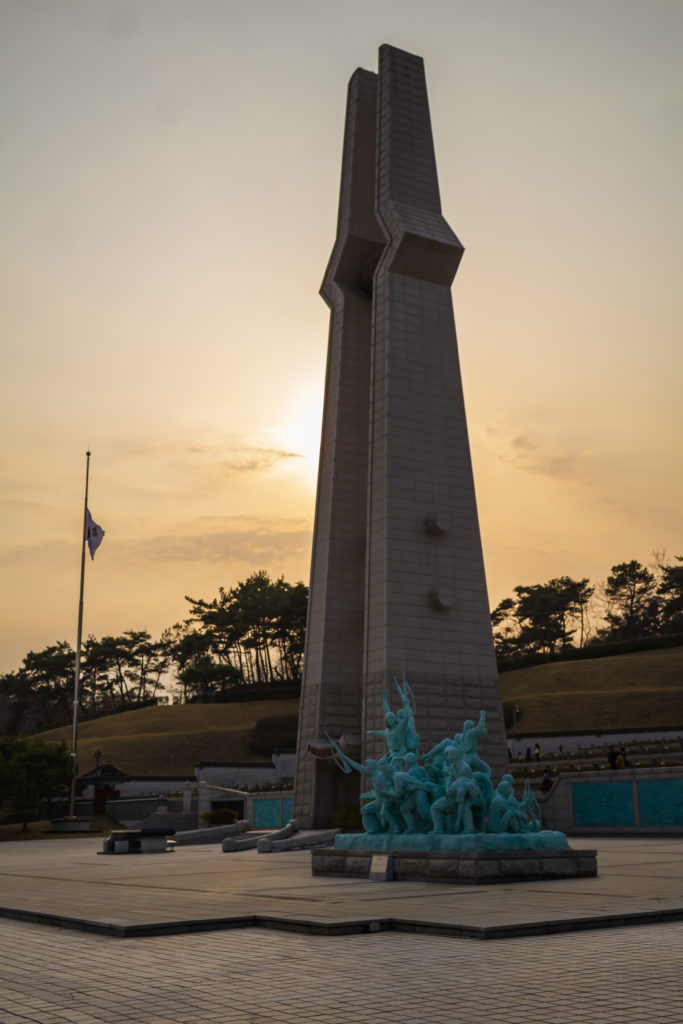
The plaza stands silent, most of the time – the fountains that ring it are rarely on. It is dominated by the high tower of the eternal flame, just before the graves. On one side is a bronze sculpture of a group of citizens, their fists and ragged weapons raised in triumph, while one man rigs a flag of liberation to fly over their heads. At their feet are the baskets of food brought to the militia by the citizens of the city, and some of the men and women extend their hands, inviting others to join them. On the other side, a jeep commandeered by the sinmingun, still crewed by a dozen fighters, stands in bronze. And, of course, the graves stand there still, gradually filling as one by one the veterans of May come to the end of their lives and return home, to rejoin their comrades.

In front of each grave is a photo – usually a young man or woman, grinning out with that ragged haircut that was popular at the time. Their eyes are bright, the faces youthful, full of promise and potential. Every single grave was a person, usually one who wanted nothing more than to finish his or her education, find a good job, a good family, and settle down to live in peace. They traded the chance for that peaceful life – some willingly, others unwillingly – so that others would have the opportunity to live freely.

The June Uprising succeeded because the Gwangju Uprising failed. The Korean opposition learned from their mistakes in the May of 1980. Then, the students had protested alone, without hte support of labor or other sectors of society. Regionalism and division ahd paralyzed the opposition to a relatively shaky military regime still trying to find its feet after the coup. Gwangju had demonstrated what the citizens of the country could do when they were united – but Gwangju had been isolated, ignored, and, ultimately, crushed.

But the memory, especially of those brave souls who sacrificed their lives at the end, to seal the revolution in blood and ensure that their struggle would not be forgotten, lived on. Every year marches and protests marked the anniversary of May 18th, and never again did the Korean opposition allow itself to be divided and conquered as they had in 1980. Protests in the future ranged from Seoul to Busan. Leaders travelled around the country, students carefully coordinated with each other across provinces, and the student democracy movement banded with the labor movement to broaden its base of support. At the same time, the leaders targetted the regime abroad, too. In May of 1980, no one overseas had known what was happening in the backwater Jeolla province – President Carter himself received reports of “citizen’s tribunals” executing capitalists in the street. Through the 1980s, the opposition learned to appeal to overseas audiences, to ensure that the harsh spotlight of global public opinion was always on Chun – who found himself handicapped by the very ambitions he had for Korea.

Chun wanted Korea to be a proud, accepted member of the family of nations – that meant he had to act like a responsible head of state. With the Olympics looming, and the opposition annoying burning down American buildings, he didn’t have the same leeway to deploy paratroopers and helicopters as he did against Those Bastards in Gwangju. Especially when deploying the military meant a crackdown not of ONE isolated city, but all across the peninsula…

And so the stand in Gwangju was not in vain. The deaths of so many students and professors and workers and drivers and people who just happened to be in the wrong place at the wrong time mattered. WIth their lives, they defied the authority of the military regime – that just because one man in an expensive suit and a fancy desk willed it so did not mean that they were slaves. And with their deaths, they dealt a mortal wound to the dictatorial regime that had ruled their homeland for three decades. It was a wound a long time killing the beast, but kill it they did.

Today, most of the hundreds of dead are little more than faded black and white photos on little gravestones, in a quiet cemetery far away from the hustle and bustle of the city. But the people in those graves were important, and though today their struggle has been almost entirely forgotten by the West, the country that they fought to create is one of the richest and free-est in the world. If nothing else, I, at least, think that they are worth remembering.

Don’t forget Gwangju’s May.