V. Aftermath
In the aftermath of the great battle at Isandlwana, both sides withdrew to lick their wounds.
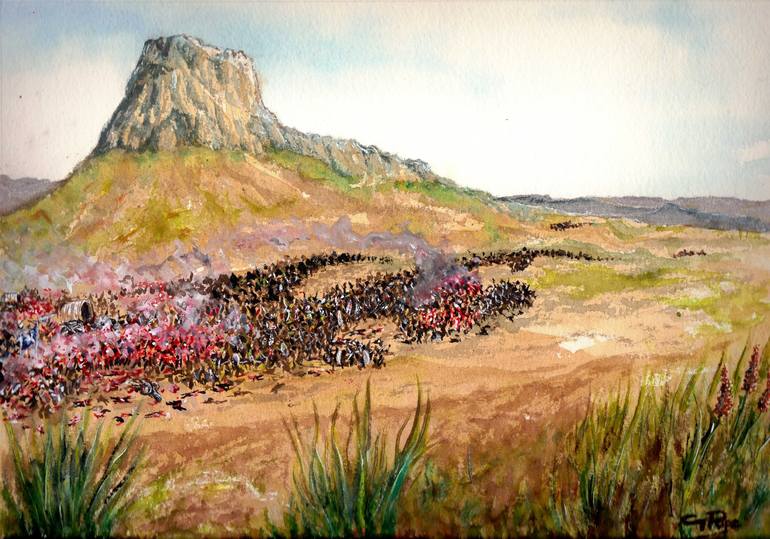
For the Zulu, dispersing the impi was a matter of necessity. In the first place, the army was not a professional standing force, but a militia. The British had carefully timed their invasion to coincide with the harvest, knowing it would handicap Cetshwayo mustering his warriors, and now that the invasion was crushed the men hastened back to their homes to get in the crops necessary to feed the nation. In the second place, a great many warriors had washed their spears and needed expiation.
The Zulu lived in a world of spirits and witchcraft – even today the traditional religion is strong in kwaZulu, co-existing alongside churches and mosques. When a man was killed, his killer first needed to make sure that his spirit could escape his body and not linger, trapped, on this plane – for this purpose a handy slit was usually made in the abdomen (this ritual disemboweling, a mark of respect and good will, was of course used by the British to denounce their adversaries as savages who mutilated the dead). Then, the killer would take a token of some kind from the dead man – the white pith helmets or brilliant red coats of the regulars were useful for this purpose – and carry it back to his home to carry out rituals of cleansing and expiation to ensure the dead man’s angry guardian spirits did not pursue his murderer. Only then would the warrior be safe to rejoin the wider society.
So, even as the sun went down on January 22nd, most of Ntshingwayo’s force* dispersed back to their homes, an incredible reprieve for Chelmsford who was otherwise cut off in enemy country with no food and no ammunition. The lord baron of course wasted no time in beating feet out of Zululand and scuttled straight back to Rorke’s Drift.
As the column marched up to the smoking mission station, the hospital in charred ruins, strewn about with the bodies of dead Zulu and a bristling line of scared-as-hell redcoats peering out from their mealie-bag fort, Chelmsford would have had mixed feelings. On the one hand, yes, the little post hadn’t been wiped out. On the other hand, though, he had hoped that his men at Isandlwana had been able to retreat from the disaster and that he would find them here at the drift awaiting him. He also hoped for resupply – but the men of the garrison had rudely fired off nearly all 20,000 stored cartridges in their own defense. No help to be had there.
Chelmsford set the men to working building a proper fort to guard the crossing against further attack, assured them he’d be right back and definitely wasn’t abandoning them, and promptly took off for Helpmekaar. Within 3 days he was back in Pietermaritzberg and hastily scribbling the report that would clear his name and blame the entire (and entirely unauthorized) disaster on Durnford and Pulleine, who conveniently were no longer around to defend themselves on account of being stabbed by Zulus.
The brief campaign had been a disaster – for both sides. The British had lost some 1300 dead in the two battles, been humiliated by the loss of most of their supplies and artillery, and the entire invasion had collapsed. The column making its way up the coast had had to pull back and hten fort up as fresh amabutho began to come against it and was now surrounded and besieged deep in Zululand at Eshowe. The northern column had promptly turned around and made the best pace dignity would allow in evacuating Zulu territory after hearing about the defeat. And, of course, Frere and Shepstone’s scheme to rapidly subjugate the Zulu and present London with a fait accompli – doing the out-of-touch politicians back home a favor, really – had failed utterly. Between the expenses of replacing the lost equipment and the needed reinforcements to make up their losses, the Zulu War, far from being quick and easy, would wind up costing the Crown more than the Crimean War.
For all that the invasion had been repulsed, Cetshwayo was scarcely better off. The victory at Isandlwana had cost the Zulu nation between 1,000-2000 dead and about twice that wounded. Then, the idiotic lunge at Rorke’s Drift had led to a further 350 dead fathers and husbands and again, about twice that in wounded. The Zulu nation had lost about 10% of all its fighting men in the space of about 12 hours. “An assegai has been thrust into the belly of the nation,” Cetshwayo moaned, when he heard about the staggering casualties.
Worst of all for the Zulu, though, they had committed the one unforgivable sin: They had embarrassed British arms in open battle. An army of natives armed with spear and shield had beaten the British army. Such a thing could never be allowed to stand – the example of the Zulu would inspire resistance all around the worldwide empire and make policing it a damned nightmare. The Zulu would have to be made an example of instead if the British wished to keep order in their far-flung dominions. Furthermore, the ghastly venture at Rorke’s Drift was far, far more costly than the simple count of dead would suggest. Word of the Zulu invasion had flashed like wildfire up and down the frontier – for most of the colonials it was their worst nightmare, bringing back memories of when the Zulu had massacred 500 settlers 40 years before. Panic reached as far as Pietermaritzberg and Durban, which began throwing up barricades in the streets to resist Cetshwayo’s impis when they arrived.
And word of all of this – the war itself, the ensuing debacle of the invasion, the panic and fear of Zulus rampaging through a crown colony – was being carried back to London on the swiftest steamers available.
Now, no doubt it raised some eyebrows in Colonial Office when they learned that not only were they now at war with the Zulus, but that they’d already lost an entire damned army, but there was nothing to be done. The Zulus had humiliated the British. You couldn’t let that sort of thing stand. Who knew where it would end? And the public was screeching about murdered heroes, of rape and massacre on the frontiers, and by Jove who was doing something about it? So, Prime Minister Benjamin Disraeli resigned himself to an expensive, idiotic war on the far side of the planet for a few hundred square miles of empty hills. The government was practical about this.
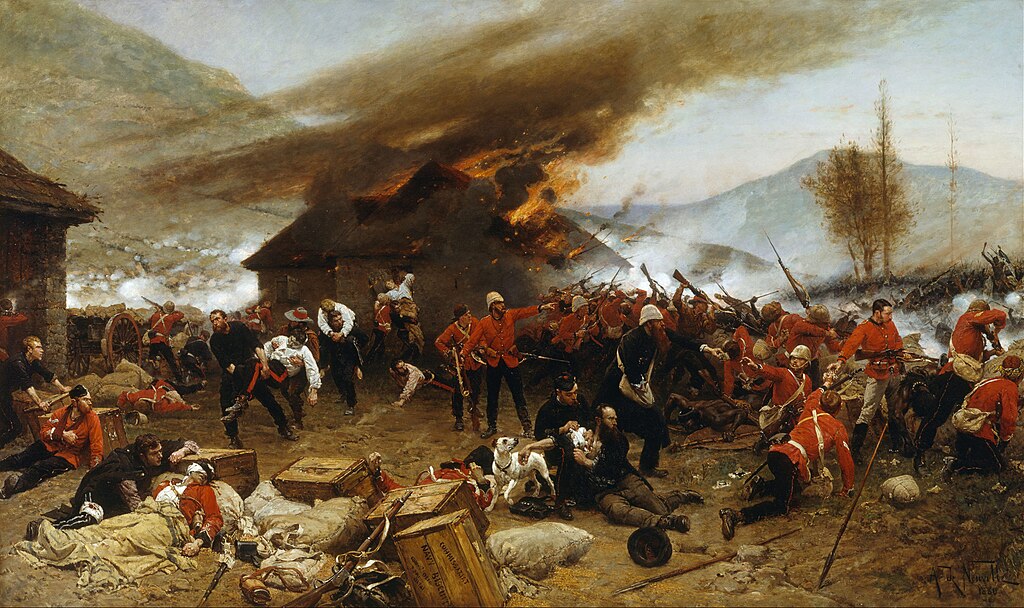
The British responded, first, by downplaying Isandlwana and playing up Rorke’s Drift. The garrison were duly feted as heroes and sterling examples of what British riflemen were capable of, and medals were handed out like candy – the 11 Victoria Crosses awarded to survivors of the battle are the most ever for a single engagement.** With some heroes to parade around in front of the public and reassure them that all was well (with some notable participants in Isandlwana thrown in for good measure), the public relations side of the affair was handled and the egg on everyone’s face somewhat cleaned up.
More immediately useful help sent to Chelmsford was a bevy of reinforcements from around the empire, making good his losses and more – more wagons, more guns, more ammunition, top of the line equipment like Gatling guns, entrenching tools (Chelmsford unaccountably lost his reluctance to fortify his camps in the future), and fully 7 regiments of redcoats (more than he had had available to police all of southern Africa before!). Then, before his replacement (Sir Garnet Wolseley himself, hero of a dozen campaigns in North America, Asia, and Africa) could arrive, he took a second crack at Zululand.
Cetshwayo, for his part, continued to send entreaties for a negotiated peace, hoping that the British public would pressure their government into stopping this unjust war. Unfortunately, though, after Isandlwana there was no way this could end apart from the total subjugation of the Zulu kingdom. When the British regrouped and renewed their invasion in April, 1879, Cetshwayo was forced to remuster his warriors.
*Apart from the corps going way beyond their orders and invading Natal at Rorke’s Drift, of course.
**Some men, like Hook, Hitch, or Corporal Allen, absolutely deserved theirs for their heroism in the hospital fight and saving their wounded comrades. Others, like Chard and Bromhead who had done more or less exactly their duty and nothing more or less? Less so.
VI. Analysis
The main cause of the British defeat at Isandlwana was overconfidence. Chelmsford could not conceive of a native army that was both willing and able to meet the British in an open field battle. The speed, stealth, and discipline of the amabutho was vastly underestimated – first, the Zulu couldn’t put that many men in the field. Second, even if they could, they had to still be around Ulundi, not lurking four miles from his camp. Thirdly, even if they WERE that close, they’d be detected by our native scouts and cavalry. Fourthly, even IF they attack, steady rifle fire will drive them off.
So, Chelmsford was confident that any force of about 1000 riflemen could take care of itself against any number of Zulus. He thought nothing, therefore, of marching into Zululand with a comparative handful of men and then of repeatedly dividing that force in the face of the enemy, flying in the face of all conventional military wisdom.
Secondly, on the operational level the failure to scout the Nqutu plateau before the morning of the 22nd was an appalling failure of intelligence. Chelmsford was utterly wrong about Zulu intentions – he was convinced that they intended to evade his army and invade Natal. He let the counsel of his fears dictate his assumptions, that the enemy would act exactly as he would in their place. Thus, of course the Zulu army must be using the hills to the southeast of camp to shield an advance into Natal. Then he fell prey to confirmation bias, as his early patrols that way found scattered Zulu which he persuaded himself were the main force. He should have taken into account what the Zulu could do, and spent an equal effort scouting his other flank.
Thirdly, tactically, Pulleine and Durnford had no plan. The two men completely failed to coordinate the morning of the 22nd, to confer, rehearse scenarios on what to do in case of attack. Instead, Durnford independently headed out into space to ‘protect Chelmsford’s flank’ and in the process blundered away his vulnerable rocket battery. Meanwhile, Pulleine, who had no combat experience, gave little serious thought to how he would defend the camp. Rather than take into account the fact that half the camp defenders were gone with Chelmsford, he complacently sought to defend the entire perimeter with only half the amount of anticipated bodies, stretching his lines out thin to do so.
That left his right and left flanks dangling in the air, and so when Durnford – who had gone too far out, independently, and had taken too little notice of his own ammunition supply before he found himself up to his ears in unfriendly locals – was forced to retreat on his right, the entire British line collapsed as the Zulu swarmed into the gap and overwhelmed the British before they could regroup into a tighter perimeter. With no perimeter defense, the British were doomed in hundreds of small-group fights all over the hillside.

The British pick up the pieces after the fall of the camp at Isandlwana
It was all a product of complacency, from top to bottom. The British were simply unable to conceive that unless they were alert and focused the Zulu absolutely could ruin their day. They didn’t treat their opponents with the same respect they would have accorded a “peer competitor,” like a French or Prussian corps. So, they were slothful and negligent, and while any one decision was understandable at the time and not an obvious blunder, added together you get- well, the worst massacre of imperial troops by natives since Custer got himself and his men killed at the Little Bighorn river 3 years before.****
It didn’t have to be that way, of course. The garrison at Rorke’s Drift did not underestimate the Zulu (probably on account of hearing about how they had brutally murdered all their buddies that morning) and took measures. The 120 defenders formed a small, tight perimeter, and reinforced with their available resources on hand – sacks of corn and boxes of biscuits. Safe in their fortifications from Zulu rushes, they were able to successfully defend themselves all night, with virtually all their casualties coming from Zulu potshots from the Oskarberg or killed in the brutal close-quarters hospital fight.
**** Worse, actually. Custer lost only about 275 men, against opponents armed with firearms. The British lost four times that amount.
VII. Conclusions
The rest of the war went about how you’d expect. Not in a hurry this time, the British were slow and patient. Here and there were more battles and losses – a supply column ambushed at Intombe, 80 dead Europeans and all supplies lost – a bloody affair at Hlobane and Kambula, with hundreds of dead British soldiers (mostly African auxiliaries) and thousands of dead Zulu – but nothing on the scale of the first invasion. Chelmsford assembled a column of nearly 6,000 soldiers, including 3,400 redcoats – 50% more powerful than the initial III Column and with triple the amount of regular infantry – and marched up the coast on March 29th to relieve his beleaguered I Column at Eshowe, where they’d been stuck since late January.
Every single night, he laagered his wagons and fortified his camp.

The hills of Gingindlovu, now overgrown, January 2022
After crushing a new Zulu army sent to stop him at Gingindlovu, he reached his trapped men and pulled them all back to Natal to regroup, reorganize the supply columns, and prepare for his decisive thrust (before his replacement arrived).
By June, 1879, Chelmsford was ready and marched up to Ulundi with a huge column (no longer worried about the Zulu bypassing his army to invade Natal). The British had learned their bloody lesson and were cautious, giving no opening to the Zulu to repeat the success at Isandlwana. The only incident of note during the whole march was the Prince Imperial, Louis Napoleon (great-nephew of the Napoleon, son of Napoleon III) arriving to lend his noble services to the cause and almost immediately getting himself killed by the Zulu (it looked bad in the papers).
By the time the British arrived at Cetshwayo’s capital on July 4th, the Zulu were very demoralized. They had lost nearly 10,000 warriors, a quarter of all their manpower, in the spring battles, and all offers of peace had failed.**** Left with no choice, the amabutho formed and came at the British one last time. The British formed a tight square, Gatling guns chattered, shrapnel from the artillery rained down from above, and the steady riflemen poured out a curtain of steel around the army. The 15,000 Zulu – a far cry from the 20,000 at Isandlwana – suffered the loss of about 10% of their force before they’d had enough, and broke and fled the battlefield.

The fall of Ulundi, July 4, 1879
****Chelmsford had no interest at all in a truce with Cetshwayo, as he was desperate to restore his military reputation with a smashing victory before Wolseley got there. His replacement had reached Durban late in June and was sending stern messages to Chelmsford up in Zululand not to engage in any serious battles, which Chelmsford was pretending not to receive.
After the war, much like after Isandlwana, no one won. More than ten thousand people were dead and millions of pounds had been spent due to mostly to the singular ambition of one Bartle Frere. The Colonial Office was understandably miffed with him. Rather than coming home covered in glory for the successful unification of South Africa, Frere was shuffled off to a minor post in Cape Town and never heard from again.
Chelmsford handed over the reins to a very irate Wolseley when he at last caught up with the baron after the battle of Ulundi. The army grudgingly awarded him a medal for winning the battle and then promptly shuffled him out of field command, too. He never did win for his career the laurels he had sought, a brutal Horse Guards investigation tearing apart his conduct of the Isandlwana campaign.
Chard was in the square at Ulundi, and returned home to England as a hero (though his superiors still thought him “dull and stupid.” He dutifully served out an undistinguished career, rising to the rank of Colonel, before dying of throat cancer.
Bromhead also had a brief hero’s tour in England before being posted to south Asia, where he saw more action fighting the Burmese. He died there of typhoid fever.
Ntshingwayo returned the colors when Cetshwayo came back to kwaZulu from exile, fighting in the civil war that broke out among the Zulu royal family. He was killed defending his king from a coup in 1883.
Dabulamanzi commanded more corps at the siege of Eshowe and the battle of Gingindlovu, and became a vocal opponent of the British following the occupation. He fought on behalf of his brother in the Zulu civil war that broke out after the conquest, eventually being killed in a dispute with Boer mercenaries he was contracting.
Wolseley promptly discarded Frere’s schemes for the confederation of South Africa and broke up the Zulu kingdom instead. Cetshwayo, a fugitive after Ulundi, was eventually caught and paraded around London in triumph – where his natural charm and graces won him much sympathy, and he was eventually returned to kwaZulu, though never restored to his throne, being overthrown in a bloody coup upon his return.
As for the Zulu?
They were conquered. Their state was destroyed, broken up, and the British selected new chiefs for them – some trustworthy blacks, others colonial whites. For over a century, they would languish in the growing system of apartheid that took root in South Africa, cut off from most opportunity in the country, second-class citizens in their own ancestral homeland. The Zulu and the Xhosa would unite, with the other African ethnic groups, in the African National Congress to fight apartheid and win back their independence, but even then the Zulu were a people apart. To this day, the ANC political party is riven with faction – this past July, Durban was rocked with riots by the Zulu, after Jacob Zuma, the former president and chief representative of the Zulu within the party, was sent to prison for corruption.
KwaZulu is still dotted with small villages, rondavels, and farms. Cattle roam on the roads, tended by children who race alongside them. The mission station at Rorke’s Drift is still a working church, the inside decorated with art and tapestries. The hospital, rebuilt, is now a museum dedicated to the little isolated waystation’s 12 hours of fury and glory so long ago. The hill of Isandlwana still stands sentinel in its valley, lonely and sphinxlike, watching over the graves of so many brave men who died there, obedient to their respective King or Queen. Sheep wander the battlefield and munch on the buffalo grass.
Nearby, Zulu craftsmen still manufacture their assegais and cowhide shields.
The tourists like them.

 Gwangju Dreaming