Distant Battlefields: Isandlwana, pt. V

V. Aftermath

In the aftermath of the great battle at Isandlwana, both sides withdrew to lick their wounds.
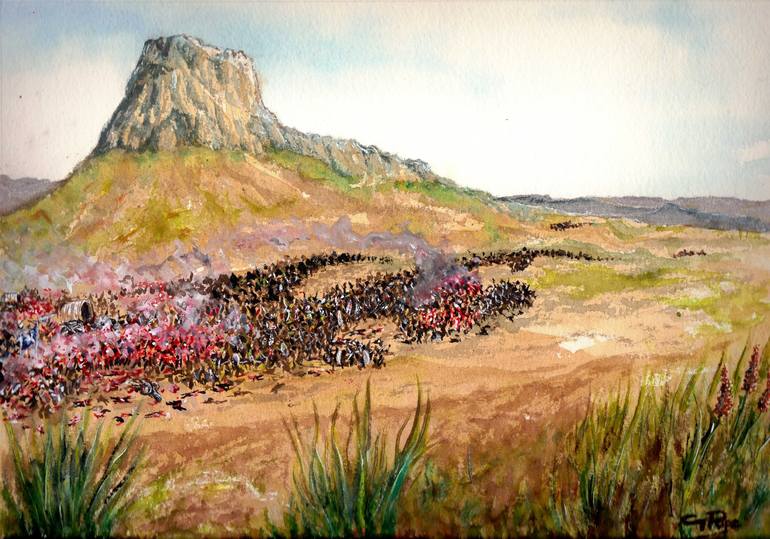
For the Zulu, dispersing the impi was a matter of necessity. In the first place, the army was not a professional standing force, but a militia. The British had carefully timed their invasion to coincide with the harvest, knowing it would handicap Cetshwayo mustering his warriors, and now that the invasion was crushed the men hastened back to their homes to get in the crops necessary to feed the nation. In the second place, a great many warriors had washed their spears and needed expiation.

The Zulu lived in a world of spirits and witchcraft – even today the traditional religion is strong in kwaZulu, co-existing alongside churches and mosques. When a man was killed, his killer first needed to make sure that his spirit could escape his body and not linger, trapped, on this plane – for this purpose a handy slit was usually made in the abdomen (this ritual disemboweling, a mark of respect and good will, was of course used by the British to denounce their adversaries as savages who mutilated the dead). Then, the killer would take a token of some kind from the dead man – the white pith helmets or brilliant red coats of the regulars were useful for this purpose – and carry it back to his home to carry out rituals of cleansing and expiation to ensure the dead man’s angry guardian spirits did not pursue his murderer. Only then would the warrior be safe to rejoin the wider society.

So, even as the sun went down on January 22nd, most of Ntshingwayo’s force* dispersed back to their homes, an incredible reprieve for Chelmsford who was otherwise cut off in enemy country with no food and no ammunition. The lord baron of course wasted no time in beating feet out of Zululand and scuttled straight back to Rorke’s Drift.

As the column marched up to the smoking mission station, the hospital in charred ruins, strewn about with the bodies of dead Zulu and a bristling line of scared-as-hell redcoats peering out from their mealie-bag fort, Chelmsford would have had mixed feelings. On the one hand, yes, the little post hadn’t been wiped out. On the other hand, though, he had hoped that his men at Isandlwana had been able to retreat from the disaster and that he would find them here at the drift awaiting him. He also hoped for resupply – but the men of the garrison had rudely fired off nearly all 20,000 stored cartridges in their own defense. No help to be had there.

Chelmsford set the men to working building a proper fort to guard the crossing against further attack, assured them he’d be right back and definitely wasn’t abandoning them, and promptly took off for Helpmekaar. Within 3 days he was back in Pietermaritzberg and hastily scribbling the report that would clear his name and blame the entire (and entirely unauthorized) disaster on Durnford and Pulleine, who conveniently were no longer around to defend themselves on account of being stabbed by Zulus.

The brief campaign had been a disaster – for both sides. The British had lost some 1300 dead in the two battles, been humiliated by the loss of most of their supplies and artillery, and the entire invasion had collapsed. The column making its way up the coast had had to pull back and hten fort up as fresh amabutho began to come against it and was now surrounded and besieged deep in Zululand at Eshowe. The northern column had promptly turned around and made the best pace dignity would allow in evacuating Zulu territory after hearing about the defeat. And, of course, Frere and Shepstone’s scheme to rapidly subjugate the Zulu and present London with a fait accompli – doing the out-of-touch politicians back home a favor, really – had failed utterly. Between the expenses of replacing the lost equipment and the needed reinforcements to make up their losses, the Zulu War, far from being quick and easy, would wind up costing the Crown more than the Crimean War.

For all that the invasion had been repulsed, Cetshwayo was scarcely better off. The victory at Isandlwana had cost the Zulu nation between 1,000-2000 dead and about twice that wounded. Then, the idiotic lunge at Rorke’s Drift had led to a further 350 dead fathers and husbands and again, about twice that in wounded. The Zulu nation had lost about 10% of all its fighting men in the space of about 12 hours. “An assegai has been thrust into the belly of the nation,” Cetshwayo moaned, when he heard about the staggering casualties.

Worst of all for the Zulu, though, they had committed the one unforgivable sin: They had embarrassed British arms in open battle. An army of natives armed with spear and shield had beaten the British army. Such a thing could never be allowed to stand – the example of the Zulu would inspire resistance all around the worldwide empire and make policing it a damned nightmare. The Zulu would have to be made an example of instead if the British wished to keep order in their far-flung dominions. Furthermore, the ghastly venture at Rorke’s Drift was far, far more costly than the simple count of dead would suggest. Word of the Zulu invasion had flashed like wildfire up and down the frontier – for most of the colonials it was their worst nightmare, bringing back memories of when the Zulu had massacred 500 settlers 40 years before. Panic reached as far as Pietermaritzberg and Durban, which began throwing up barricades in the streets to resist Cetshwayo’s impis when they arrived.

And word of all of this – the war itself, the ensuing debacle of the invasion, the panic and fear of Zulus rampaging through a crown colony – was being carried back to London on the swiftest steamers available.

Now, no doubt it raised some eyebrows in Colonial Office when they learned that not only were they now at war with the Zulus, but that they’d already lost an entire damned army, but there was nothing to be done. The Zulus had humiliated the British. You couldn’t let that sort of thing stand. Who knew where it would end? And the public was screeching about murdered heroes, of rape and massacre on the frontiers, and by Jove who was doing something about it? So, Prime Minister Benjamin Disraeli resigned himself to an expensive, idiotic war on the far side of the planet for a few hundred square miles of empty hills. The government was practical about this.
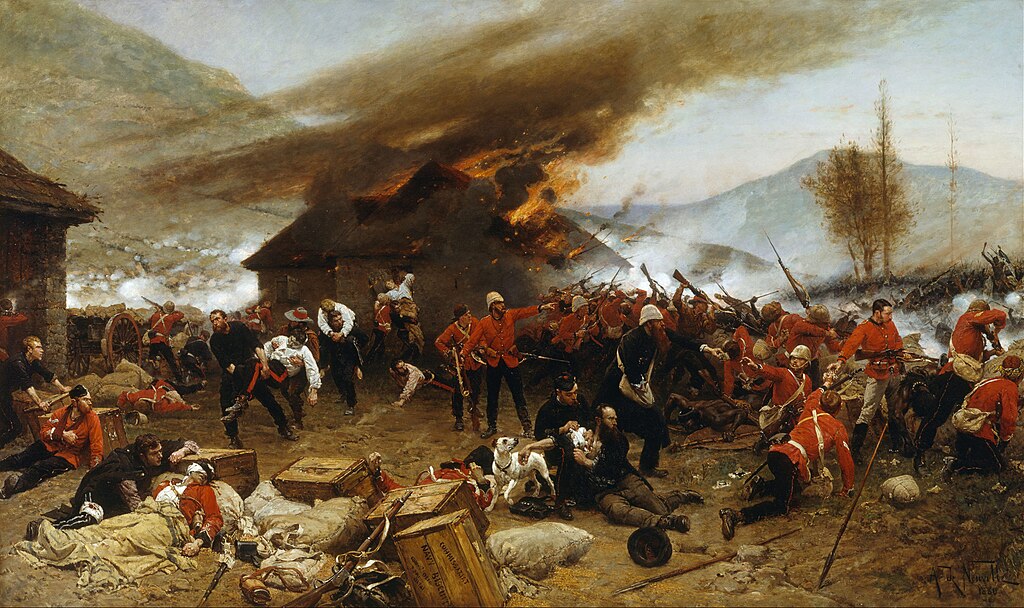
The British responded, first, by downplaying Isandlwana and playing up Rorke’s Drift. The garrison were duly feted as heroes and sterling examples of what British riflemen were capable of, and medals were handed out like candy – the 11 Victoria Crosses awarded to survivors of the battle are the most ever for a single engagement.** With some heroes to parade around in front of the public and reassure them that all was well (with some notable participants in Isandlwana thrown in for good measure), the public relations side of the affair was handled and the egg on everyone’s face somewhat cleaned up.

More immediately useful help sent to Chelmsford was a bevy of reinforcements from around the empire, making good his losses and more – more wagons, more guns, more ammunition, top of the line equipment like Gatling guns, entrenching tools (Chelmsford unaccountably lost his reluctance to fortify his camps in the future), and fully 7 regiments of redcoats (more than he had had available to police all of southern Africa before!). Then, before his replacement (Sir Garnet Wolseley himself, hero of a dozen campaigns in North America, Asia, and Africa) could arrive, he took a second crack at Zululand.

Cetshwayo, for his part, continued to send entreaties for a negotiated peace, hoping that the British public would pressure their government into stopping this unjust war. Unfortunately, though, after Isandlwana there was no way this could end apart from the total subjugation of the Zulu kingdom. When the British regrouped and renewed their invasion in April, 1879, Cetshwayo was forced to remuster his warriors.

*Apart from the corps going way beyond their orders and invading Natal at Rorke’s Drift, of course.

**Some men, like Hook, Hitch, or Corporal Allen, absolutely deserved theirs for their heroism in the hospital fight and saving their wounded comrades. Others, like Chard and Bromhead who had done more or less exactly their duty and nothing more or less? Less so.

VI. Analysis

The main cause of the British defeat at Isandlwana was overconfidence. Chelmsford could not conceive of a native army that was both willing and able to meet the British in an open field battle. The speed, stealth, and discipline of the amabutho was vastly underestimated – first, the Zulu couldn’t put that many men in the field. Second, even if they could, they had to still be around Ulundi, not lurking four miles from his camp. Thirdly, even if they WERE that close, they’d be detected by our native scouts and cavalry. Fourthly, even IF they attack, steady rifle fire will drive them off.

So, Chelmsford was confident that any force of about 1000 riflemen could take care of itself against any number of Zulus. He thought nothing, therefore, of marching into Zululand with a comparative handful of men and then of repeatedly dividing that force in the face of the enemy, flying in the face of all conventional military wisdom.

Secondly, on the operational level the failure to scout the Nqutu plateau before the morning of the 22nd was an appalling failure of intelligence. Chelmsford was utterly wrong about Zulu intentions – he was convinced that they intended to evade his army and invade Natal. He let the counsel of his fears dictate his assumptions, that the enemy would act exactly as he would in their place. Thus, of course the Zulu army must be using the hills to the southeast of camp to shield an advance into Natal. Then he fell prey to confirmation bias, as his early patrols that way found scattered Zulu which he persuaded himself were the main force. He should have taken into account what the Zulu could do, and spent an equal effort scouting his other flank.

Thirdly, tactically, Pulleine and Durnford had no plan. The two men completely failed to coordinate the morning of the 22nd, to confer, rehearse scenarios on what to do in case of attack. Instead, Durnford independently headed out into space to ‘protect Chelmsford’s flank’ and in the process blundered away his vulnerable rocket battery. Meanwhile, Pulleine, who had no combat experience, gave little serious thought to how he would defend the camp. Rather than take into account the fact that half the camp defenders were gone with Chelmsford, he complacently sought to defend the entire perimeter with only half the amount of anticipated bodies, stretching his lines out thin to do so.

That left his right and left flanks dangling in the air, and so when Durnford – who had gone too far out, independently, and had taken too little notice of his own ammunition supply before he found himself up to his ears in unfriendly locals – was forced to retreat on his right, the entire British line collapsed as the Zulu swarmed into the gap and overwhelmed the British before they could regroup into a tighter perimeter. With no perimeter defense, the British were doomed in hundreds of small-group fights all over the hillside.

The British pick up the pieces after the fall of the camp at Isandlwana

It was all a product of complacency, from top to bottom. The British were simply unable to conceive that unless they were alert and focused the Zulu absolutely could ruin their day. They didn’t treat their opponents with the same respect they would have accorded a “peer competitor,” like a French or Prussian corps. So, they were slothful and negligent, and while any one decision was understandable at the time and not an obvious blunder, added together you get- well, the worst massacre of imperial troops by natives since Custer got himself and his men killed at the Little Bighorn river 3 years before.****

It didn’t have to be that way, of course. The garrison at Rorke’s Drift did not underestimate the Zulu (probably on account of hearing about how they had brutally murdered all their buddies that morning) and took measures. The 120 defenders formed a small, tight perimeter, and reinforced with their available resources on hand – sacks of corn and boxes of biscuits. Safe in their fortifications from Zulu rushes, they were able to successfully defend themselves all night, with virtually all their casualties coming from Zulu potshots from the Oskarberg or killed in the brutal close-quarters hospital fight.

**** Worse, actually. Custer lost only about 275 men, against opponents armed with firearms. The British lost four times that amount.

VII. Conclusions

The rest of the war went about how you’d expect. Not in a hurry this time, the British were slow and patient. Here and there were more battles and losses – a supply column ambushed at Intombe, 80 dead Europeans and all supplies lost – a bloody affair at Hlobane and Kambula, with hundreds of dead British soldiers (mostly African auxiliaries) and thousands of dead Zulu – but nothing on the scale of the first invasion. Chelmsford assembled a column of nearly 6,000 soldiers, including 3,400 redcoats – 50% more powerful than the initial III Column and with triple the amount of regular infantry – and marched up the coast on March 29th to relieve his beleaguered I Column at Eshowe, where they’d been stuck since late January.

Every single night, he laagered his wagons and fortified his camp.

The hills of Gingindlovu, now overgrown, January 2022

After crushing a new Zulu army sent to stop him at Gingindlovu, he reached his trapped men and pulled them all back to Natal to regroup, reorganize the supply columns, and prepare for his decisive thrust (before his replacement arrived).

By June, 1879, Chelmsford was ready and marched up to Ulundi with a huge column (no longer worried about the Zulu bypassing his army to invade Natal). The British had learned their bloody lesson and were cautious, giving no opening to the Zulu to repeat the success at Isandlwana. The only incident of note during the whole march was the Prince Imperial, Louis Napoleon (great-nephew of the Napoleon, son of Napoleon III) arriving to lend his noble services to the cause and almost immediately getting himself killed by the Zulu (it looked bad in the papers).

By the time the British arrived at Cetshwayo’s capital on July 4th, the Zulu were very demoralized. They had lost nearly 10,000 warriors, a quarter of all their manpower, in the spring battles, and all offers of peace had failed.**** Left with no choice, the amabutho formed and came at the British one last time. The British formed a tight square, Gatling guns chattered, shrapnel from the artillery rained down from above, and the steady riflemen poured out a curtain of steel around the army. The 15,000 Zulu – a far cry from the 20,000 at Isandlwana – suffered the loss of about 10% of their force before they’d had enough, and broke and fled the battlefield.

The fall of Ulundi, July 4, 1879

****Chelmsford had no interest at all in a truce with Cetshwayo, as he was desperate to restore his military reputation with a smashing victory before Wolseley got there. His replacement had reached Durban late in June and was sending stern messages to Chelmsford up in Zululand not to engage in any serious battles, which Chelmsford was pretending not to receive.

After the war, much like after Isandlwana, no one won. More than ten thousand people were dead and millions of pounds had been spent due to mostly to the singular ambition of one Bartle Frere. The Colonial Office was understandably miffed with him. Rather than coming home covered in glory for the successful unification of South Africa, Frere was shuffled off to a minor post in Cape Town and never heard from again.

Chelmsford handed over the reins to a very irate Wolseley when he at last caught up with the baron after the battle of Ulundi. The army grudgingly awarded him a medal for winning the battle and then promptly shuffled him out of field command, too. He never did win for his career the laurels he had sought, a brutal Horse Guards investigation tearing apart his conduct of the Isandlwana campaign.

Chard was in the square at Ulundi, and returned home to England as a hero (though his superiors still thought him “dull and stupid.” He dutifully served out an undistinguished career, rising to the rank of Colonel, before dying of throat cancer.

Bromhead also had a brief hero’s tour in England before being posted to south Asia, where he saw more action fighting the Burmese. He died there of typhoid fever.

Ntshingwayo returned the colors when Cetshwayo came back to kwaZulu from exile, fighting in the civil war that broke out among the Zulu royal family. He was killed defending his king from a coup in 1883.

Dabulamanzi commanded more corps at the siege of Eshowe and the battle of Gingindlovu, and became a vocal opponent of the British following the occupation. He fought on behalf of his brother in the Zulu civil war that broke out after the conquest, eventually being killed in a dispute with Boer mercenaries he was contracting.

Wolseley promptly discarded Frere’s schemes for the confederation of South Africa and broke up the Zulu kingdom instead. Cetshwayo, a fugitive after Ulundi, was eventually caught and paraded around London in triumph – where his natural charm and graces won him much sympathy, and he was eventually returned to kwaZulu, though never restored to his throne, being overthrown in a bloody coup upon his return.

As for the Zulu?

They were conquered. Their state was destroyed, broken up, and the British selected new chiefs for them – some trustworthy blacks, others colonial whites. For over a century, they would languish in the growing system of apartheid that took root in South Africa, cut off from most opportunity in the country, second-class citizens in their own ancestral homeland. The Zulu and the Xhosa would unite, with the other African ethnic groups, in the African National Congress to fight apartheid and win back their independence, but even then the Zulu were a people apart. To this day, the ANC political party is riven with faction – this past July, Durban was rocked with riots by the Zulu, after Jacob Zuma, the former president and chief representative of the Zulu within the party, was sent to prison for corruption.

KwaZulu is still dotted with small villages, rondavels, and farms. Cattle roam on the roads, tended by children who race alongside them. The mission station at Rorke’s Drift is still a working church, the inside decorated with art and tapestries. The hospital, rebuilt, is now a museum dedicated to the little isolated waystation’s 12 hours of fury and glory so long ago. The hill of Isandlwana still stands sentinel in its valley, lonely and sphinxlike, watching over the graves of so many brave men who died there, obedient to their respective King or Queen. Sheep wander the battlefield and munch on the buffalo grass.

Nearby, Zulu craftsmen still manufacture their assegais and cowhide shields.

The tourists like them.

Distant Battlefields: Isandlwana, pt. IV

Part IV (for real this time, thanks John. I really need to proofread): Rorke’s Drift

Again, recommended music for reading.

On the morning of January 22nd, Lt. John Chard, Royal Engineers, road up to Isandlwana from his post at Rorke’s Drift. Freshly arrived in South Africa, only a few weeks out from getting off the boat in Durban, he was trying to find useful employment for himself. Unfortunately, he was stuck improving the road for Chelmsford’s clunky column, building a bridge at the mission post at Rorke’s Drift. He hoped to ask the lord baron for a more suitable assignment, but upon arrival at camp he found that Chelmsford had gone haring off that morning looking for fuzzies to fight and wouldn’t be back until nightfall. Plus, scouts were seeing groups of Zulu moving around on top of the Nqutu plateau and Durnford was checking it out. Figuring he better make sure his post was fortified in case the Zulu tried to cut the road, Chard rode back to the mission station at Rorke’s Drift.

The mission station is a tiny little outpost on the hill overlooking the ford over the Buffalo, significant only due to its location on the main road between Ulundi and central Natal. It was named after its founder, James Rorke, a missionary who had come to Natal a few decades before and drank himself to death on its grounds. The Zulu called it KwaJimu, “Jim’s Place.” Jim had built a small colonial house, facing west, and nearby a large stone storehouse and a few small cattle kraals. The entire complex isn’t much larger than a typical American house with a yard.

The mission station in January 2022, viewed from the north. The hospital is on the hill at center (note that it’s not flat ground!), the storehouse visible behind it at left. Shinane/Oskarberg at right center in the background.

When Chelmsford prepared his invasion, he had seized the drift from the Swedish missionaries who had taken over after Rorke shot himself out back and set it up as a supply base and hospital to support his attack. He garrisoned it with one unlucky company of the 24th and a company of NNC, under Lt. Bromhead, who was “stone-deaf” and considered “hopeless” by his superiors. The quiet posting would keep Bromhead out of trouble. There were about 80 redcoats in B Company (2/24), plus a gaggle of sick and wounded in the hospital, totaling ~120 effectives, on the afternoon of the 24th. There was a company of NNC present as well, but – well, you’ll see.

Prince Dabulamanzi commanded the Zulu reserve at Isandlwana. A brother of the king, Ntshingwayo had dispatched his undi (corps) on a wide flanking maneuver, but the damned British had all died or run off before his men got the chance to wash their spears. Unhappy at missing out on the greatest victory in Zulu history – imagine the boasts and fireside tales other warriors would have in years to come! (“And what did you do, grandpa, in the great invasion of the whites?” “Well, son, I squatted on my loins and watched everything from a safe distance.” Unthinkable!). So, when his men begged him – “Let’s go have a fight at Jim’s place!” – Dabulamanzi didn’t hesitate too much. Sure, he was violating his brother’s orders not to invade Natal. But that was the trouble with politicians – they always tied their soldiers’ hands with these idiotic “rules of engagement.” Let the fighting men fight, not hamstrung by the civvies! His soldiers would never be able to hold up their faces in society if they didn’t get some action. So, Dabulamanzi led his force towards KwaJimu to wipe out the garrison and supply post there. He had in his command four amabutho, the uThulwana, uDloko, uNdondlo, and uNdluyengwe, in total about 4,000 effectives.

Back at the drift, the officer in command, Major Spaulding, and some of his hangers-on could see something was up on Isandlwana – the hill was visible from the top of the Oskarberg, the eyebrow-shaped hill just south of the drift. Spaulding decided his lone company needed some backup and so he rode down and said to Chard and Bromhead, “Right, you chappies. I’m going to ride up to Helpmekaar and round up some reinforcements. Chard, you’re in charge.” With that, Spalding rode off, out of the drift and out of his place in history.

A few minutes after Spalding left, two ragged survivors came galloping down the road – Gert Aldendorf, Lt., Natal Native Contingent, and a trooper from Durnford’s column – and gave the slightly disconcerting news that everyone Chard had talked to at camp that morning was dead. Well, no, maybe not everyone – no, yes, definitely everyone, all dead. Quite how Aldendorf and the other survivor had made it down the road after the right horn had cut off retreat has never been explained to me.

Conferring with each other and with Acting Commissary James Dalton, who despite his low rank was actually the most experienced soldier present (Dalton had retired and only come back to the colors for this invasion), Chard and Bromhead decided that trying to evacuate the sick and wounded on unwieldy wagons would just see them run down by the Zulu in open country.* Lots of unpleasant stabbing would ensue. No, their only chance was to fort up and pray to hold out until relief arrived.

A map of the fort from the same angle as the photo above – hospital at right center, storehouse at left.

Now, in their favor the men had a small perimeter to defend and a LOT of supplies to work with. In the hours before Dabulamanzi arrived with his warriors spoiling for a fight, the redcoats worked feverishly, tossing 200-pound bags of cornmeal out of the storehouse and into the yard. There, more dragged the heavy bags and formed two walls running between the storehouse and hospital, enclosing a small perimeter. At the same time, others boarded up the windows and doors of the hospital, piling up furniture and barricading the only entrances. Loopholes were dug in the walls to enable soldiers inside to shoot out. The sick were left in place – safer there than in the open yard.

A company of Durnford’s horse, posted to guard the supply wagons, was able to extricate itself nearly intact from the disaster up the road and came galloping down in some disorder early in the afternoon, but Chard was able to get them to join the defense – temporarily. Worn out mentally, worn out physically, and worn out of ammunition, the troopers skirmished at the drift a short while with the advancing Zulu, before they whirled away past the post towards Helpmekaar, 5 miles distant. “Here they come, black as hell and thick as grass!” one man shouted as they road past. This was enough for the NNC contingent at the post, who decided to sauve qui peut and raced off in the wake of the cavalry.**

With their numbers suddenly halved, Chard and Bromhead realized they would need a dramatically smaller perimeter. An outer fortification around the hospital was abandoned, leaving the building very exposed to attack, and a second, inner wall of 100-pound boxes of biscuit was started to cut their little fortress in half. Chard would defend in depth, abandoning his outer lines one by one as they were overwhelmed and holding an ever-smaller perimeter.

Chard’s map for his report, showing the full system (note that the map is flipped compared to above). Biscuit box inner line and a final redoubt.

Dabulamanzi arrived shortly past 4:30. In the summer in Natal, sunset is around 7:30, so he had a good couple hours of light to work with. His first warriors swept in from the south, around the Oskarberg (Shihane, “Eyebrow Hill”, in Zulu), and attacked the post from the southwest. Steely volleys of .45 caliber Martini-Henry fire met them, showing the warriors what they had missed out on at Isandlwana. Losses were heavy and the rampart was difficult to climb – the western face of the post actually sat atop a ledge some 3 feet above the gardens, Chard carefully siting his wall to take advantage of this fact. So, the Zulu couldn’t simply spring over the barrier, but would need to climb it with both hands, dodging rifle fire and bayonets wielded by very unfriendly whites in the process. And remember – the Zulu are not kamikazes. These were not suicidal human wave charges, but done by courageous men who nevertheless wished to live to celebrate the victory.

So, bloodied, the first attack recoiled and went to ground behind the trees in the garden southwest of the post. From Shihane, those Zulus with rifles*** began taking potshots at the garrison below them. This harassing fire and the fall of the hospital were responsible for the vast majority of British losses that night.

Right, the fall of the hospital. So, more the amabutho came up and joined the fight, and a second wave went in. This one was pressed home fiercely on both sides of the little fort. Time and again the Zulu would threaten to breach the rampart, only for Bromhead, leading a reserve platoon of bayonets, to charge in and drive them off. Chard was forced to pull his garrison almost entirely back from the hospital, defending only the short side within his perimeter, leaving the two long sides and third short side completely exposed. The Zulu pressed themselves into cover around the walls of the hospital and began trying to break in.

Six redcoats had volunteered to be barricaded into the building, to defend their sick and wounded buddies – some of whom could also carry a rifle. The men fired furiously ouf of their loopholes, while the Zulu tore through the walls and doors, slowly, dying as they did so. Private Harrigan, in the far western room, had his rifle seized and he was dragged outside to be speared to death. Another, Private Cole, tried to race out the front door of the hospital and around to the mealie bag rampart, but a bullet to the head checked his progress.

The yard and storehouse (now a chapel), viewed from the hospital. The main British defense was centered here.

Outside, the pressure was growing so severe, especially the fire from Shihane, that Chard had to abandon the western half of the perimeter – that part that included the hospital – and pull back to the line of biscuit boxes, so that now the British held a small perimeter in front of the storehouse only, while a few stubborn defenders held out in the hospital building. The yard between the biscuit boxes and the hospital was swept with bullets – no man could live long there.

Scale model of the attack on the hospital.

As darkness fell, some men raised a cheer – dust could be seen to the west, on the road to Helpmekaar. Major Spalding was back, with the two companies of redcoats left at that distant colonial town was reinforcements! However, Spalding rode up, saw the mass of Zulu around the station, and the hospital burning – did I mention the hospital was on fire by this point? – and concluded that poor hopeless Bromhead and Chard and all their lads were dead, just like Chelmsford’s entire column, and it was his patriotic duty to ensure he survived so word could be sent to London about the disaster. The 2 companies – 160 redcoats, twice as many men as were inside the little cornmeal fort – turned around and marched back to Helpmekaar.

Oh, yes, the hospital, on fire. So as night fell, what most likely happened is that one of the surviving defenders of the building, in the excitement of load – fire – load – fire – load – fire for hours at one point, wearily, accidentally discharged his weapon at the roof. See, it rains a lot in Zululand in January, and the outer thatch roof was pretty damp from the days of rain they’d been having that year of 1879. So it’s unlikely that anyone outside managed to set the roof on fire. But the inner thatch? Ah, that’s a different story – that was dry. Now, the Martini-Henry discharges a lot of hot gas and sparks when it fires, not just the bullet. The barrel gets so hot with extended firing that Zulu survivors of this fight reported seeing the rifles glow red at night – and the dry thatch would easily catch.

Scale model of the entire battle. Chard’s biscuit box inner wall at left center, hospital at right.

So yeah, for the defenders, now not only were there thousands of murderous savages trying to break into their building full of sick and unable to move comrades, who also happened to have them totally surrounded, but also said building was burning down around their ears. And, like most colonial houses of the day, there was little interior communication between rooms. Most houses on the frontier in Natal had rooms that only opened to the outside, since hallways took up space and the climate was so mild going outside was no problem. Usually. When the outside was full of 4 entire Zulu amabutho eager to wash their spears in your belly it becomes more of an inconvenience.

As the Zulu began to at last break through the barriers into the interior, then, the men inside staged a desperate race to safety. Privates John Williams and Henry Hook formed a fighting team – Hook singlehandedly holding off the Zulu as Williams hacked a hole in the wall to the next room. They dragged the men in their room through the hole, then fell back into the next room, Hook again fending off the Zulu while Williams madly dug at the wall. They eventually linked up with Privates R. Jones and W. Jones, who joined in the effort, eventually tunnelling all the way to the outer room of the hospital and a window that faced across the bullet-swept yard to Chard’s biscuit box inner wall.

Corporal William Allen and Pvt. Fred Hitch, seeing the men appear in the window, leapt over the wall and raced over, while the defenders behind the rampart kept the Zulu’s heads down. Together, the 4 surviving defenders worked with the two men to evacuate the majority of the sick and wounded, while the flames spread through the hospital. A handful of other men were able to hide in the hospital wardrobe and slip out behind the Zulus, concealing themselves among the dead until morning. The last man out was Henry Hook, who tried and failed to save one last patient, before the flames and Zulu were too much and forced him back. The British abandoned the building at last – all the surviving defenders were now concentrated in the small perimeter in front of the storehouse.

View from the biscuit box line towards the hospital. Hitch and the others would have raced across this yard to the hospital to pull out survivors.

Chard had been active in the meantime, piling up his remaining mealie bags into a “final redoubt” in the center of his perimeter. The sick and wounded were safely ensconced in there, while the firing began to die down. The flames of the hospital brightly lit up the battlefield – they were visible to Chelmsford, dazedly wandering the battlefield at Isandlwana – and provided excellent illumination for the defenders to pick off Zulus trying their luck in the darkness. Chard even felt safe enough to lead a sortie and retrieve a water cart for his desperate garrison. Then his men bunkered up and braced themselves for the final rush at dawn, which they expected would finish them off.

The final redoubt (circle of stones at lower center) and the stone cattle kraal behind it.

By now, though, the fighting was fading away. Dabulamanzi’s men hadn’t eaten at all on the 21st or the 22nd. They had run twenty miles since that morning, over hill and valley and river, and now fought a fierce 8-hour battle at the end of it. They were even more worn out than the defenders, and as midnight rolled past the Zulus straggled to a halt and began to catch what sleep they could, huddling down in caves on Shihane or in the gardens near the mission station. Both sides caught their breath for a short couple of hours.

At dawn, the Zulus reappeared in force.

Now, to this day it’s debated what was in Dabulamanzi’s head at this point. He would later deny the entire affair ever happened – after all, he had greatly exceeded his brother’s orders to come here and could easily have been executed for this.**** ‘What, attack Rorke’s Drift? Nonono, that was never our intention!” he later claimed. “We were just after the cattle!” And to be sure, they did gather up hundreds of cattle, which was money, in the battle.

However, it is possible he did intend one last rush to overwhelm the defenders – except…from his position atop Shihane, Dabulamanzi could see the road to Isandlwana. Marching down it were…redcoated soldiers? Now that was a puzzler, and no mistake. The Zulu had killed all the redcoats the day before! There were no British soldiers left in Zululand. So who were they?

WIth his men worn out, hungry, thirsty, the prince decided not to take his chance with what was an apparently an army of ghosts marching up behind him. He rounded up his guys and marched down the road back to Zululand. On the way, they passed the ghost soldiers marching down the other side of the road. As the mysterious British army marched past on the far side, Dabulamanzi kept his men from attacking the undead. They wanted no part of this fresh army.

——–

Chelmsford had gotten his men up early that morning, just before dawn. THe camp was lost, he had no ammo for a fight, and he had no idea what had become of most of his army. Rorke’s Drift had been torched, presumably to the ground, the night before, and he wanted nothing more than to get the hell out of Zululand, as fast as possible. So the remnants of III Column were up and moving before the sunrise.

As they came down the road to Rorke’s Drift, moving fast now that all those damned wagons were, uh, stolen by the Zulu, he saw marching towards him a fresh impi of thousands of warriors. Chelmsford despaired. He had no ammunition for a fight with that many warriors, and his men were tired and demoralized. As the mysterious Zulu army marched past on the far side, Chelmsford kept his men from attacking the new enemy. They wanted no part of this fresh army.

*Actually, Bromhead was all for taking his chances in the open country and was in the process of getting the wagons ready to move when Dalton talked him and Chard out of it.

** B Company expressed its displeasure with this development by an unauthorized volley at the fugitives, killing one white officer.

***NOT looted from Isandlwana, like some claim – remember, Dabulamanzi’s men didn’t fight there!

****Shaka famously executed people for sneezing in his presence, or looking at him wrong. Cetshwayo would have been will within his rights to have Dabulamanzi’s head for such a blunder.

Distant Battlefields: Isandlwana, pt III

Part IV III: the Battle of Isandlwana

Lt. Col. Henry Pulleine was nearly 40 years old, yet had almost no combat experience before the Zulu War. Born, like the rest of his generation, in that awkward time for soldiers after Waterloo, he had proved himself a capable administrator in his years of service, and so Chelmsford felt fairly secure leaving the camp in his hands (it’s not like trouble was expected). Pulleine had the 1/24 battalion available, supported by two companies of NNC and two pieces of light artillery, to defend the camp. As the 2/24 marched out under the lord baron that morning, Pulleine was left to his own devices. He posted pickets atop the nearby ridgelines, had the men stand to, and then dismissed them to their breakfasts while he busied himself preparing to strike the camp and move on to Chelmsford’s position later that day or the next.

Back at Rorke’s Drift, at about 5:30 that morning a rider arrived from the column and delivered his message to Col. Anthony Durnford, commander of the II Column, charged with defending Natal against Zulu counteroffensives. Durnford, unlike Chelmsford or Pulleine, had long experience in Africa’s bush wars, and had raised a very effective mounted unit of blacks. He was a war hero, and had lost the use of his left arm in a fight against the Xhosa some years before. That had led to some abrasiveness in his relationship with the baron, who resented the younger man’s popularity amongst the frontier community. So, Chelmsford had stuck Durnford with the safe sideshow of guarding the border while he got all the glory of marching to Ulundi. Now, though, he called up II Column to reinforce the camp – the 500 men would do good service filling out the defenders in case of emergency. Durnford saddled up his men and moved out, unhampered by the unwieldy baggage train.

HIs arrival around 11 am was heralded by cheers and relief from the camp at Isandlwana, which had frankly been feeling rather abandoned after most of the fighting men had marched out. Durnford and Pulleine squabbled over who held command – Durnford, while senior, was also outside Pulleine’s chain of command in II Column, not III Column – but reports from the pickets atop the ridge to the north cut short that discussion. Hundreds of Zulu scouts and foragers had been seen milling about on the plateau to the north.

Both men were keenly aware of how exposed they were to the north – even from the top of Isandlwana, you can’t make out what’s going on on the Nqutu plateau – and were a bit anxious with all the army marching east and south. Durnford suspected that the activity might mean more amabutho lurking in the area, possibly intending to fall upon Chelmsford’s rear as he engaged the main impi. He resolved to take the initiative and put a stop to it, and ordered his men to ride out to the east and interpose themselves between the main army’s rear and any threat from the north. With Durnford was a little troop – 10 men – hauling experimental rockets, mostly useful only as psychological weapons. The colonel ordered the rocket troop to follow along behind him as best they could, dispatched two troops of riders to sweep the northern plateau, and then set off to the east.

Situation, approximately 11 am, 22 January

Chelmsford had a frustrating morning. His ‘relief column’ had arrived at Lonsdale’s bivouac after a two-hour march, only to find the commanders somewhat sheepishly reporting that the Zulus were gone. Irritated, he had set his men to beating the bush, hoping to flush the impi into the open for his decisive battle. Lonsdale, exhausted, gave his report and then set off to return to the main camp at Isandlwana.

A few scattered groups were seen – a hundred here, fifty there- and there were a few skirmishes in the morning, but nothing major. The visible Zulus withdrew to the east and the British pursued. By 9 am, Chelmsford himself had given up directing the action and settled down to breakfast, when a messenger arrived from Isandlwana reporting that large bodies of Zulu had been seen moving about north of camp. He dispatched a naval attache with a powerful telescope to spy out what could be seen of Isandlwana, 8-10 miles distant, but when the man reported that he could make out nothing other than that the cattle had been driven somewhat closer to camp, Chelmsford shrugged and had a nice breakfast with his officers. Soldiering – it was a good life!

The naval lieutenant would have stood atop the blue mountain at top center, looking west towards Isandlwana (out of frame to the right). The conical hill where the rocket battery is destroyed (spoilers!) is at center.

Breakfast finished, Chelmsford took his men back in hand and set them off in a flurry of orders to sweep the hills to the east some more, still seeking the Zulu. He also grabbed a man and ordered him to ride to Pulleine and get him started striking camp – this country seemed like a fine place for his next halt on the march. Just as the man rode off, another messenger galloped up in a flurry of dust. He handed Chelmsford a message: “For God’s sake come with all your men; the camp is surrounded and will be taken unless helped.” At the same time another messenger came to report that the Zulu were attacking Isandlwana in force.

Chelmsford was alarmed by this news – especially since one could now make out cannon fire, booming in the distance – but puzzled, too. Had he not left 1,000 men to guard the camp? Where was Durnford? 1500 rifles should be more than enough to see off any number of Zulu! He galloped to the top of a nearby hill and squinted back towards Isandlwana, the sphinx-shaped hill blue in the distance. He could see nothing from this distance.

The camp should have been able to take care of itself, but Chelmsford was starting to conclude that perhaps it had not been such a grand idea to split his army in half in enemy country, with the Zulu’s main strength at present still entirely unlocated. He gave orders and sent horsemen flying over the hils in various directions, trying to regather the column which had become massively scattered during the morning’s scouting. It took hours, but by about 3 pm, Chelmsford was regrouped and set off back towards Isandlwana, a march of 3-4 hours away.

As they marched, he met more desperate messengers, carrying unbelievable news: the camp had fallen! The Zulu had overrun it and were murdering anything that moved. Obvious nonsense – “I left a thousand men to guard the camp!” Chelmsford protested – but the next rider was not so easily dismissed: haggard, weary, and completely exhausted, Major Lonsdale himself, who had left Chelmsford that morning, came straggling in on a completely worn-down pony. He reported what he had seen with his own eyes, and confirmed that everyone’s fears were true:

Something terrible had happened at Isandlwana.

——

Ntshingwayo had kept his men closely under wraps the night of the 21st. While Chelmsford prepared to ride out to the southeast to reinforce Lonsdale and Dartnell, the impi had crouched in the ravine along the banks of the Ngwbini stream some distance to the north. No noise was made, no campfires were lit. A Zulu army could melt into the landscape when it wanted, and right now it very much wanted to lie doggo. They would wait out the 22nd – an inauspicious day for a battle, as it was a new moon – and attack at dawn on the 23rd, when the redcoats were strung out on the march.

But all armies, even Zulu armies, need to eat, and the Zulu carried no provisions with them. Food was instead supplied by foragers seizing cattle from nearby kraals and herding them back to the main force, so early in the morning on the 22nd small groups of these had slipped out to begin gathering in provision for the men. It was these foragers who had aroused Durnford’s suspicions upon his arrival at Isandlwana later that morning.

A group of boys had gotten their hands on a particularly juicy set of bovines and were urging them along the top of the Nqutu plateau, when over the crest rode one of Durnford’s scout troops, a small company of horsemen led by Lt. Raw. Raw and his men saw the meat on the hoof and the possibility of a bit of action (much better than dull guard duty on the Buffalo river!), and whooping, the horsemen swooped down on the boys.

Now, the top of the Nqutu plateau – all the land around Isandlwana, really – is wretchedly rocky and broken. The ground is strewn with boulders, rocks lurking in the tall grass capable of breaking a leg to the unwary runner or galloping horse. So, Raw and his men hardly rode like the wind, instead picking their way as rapidly as they could through the treacherous boulder fields towards the fleeing boys. The Zulu ‘little bees’ scampered away and dove over the lip of a ravine. Hard on their heels, Raw rode up – and halted.

In what I can only imagine was a supremely awkward moment, Raw looked down at 25,000 Zulu warriors, who were looking back at him, just as surprised. For a few frozen seconds, no one moved, then the nearest warriors starting shouting, “Usuthu!”  – “Kill!” The war cry of the Zulu. Raw calmly summoned a rider, and asked him, “Please ride to Col. Pulleine. Tell him I’ve found the Zulu army.” Then the nearest Zulu were boiling up the ridge, the horsemen were racing back, and the battle of Isandlwana had begun.

Here the strength of the Zulu system showed itself. No one had planned this battle to start the way that it did, and no one gave orders. But the men knew they were discovered and that the chance of surprise was blown. So they attacked without orders – but not as a mindless horde. The amabutho began naturally falling into their various places in the system, the men dividing themselves without orders, already assuming the correct plan of attack. Thousands swarmed across the plateau and down its southeastern slopes – the left horn of the buffalo. Thousands more charged due west, across the top of the plateau, and down the broken terrain on the fair side before beginning to hook south – the right horn. And the majority went right over, straight to the crest, and then started pouring down upon the startled British on the hill below – the chest and the loins.

Raw and his men did not flee pell-mell back to camp. Instead, they executed a disciplined retreat – they would dismount, fire off a volley from their carbines, and then leap back on their horses to ride another 100-200 yards, reloading as they did. The Zulu were not suicidal beserkers, and every volley would drive their leading elements for cover on the ground. The camp was four miles distant – some say that the Zulu were able to cover that span in 20 minutes, others that it took closer to forty minutes or an hour. Regardless, for that hour, Raw and his men conducted a fighting retreat, carefully picking their way back through the boulder field – a horse stumbling now meant swift death (some men did stumble – and died).

Looking east towards the conical hill and Chelmsford’s distant scouting party.

Back at camp, men looked up from their card games or their meals at the sound of gunfire, up on the plateau. They knew cavalry had gone that way looking for Zulu a few hours ago, and they had pickets up there now. The firing did not die away, as one might expect in minor skirmishing, but continued and even grew in intensity. Soon enough a man came galloping into camp – “Zulu!” he shouted (duh) – and raced to Pulleine, who immediately sounded the alert. As drum rolls and bugles played, men sprang up, seizing their rifles and helmets, and began falling into line. Pulleine had them head out of camp a few hundred yards and line up on the lip of a small rise, to cover some dead ground and prevent the Zulu from taking advantage of it. The time was about noon.

East of camp, struggling through the difficult, boulder-strewn terrain, was the little rocket battery vainly trying to keep up with Durnford’s cavalry. They had just passed a small, cone-shaped hill when the left horn of the impi came sweeping down the plateau and around the hill. The miserable rocketeers, lonely and abandoned, had just enough time for a started volley before the amabutho swept over them, iKwla flashing.*

Durnford had heard the firing and had just about achieved his desired tactical position, that is between Chelmsford and any Zulu threat to his rear. Quite exactly what he expected to do with his 300-odd men against tens of thousands of Zulu, now that he had gotten there, is unclear, and Durnford didn’t wait around. As the left horn overran the rocket battery, Durnford found himself the only organized military force on the plain, and so he pitted his men against the Zulu. The horsemen fought the same way Raw’s troopers did – firing, then retreating, then firing again.

View north from camp towards the ridge the Zulu appeared on. Conical hill at right.

At camp, the line of redcoats forming outside it saw the pickets on the ridgeline before them suddenly open an intense fire. They didn’t last long before all the men atop the plateau were streaming down in pell-mell retreat – and then, hot on their heels, Zulu shields began appearing along the crest. The chest of the attack appeared, and after a pause to regroup from their long charge across the plateau, the Zulus descended to launch a frontal assault on Pulleine’s line.

The redcoats were not the famous “thin red line,” mind you. Chelmsford taking half the damn army with him had made that deployment impossible – the camp was too large for a tight grouping of soldiers. Instead, the British riflemen at Isandlwana fought in a loose skirmish order, a yard or two between every man, as the companies spread out to cover the gaps in the line left by the absence of so many of their fighting units. Now less than 1,000 of them opposed 20 times their number in Zulu warriors.

The Zulu’s view descending the plateau south towards Isandlwana.

Same view, January 2022

Still, morale was high. The Zulu descending the plateau were met by shellfire from the two field cannon, and crashing volleys from the Martini-Henrys of the 24th Regiment. A curtain of steel swept out around the British and cut down the Zulu. The amabutho went to cover, as any attempt to advance was met with a hail of rifle fire. On the left, the picket company – “A” Company, under Capt. Younghusband – made their way down from the plateau and onto the slopes of Isandlwana itself. In the center, the British line extended from west to east a few hundred yards, before bending to the south to cover the camp. Durnford was still invisible, out on the plain, trying his damndest to slow down the left horn, which had yet to appear to the main camp.

Troopers laughed and joked about the good day’s hunting, their initial shock wearing off as they saw that their rifles could indeed ward off the Zulus. By half twelve, the situation seemed stable – the main Zulu attack was pinned down north of camp along the base of the plateau, Durnford was holding off the left horn over on the British right. Around this time the messenger from Chelmsford arrived, instructing Pulleine to strike the camp and prepare to join him out east. Pulleine felt comfortable enough to reply, “”Heavy firing to left of our camp. Cannot move camp at present. Shepstone has come in for reinforcements and reports the Basutos [Raw and Roberts horse] are falling back. The whole force at camp turned out and fighting about a mile to left flank.” It was the last message he would send.

Up on the Nqutu plateau, Ntshingwayo exercised what control he could over a battle he had not intended to fight. From his position atop the ridgeline he could see the entire battle spread out below him – the amabutho in the center working their way towards the British firing line, taking advantage of every gully and crack in the ground for cover, over on the left his warriors driving the heavily outnumbered Durnford before them. Vainly the Zulu commander urged his men via gesture and runner to shift to the left, to outflank the redcoats and storm the camp from its open right flank, which was dangling in the air, apart from Durnford’s cavalry.

View from British camp to the east, where their left flank is in the air. Note the cairns…

The troopers under the one-armed colonel by now were back across the plain and tumbling into a big donga that ran near camp on the British right. It was a solid position from which to fight, and for a while their volleys again checked the Zulu left horn. Everything still seemed under control – but the British were unknowingly on the edge of catastrophe.

The standard British rifleman was typically issued 70 rounds of ammunition. Further issues of rounds were made from regimental ammunition wagons, stationed behind the lines or in camp. In the years after the disaster, some would allege that at Isandlwana this supply broke down – overly stingy quartermasters refused to issue bullets to any but their own companies, or that the lids on the boxes were screwed on too tightly. Later battlefield archaeology has shown most of these rumors to be false – with one exception: Durnford’s cavalry, holding the British right.

The big donga Durnford’s men were making their stand in was a solid half-mile or more from the camp. The left horn was pressing them closely, and the troopers had been fighting now for hours across the plain. Men were nervously patting their pockets, checking with their mates to see if they had any rounds to spare, and looking expectantly towards the colonel: ammunition was running out.

Durnford dispatched two troopers back to ride like hell to camp and round up some crates of cartridges. The two tore across the plain back to the slopes of Isandlwana – but then, chaos. See, Durnford had ridden up just that morning from Rorke’s Drift, and hadn’t much bothered about his supply train as he did so. The southern part of the camp was given over to a vast wagon park (the laager Chelmsford had refused to make), and now II Column’s supplies were hopelessly snarled in it. The first quartermasters the troopers found flat refused to give them any more rounds – those were the 24th’s, they would have to find their own. Helplessly, they scoured the vast tangle of wagons searching for their own – but by the time they were at last successful, it was too late.

As the steady volleys of fire from Durnford’s donga sputtered to a close, the men in the leading amabutho of the left horn sensed the change. The Zulu began to press more closely – some still fell, but much more sporadically. Within moments, the entire horn was once more in full charge, and Durnford decided to call a retreat.

Situation, 12:30, as Durnford retreats.

II Column’s retreat back towards the camp and ammunition opened up the British right flank to attack. The Zulu swarmed forward, taking the too-extended British skirmish line in the flank, iKwla flashing, and Pulleine realized his men were too far out. He issued orders for the entire line to fall back towards the camp, to reform a tighter defense there – but the Zulu were not fools. As the British troopers ceased fire and began to retire, the warriors leapt up from their covered places and charged after them. What ensued was a foot race back to the camp, the Zulu running like hell to get in among the British before they could re-establish their deadly curtain of rifle fire. Pandemonium ensued.

The neat lines of the 24th dissolved as Zulu and redcoat together came in among the tents. The imperial soldiers were reduced to fighting in isolated knots with bayonets as the Zulu swarmed around them. Many men fell on the run, never able to get back to the camp. Others did so, and gradually company squares started to form here and there. But it was already too late – the British were doomed. Some men tripped over anchor lines on the tents – any fall being met with swift death. Others backed up against the canvas walls, defending themselves until Zulu crept through the tents and slashed their way out the back. Drovers, cooks, stewards raced here and there, falling and dying as the wave of amabutho swept over the encampment.

The cairns that still stand today on the slopes of Isandlwana mark the places where British soldiers lie, buried where they fell. Pulleine, observing the disaster of what was the only battle he’d ever fight, ordered two subalterns, Lts. Melville and Coghill, to escape with the regimental colors, then by all surviving accounts retired to his tent, where he met his fate. Entire companies dissolved and were massacred as the Zulu fought their way through the camp.

Two patches of organized resistance remained – on the left, Capt. Younghusband’s A company withdrew across the shoulder of Isandlwana in good order, fending the Zulus off and making their way towards the southeastern corner of the hill. On the right, Durnford’s troopers provided a rallying point and many redcoats gathered around the one-armed colonel, who made a stand on the saddle just south of Isandlwana. As terrified teamsters, camp followers, NNC, and other hangers-on streamed past him to the south, it looked for a few heartbeats like Durnford might be able to make a stand and shield the retreat of a good portion of the British force.

Then the right horn arrived.

The Zulu right had made a wide swing through the hills to the west as the battle had progressed, all the way around the far side of Isandlwana. It had taken ages, but now thousands of fresh warriors poured right in at the British rear, cutting off all retreat. Durnford and his men formed one last square, surrounded and shrinking as men fell to thrown assegais or to random Zulu rifle fire**. Durnford himself was visible to the end, haranguing and encouraging his men, before falling himself to a Zulu bullet. Then the final rush came and overwhelmed the last few dozen survivors.

Durnford’s cairn, on the saddle just south of Isandlwana. Younghusband’s A company fought on the hill itself at top-center.

Up on the hill, Younghusband’s A company ran out of room to retreat as the right horn swept over the hill behind them. The Zulu report that, as the British fixed bayonets and prepared for a last stand, the inDuna (that is, a Zulu officer in charge of an amabutho) halted his men and allowed the British to prepare themselves for one last honorable fight. Younghusband sheathed his sword, and proceeded down the line of his survivors, offering each man his hand in turn and thanking them for their service. His farewells given, the British resolved to die like imperial soldiers and charged the Zulus with a roar. The fight was swiftly over.

At about 3:00 in the afternoon of the 22nd, a solar eclipse swept over the ruins of the British camp. The only living things in the camp were the Zulu warriors, who roamed around the tents and carriages, looting and pillaging, celebrating their great victory over the invaders of their country. To the southwest, panicked survivors, hotly pursued by the Zulu, fled down a ravine towards the nearest practicable ford in the Buffalo – to this day known as Fugitive’s Drift. There were no redcoats among them – the men of the 24th had died in their places. More than 1300 of the defenders died – 800 redcoats and sundry other camp followers, NNC, cavalry, etc. The Zulu dead are estimated to be about 1,000.

Lts. Melville and Coghill, with the colors, fled down this ravine with the Zulu hot on their heels and splashed across the river, which was running high. Melville fell from his horse in the difficult crossing, losing the colors. Coghill, safe on the opposite bank, threw himself back into the river and pulled his companion to safety – but in the process was wounded by a Zulu bullet fired from the far bank. The two men struggled onto the Natal side of the river and collapsed, Melville refusing to leave the injured Coghill’s side. The Zulu came upon them there and both men were killed. The colors were recovered from the river a few days later.

All told, a handful of whites – about 74 – managed to flee down the ravine and escape at Fugitive’s Drift. No one bothered to count the amount of NNC troopers who escaped that way, but it was some hundreds, as well as many of Durnford’s troopers. Among them was Lt. Raw, who had fought the Zulu all the way from the Nqutu plateau, across the plain of Isandlwana, and then escaped. He was one of only 5 British officers to survive the day.

The memorial to the Zulu dead takes the form of an honorary leopard tooth necklace, awarded to a warrior who showed bravery in defense of his people. The arms of the necklace mimic the horns of the buffalo encircling the British invaders on the hill above.

As night fell, the Zulu amabutho finished their looting and dispersed. It wasn’t until after dark when Chelmsford’s column came straggling over the plains. Zululand is dark at night, in a way that is difficult for those of us who live with constant electric light to appreciate. There was no moon and it was impossible to see more than a few feet. Chelmsford had his men camp in the ruins of the wagon park, unwittingly surrounded by the mutilated corpses of their comrades, and forbade anyone to leave camp – ostensibly due to the danger of attack, but more likely to prevent the harm to morale that would ensue from the men discovering the horrible fate of half the army. Chelmsford himself rode to the shoulder of Isandlwana and looked out to the west.

In the distance, he could see a red glow on the horizon.

Rorke’s Drift was burning.

Chelmsford’s view of Rorke’s drift from the shoulder of Isandlwana. The mission station is just behind the small hill at center.

*Amazingly, 3 survived by playing dead.

** The Zulu had been importing guns for decades, but didn’t use them in any organized fashion. Mostly they were used for harassing and skirmishing fire, the arm of decision was still the iKwla-armed regular infantry.

Distant Battlefields: Isandlwana, pt II

Part II. The Campaign

For appropriate mood music, have this video open and playing as you read:

Cetshwayo had no desire to fight the British. His uncle, King Dingane, had gotten his nose badly bloodied by Boer settlers 40 years before and had been assassinated for it. Cetshwayo knew that his impis would probably fare similarly in open battle. However, the British ultimatum was carefully couched so that he would have no choice but to refuse – especially the demands that he accept a British resident and disband his armies.

Zulu warriors, 1879 (note the red cloths tied around arms and heads – that indicates that these Zulu were actually NNC fighters. More on them later).

The Zulu army was the backbone of the kingdom’s society. It was not a professional military force, but rather a permanently maintained militia. Every Zulu man was recruited with others of his age cohort and formed into a regiment (or amabutho). These were a permanent establishment through the decades of his life – the amabutho lived together, trained together, worked together, and fought together year in and year out. The result was a force of highly cohesive, veteran amabutho.

They were well-armed for an African tribe, much better equipped than the Xhosa the British were used to fighting further south along the borders of Cape Colony. Forgoing missile weapons, the Zulu were armed with the iKwla, a short stabbing spear very similar in function to a Roman gladius. In another parallel with the Romans, the Zulu carried a five-foot long leather shield, which could deflect thrown missiles as well as being very handy in hand-to-hand combat.

Life in the amabutho was strictly regimented. Zulu warriors were required to be celibate* until the men were given permission by Cetshwayo to marry en masse. Until a warrior had ‘washed his spear’ in the blood of an enemy, many rights and privileges were denied to him. And, of course, the king retained right of arbitrary execution over any of his subjects who placed a toe out of line. Thus, the amabutho were extremely motivated and disciplined in battle – as the redcoats were shortly to discover.

Tactically, then, the Zulu were very dangerous in open battle, quickly closing to deliver shock attacks rather than reliant on missile skirmishing. Though the command and control system of the amabutho was rudimentary at best, the Zulu army attacked on a well-rehearsed pattern, the “horns of the buffalo”. Two younger amabutho would circle right and left of the enemy, forming the horns, then turn and drive the enemy on a central amabutho of more experienced warriors – the head. The wizened veterans of many campaigns formed the reserve, or loins, closing for the decisive final attack.

Strategically, the Zulu army was light and mobile, able to rapidly cross the rough terrain of Zululand and approach enemies virtually undetected. The men lived off the land, with virtually no baggage – camping and cooking gear was carried by the umbidi, the “little bees”, young boys who followed the army as best they could and joined their fathers and brothers in camps every night. The model Zulu war, then, saw army rapidly march out (the Zulu could run, barefoot, over 20-30 miles a day), find the enemy, and then fall upon him in a single decisive annihilating battle. The amabutho, as a militia force, would then disperse back to their homes.

The weaknesses of the Zulu system were several (apart from the technological disadvantage Cetshwayo faced). First and foremost, they were a militia. That meant that the warriors were also farmers, and in January they were urgently needed to gather in the harvest or the Zulu would starve. Furthermore, the army had no logistical system whatsoever – once the local area was eaten out, the army would be forced to disperse. These two factors meant that the army had no staying power – it had to win quickly, in a short campaign, or else be defeated. Tactically, however formidable the horns of the buffalo were, it was predictable. There was no hierarchy of rank in the Zulu army – amabuthos were led by their particular officers, and the army as a whole typically had a royal family member overseeing it, but there was no well-defined pyramidal structure as in Western armies. Zulu led more via prestige, and it was common for amabutho to ignore orders they felt disinclined to follow. Thus, the Zulu fought more or less headlessly, the army working through its tactical evolutions mechanically. They had a difficult time adapting to changing circumstances, or altering their tactics to try other approaches.

This was the system the BRitish demanded Cetshwayo disband, which of course he could not. The amabutho gathered every year and were used for public works projects, campaigns against hostile neighbors, or to enforce his writ within Zululand. It was the backbone of Zulu society – it could not simply be dismissed with a wave of Cetshwayo’s royal hand! Still, the Zulu king knew a war with the British was unlikely to be won, and he was desperate for a diplomatic solution. So, when the ultimatum was delivered, he agreed to give up the demanded hostages required by Frere, and to pay the fine in cattle, while asking for more time to negotiate a solution to the other demands. When that was refused, Cetshwayo began to muster his forces at Ulundi, his capital.

Knowing that the army could only stay in the field a short time, and needing an early decisive battle, Cetshwayo opted to keep the army close to Ulundi at first. He had excellent spies from renegades on the far side of the border, in Natal, and was well-informed about the British plan. The whites were gathering in several armies all along his border, but where did they intend to invade first? Which column was the most dangerous? When that question was answered, he would unleash his amabutho and crush the invaders, driving them out of Zululand. That done, he would then turn and defeat the other invading forces in detail.

Skirmish at Sihayo’s Kraal, January 12, 1879

The answer came on the 17th of January, 1879. Word came to Ulundi from Sihayo, the chief whose seizure of his renegade wives had provoked the war. His kraal, near Rorke’s Drift, where one of the British armies was gathered, had come under attack by the redcoats and he was fleeing with his people towards Ulundi. The action at Sihayo’s kraal settled Cetshwayo’s mind, and he ordered the army to march to the southwest, find the red-coated soldiers, and destroy them.

There is a broad valley that runs from Ulundi through the hilly terrain of Zululand almost all the way to the Buffalo river, the border with Natal. It forms a highway straight from the capital to one of the only fords over the river – a drift, in South African parlance. This particular drift was named after a missionary who had set up a station nearby, James Rorke – hence, Rorke’s Drift. The road from Rorke’s Drift crossed through difficult, hilly country, before emerging near the outcrop of Isandlwana and running through the Valley of Kings to Ulundi. Accordingly, it was one of the main routes of invasion of Zululand, and it was down this valley that the Zulu army moved over 3 days, quickly drawing near to Isandlwana.

The valley near its exit at Isandlwana, January 2022

On the night of the 20th, the Zulu commander, Ntshingwayo, a relative of the king, stood on a broad hill looking west. Isandlwana, a lonely outcrop of rock shaped like a sphinx, was visible in the distance – and below it the slopes were studded with white-canvas tents. The British army was in sight.

Ntingshwayo had a choice. To his left, a line of rocky hills extended south and west towards the Buffalo river. It was difficult terrain for the British to operate in, and the hills would shield him from view should he strive to invade Natal. It was also populated with several small villages that would provide food for his army, which was rapidly eating through its rations. However, Cetshwayo had expressly forbidden Ntingshwayo from crossing the border, instead charging him with attempting to negotiate a peaceful solution with the British and acting only in self-defense. So, he had no reason to try and invade the whites’ territory. To his right, across a broad valley, was another ridgeline – more broken, hilly terrain. It was less well-populated nad it would be more difficult to supply his men there, however, it would let him approach the camp on the slopes of Isandlwana more closely.

Ntingshwayo decided to avoid the southwest, not trusting all the locals who lived there, and instead swung his men across the valley to the north, bringing to the banks of the Ngwebeni stream just behind the plateau of the same name, by the afternoon of the 21st. He intended to rest his army there through the 22nd and then at dawn on the 23rd seek battle with the British, assuming no diplomatic solution had been found.

In the event, the British superseded his plans.

—–

Lord Frederick Thesiger, Baron Chelmsford, commander of all imperial British forces in southern Africa, had had an undistinguished career thus far. One of those soldiers regrettably born after the great war of his times (12 years after Waterloo), he had served solidly in the Crimea and in India but with little opportunity for glory. Since plodding through the cursus honorum of the British Army to commander in Africa, he had successfully fought a minor bush war with the Xhosa. It was that experience that formed his plan of campaign for the conquest of the Zulus.

Chelmsford did not fear meeting the amabutho in battle – quite the opposite, in fact. He had only about 7,000 regulars distributed in 9 battalions in all of southern Africa (the War Office had refused to send more troops to what was in essence a police garrison, worried [rightly] that reinforcements would encourage Frere to launch his damned war), but they were armed with the highly reliable and effective breech-loading Martini-Henry rifle. Disciplined fire from a battalion of redcoats would lay down a curtain of steel capable of warding off any number of iKwla**-wielding natives. Thus, open battle with the Zulu was to be preferred, letting him settle the business in a bloody afternoon. However, he would have to make sure that his regulars were well-supplied with food, water, ammunition, and other essentials for war in trackless Zululand – a formidable task. Each battalion, for example, consumed a ton of food per day, which would have to be hauled with them. Ammunition would have to be carried. Water was difficult to find in the country, and so he would need to invade in the wet season, when the dry watercourses (dongas, in South African parlance) would flow. All of this would have to be hauled with him, and his central column alone required more than 300 wagons

In turn, the wagons could create problems. Each would be hauled by a team of 16 oxen – sturdier, more reliable than a horse, and capable of feeding itself off the local forage, oxen were the ideal choice. But oxen are slow, and stubborn, and are not bred for work – to keep each team in harness continuously would see all his beasts dead before he’d made it a tenth of the way to Ulundi. No, the oxen would need to rotate, one day on, two days off – so each wagon would need not 16 but 48 beasts to haul it, meaning one column alone would require damn near 15,000 cattle to supply it. So, unlike the Zulu, any British column would be hideously slow on the march – and the slower they went, the more supplies they would consume, the more of the wet season they would lose, exacerbating the water problem, etc.

The supply problem fed into Chelmsford’s other great fear: that the Zulu would not fight him. The Xhosa made war via ambush and subterfuge, avoiding open battle and opting to raid British supply lines and frontier farmsteads. The Zulu, with their legendary stealth and mobility, might avoid his army entirely, slip around behind, and go pillaging in Natal as they had the generation before. They might even get as fars Pietermaritzburg, or Durban! With a war on thin enough political ice as it was, such a move might be a deathblow to his and the politicians Frere & Shepstone’s careers (and also literal death to lots of innocent colonials, but we’re focused on what’s important here).

So, Chelmsford adopted the obvious strategy for invading Zululand: he divided his forces. Obviously he couldn’t mass all 7,000 troops in one weighty column and smash ahead to Ulundi. Ulundi was nothing more than a pile of rocks on the ground – it could be razed entirely by the British, but the Zulu would just rebuild it as soon as the army left. Further, one huge column would have its wagon train stretch for miles upon miles – it would be so sluggish as to be almost immobile. The amabutho would slip around it and pillage to their heart’s content. No, he needed to spread his armies over multiple routes, to lower each column’s supply train to a manageable level. Plus, he would throw his net wide, and hem the Zulus in so no matter which way they turned, they would meet one of his armies coming in. Then the British would get their bloody afternoon, shatter the Zulu armies, press on to Ulundi, capture Cetshwayo, and put an end to the business before the Colonial Office even finished its meeting trying to decide what to do about Frere.

Chelmsford had, as stated, about 7,000 British regulars to work with, infantry and light artillery for the most part. He had virtually no professional cavalry, but was able to recruit volunteers from the local colonial and Boer population. These would provide essential scouting and screening duties in the trackless Zululand. Further, he had several thousand renegade Zulu to call upon – the Natal Native Contingent, identical in arms, equipment, and dress to their brethren across the Buffalo river, distinguished only by a red cloth tied around their arms.*** All told, he had about 17,000 men to confront the Zulu’s estimated 40,000-50,000 strong army (impi, in Zulu).

The good baron split his army into five. I Column, with one regiment of regulars, would invade up the coast road from Durban through Eshowe and approach Ulundi from the southeast. His main force, which Chelmsford assumed personal command of, III Column, would strike from the main crossing at Rorke’s Drift over the hilly border terrain and then straight up the valley of kings to Ulundi from the southwest. A final invading column, IV Column, would march from the Transvaal in the north and come upon the capital from the northwest. Meanwhile, one column of volunteer horse under one Colonel Durnford (II Column) would patrol the Natal/Zululand border, and a second (V Column) would keep an eye on the border between the Boer Transvaal republic and the Zulus – as much to keep the Boers from getting any funny ideas while the British had their hands full as to protect them from Zulu raids.

It is the fate of the central column under Chelmsford that has become legend. Its core was two battalions of the 24th Regiment of Foot, about 1300 regulars, all told. They were supported by various companies of mounted volunteers, Natal mounted police, etc, providing about 300 horsemen, and more than 2500 warriors of the 3rd Regiment, Natal Native Contingent. All told, there were roughly 4500 fighting men in the column, with a further 300ish camp helpers, drivers, sutlers, etc.

Saturday morning, January 11, 1879, dawned grey and drizzly – Natal’s rainy season, although it would definitely get hot later in the day. Chelmsford’s column lurched over the Buffalo at Rorke’s Drift as Cetshwayo’s deadline expired, and the invasion officially began. The terrain immediately on the far side of the drift, although the most favorable terrain for wagons, was hardly promising – steep hills and rocky, broken terrain made it apparent that Chelmsford would have to carve a road. So, the British pitched camp and began to dig.

On the 12th, the NNC, supported by 4 companies of the 24th (in case they got into trouble), launched an attack on Sihayo’s kraal. Sihayo was the chief who had provoked the whole war, in British eyes, by his repeated violations of the border. His kraal was sited in a rocky gorge just off the northern flank of the column and would need to be cleared out to secure the line of march – plus, it’d be a nice bit of first blood. The skirmish was short and easy, settling the British mind that this campaign would be more of a glorified hunting expedition than a serious battle against a dangerous adversary.

While the British crawled through the hills, survivors from Sihayo’s kraal fled to Ulundi and raised the alarm. Soon, all the amabutho were aroused and streaming towards III Column.

Isandlwana from the southeast. The British came through the small saddle on the left. The Zulu army is lurking a few miles away atop the plateau at right.

After days of difficult travel, the British army straggled around the hill of Isandlwana. This striking hill was compared to the Sphinx by the men of the 24th, who had fought in Egypt. It looked grim and ominous, looming out of the plain, but Chelmsford was not troubled by superstition. Isandlwana provided good firewood for his camp, access to water, and was in a secure location – the hill itself shielded the camp from attack to the west, and its sightlines to the east (the road to Ulundi) and south were excellent. A plateau to the north did offer some opportunities for concealment, but that was easily remedied via pickets on the heights. By the afternoon of the 20th, camp had been laid out while the wagons straggled up.

That same afternoon, Chelmsford reached the slopes of Isandlwana, staring across the same valley that Ntshingwayo, head of the Zulu impi far to the east, was even now looking down on. The baron conducted a personal reconaissance to the south and east from the hill, and though he saw several villages with Zulu milling about, no sign of the main force was seen. He expected the arrival of the Zulu army any day now, and so Chelmsford decided to launch a major scouting effort the next day.

Meanwhile, several of the Boer volunteers in camp had approached Chelmsford and warned him that he needed to laager his wagons – that is, to pull the wagons into a ring around the camp as a makeshift fort. Generations of battling Zulus had taught the Afrikaaners that this was the only safe way to campaign. But Chelmsford could not. Laagering a small Boer kommando of a few hundred fighters was a very different proposition than laagering 5,000 of Her Majesty’s troops. His wagons were employed in hauling supplies to and from Rorke’s Drift – he did not have the numbers to spare. Nor could the ground be entrenched – the terrain at Isandlwana is hard and rocky. It would take a week to fortify the camp and the British would not be at Isandlwana a week. This was a temporary halt while supplies were got up and the terrain ahead scouted, nothing more. Remember, Chelmsford was on a time limit. He had to reach Ulundi before his supplies and the wet season gave out, and his advance was already too slow. So, Isandlwana remained unfortified.

The road from Isandlwana to Rorke’s Drift. Though the distance is short – the mission station is just behind the hill at center – the rocky & hilly terrain made the British advance agonizingly slow.

The baron’s main concern was his right flank. The plain in front of Isandlwana was boxed in on three sides by hills and ridges – to the north, a few miles to the east, and to the south. The hills east and south of the plain would screen any Zulu force attempting to slip past III Column and invade Natal by one of the lower drifts. The possibility of invasion constantly occupied his mind. Before dawn on the 21st, Chelmsford dispatched Major Lonsdale with nearly his entire NNC contingent – more than 2,000 men – to scout to the south and east and seek out the main impi. Then, he followed up by detailing Major Dartnell with 150 mounted men from the Buffalo Border Guard, the Natal Mounted Police, the Newcastle Mounted Rifles, and Natal Carabineers – nearly all of his light cavalry – to ride due east and then turn and sweep south to meet up with Lonsdale’s renegade Zulus. Thus, the entirety of the British scouting effort – including all of its light infantry and cavalry – was directed in entirely the wrong direction. The main Zulu army, quietly resting in the valleys to the north of Isandlwana, was entirely undetected on the 21st.

British scouting efforts on the 21st and 22nd. Isandlwana is just to the left of the white square at left center (the British camp).

The area to be scouted was immense, and the terrain very difficult. Dartnell led his cavalry over the hills and out of sight of camp, and very soon found himself in trouble. There were hundreds, perhaps thousands, of Zulu in the hills – either warriors operating independently of the main army, or, as some allege, amabutho deliberately planted there by Ntshingwayo to draw off British attention. However it was planned, the Zulu alarmed Dartnell, who several times nearly found himself surrounded with his horsemen. He linked up with the NNC under Lonsdale coming up from the south, and sent a slightly shrill message back to Chelmsford, announcing that he had found the main Zulu column and was forting up for the night.

Now, Dartnell and Lonsdale had both been ordered to return to camp by nightfall – Chelmsford certainly didn’t want his light infantry and cavalry to be caught out there alone without the support of the regular line infantry. But the message came so late in the day that there was little the baron could do – it was already growing too dark for the men to return to camp in the light, and straggling over the hills in the utter darkness of Zululand at night (believe me, in my experience there you can’t see your hand in front of your face without a light source – and the night of January 21 was a new moon!) was a recipe for ambush and disaster. Irritated, he granted permission for the men to bed down on the far side of the hills.

At 1 in the morning on the 22nd, a further messenger arrived from Dartnell. By now on the edge of panic, Dartnell and Lonsdale reported hundreds of campfires visible in the darkness, a patrol was nearly cut off by roving Zulu in the night, and twice the skittish NNC had stampeded from imagined night attacks. Dartnell begged for infantry support in the morning – if Chelmsford sent reinforcements he could be certain of his battle with the main Zulu army. Perhaps tired, short on sleep, or simply having his expectations confirmed, Chelmsford prepared for a dawn march.

What the terrain looks like on the ground – looking east from the British camp. Dartnell and Lonsdale are camped beyond those hills on the right. The Zulu, of course, are behind the ridge on the left.

When day broke on the 22nd of January, the baron moved out. He took with him the 2nd battalion of the 24th – half his redcoated infantry. He left the remainder, the 1st battalion, to guard the camp from any raiders lurking about, and sent word back to Dunford with II Column at Rorke’s Drift to come up and support the camp. Then he set off to seek the enemy and decisive battle.

Thus, at about 8 in the morning, the British army was scattered all to hell and back around Isandlwana. In the furthest eastern advance, Dartnell and Lonsdale crouched in their temporary bivouac, surrounded by imagined foes with the light cavalry and native auxiliaries, roughly 1,000 men. Marching to their relief was Chelmsford with half his regular infantry and more natives, nearly 2500 combatants. Encamped at Isandlwana itself was his other battalion of infantry, camp guards, and sundry followers totalling about 1100 defenders. Hastening up from Rorke’s Drift a few kilometers away was Durnford’s column of a few hundred cavalry. Finally, lurking just to the north of the main camp, and as yet undetected, was the main Zulu army of about 25,000 men.

Everything was in place for one of the greatest debacles in British colonial history.

*more or less
**The British wrongly dubbed them assegais
*** In the heat of battle this distinction was often overlooked by jumpy British regulars

Distant Battlefields: Isandlwana

Note: The next couple of posts are re-posts of writing I did elsewhere. I thought it would be sensible to rehost it and revive my blog a bit, doing a bit of historical writing.

I recently had the chance to visit another obscure battlefield in a far corner of the world, and so I thought I’d repeat the effort. Read on for a tale of wicked invasion and bloody battle, of greed and ambition running into defiant courage, of man’s folly and incompetence – but also his heroism.

The Battle of Isandlwana

Today, sheep graze in the shadow of the hill of Isandlwana.

The sphinx-shaped hill is in far-distant country, hundreds of kilometers from the nearest major city of Durban, in South Africa’s KwaZulu-Natal province. To get there, I had to wind up and down hills on gravel roads littered with obstacles – massive potholes capable of swallowing a small car, herds of cattle wandering to and fro on the ‘highway,’ the omnipresent taxis careening past the switchbacks. It’s a hair raising journey, and nothing at all like the quiet and easy train ride out to remote Sekigahara, the last obscure battlefield I visited.

Life in Zululand, or KwaZulu in its own tongue, carries on today much as it has for over 200 years. The Zulu still live in villages of small rondavels gathered around the chief’s house. The main source of wealth is still livestock, left free to graze where it will on the rolling hills. The hills themselves are largely untouched by agriculture, outside the massive eucalyptus tree plantations, since most of Zululand is game reserve. In the royal palace, the king of the Zulus still carries out his duties – albeit today the succession dispute rocking the royal household is now fought in the courts in Pietermaritzberg rather than with spears out in the hills.

The valley of Isandlwana is no different. The distinctive hilltop looks over a plain dotted with Zulu villages. Young boys chase goats around the gravel roads, women carry water from the sparse wells in this dry country back to their rondavels, and scarcely a car ever passes through the pastoral landscape (no surprise, getting here with all 4 tires intact is a hell of a task).

Isandlwana from the Nqutu ridge, January 2022

As I arrived on the ridgeline overlooking Isandlwana on a sunny January day (this time not alone, as I was in Sekigahara, but somehow having convinced my wonderful wife to trek with me hours out into the African wilderness to see this field), I saw the Zulu children playing on the slopes of the hill. It’s grassy, with a few scrub trees and bushes, and rocky, the entire landscape dotted with boulders. I wondered if the kids recognized the significance of where they were playing – for on the shoulder of Isandlwana there are visible dozens upon dozens of small white stones piled into cairns.

Every single cairn marks the grave of redcoated soldiers. Every cairn is the final resting place of one of the men of the 24th Regiment of Foot. Nearly 124 years ago, the 24th was wiped out on the slopes of this hill by the armies of Zulu king Cetshwayo, in one of the worst colonial disasters ever to overtake British arms. This quiet valley and the cairns of stones, ignored by the young people playing among them, is the scene of the greatest victory in Zulu history – and the last gasp of an independent people before conquest, subjugation, and decades of apartheid.

Over the next few days in this thread I would like to share the story of what happened here, and what came afterward.

I. Strategic Background

The British Empire in 1878 was indisputably the premier power of the world. From the small, rain-swept island off the coast of northwest Europe, conquering fleets and armies had issued forth time and again to plant the flag in the wilds of North America, across the Caribbean, to hold the Mediterranean in a vise at Gibraltar, Malta, and Egypt, to throw open the gates of China’s Celestial Empire, to bring all of the Indian subcontinent under its sway, to seize the entire continent of Australia, and, lately, into the deepest heart of Africa. The Royal Navy held this sprawling, disparate empire together with hundreds of the most modern warships in the world, far outclassing any potential rival, and the Royal Army, though small, was perhaps the most disciplined and professional infantry fighting force in the world.

But for all that, this empire was a patchwork one. There were simply too few British gentlemen of quality to completely administer the hundreds of princely states, kingdoms, renegade republics, penal colonies, frontier towns, garrison isles, and dependencies in the vast territory that swore allegiance to Victoria. Instead, the British ruled with a light hand, dependent upon local allies and compliant puppet rulers to ensure London’s will was done.

Southern Africa in 1879. Natal and Zululand are at far right.

Nowhere was this patchwork more evident than in the British-ruled areas of southern Africa. A half-dozen major states dotted the area, all more or less officially ruled by Her Majesty. In reality they were an unruly, squabbling pack of siblings as inclined to fight each other as to trade. The Cape Colony and Natal were built around their magnificent harbor cities of Cape Town and Durban, respectively, and were the most British in character. In the high veldt, the stubbornly independent Boers had established their own republics of Transvaal and the Orange Free State, though they nominally accepted British suzerainty.* In between were dotted African statelets and kingdoms – Lesotho, Eswatini, Transkei, and, significantly, Zululand. The man appointed to oversee this nonsense, Theophilous Shepstone, was officially titled the Secretary of Native Affairs in Natal. Basically he was the poor sap in charge of handling all negotiations between the Boers, the Zulu, the Sotho, the Swazi, the Khosa, and a dozen other tribal groups in South Africa.

Ten years before our story begins, in Canada, the British had been able to weld a similarly disparate group of colonies into one Dominion. Quebec, Ontario, the Maritimes, and even the sparsely settled western frontier provinces had been federated and placed under unified rule in Ottawa. A similar scheme might ease the British headaches in South Africa, a land they had never really intended to rule.** And so in 1876 a new High Commissioner for South Africa was appointed: Sir Bartle Frere.

Sir Henry Bartle Frere, chief architect of disaster

Frere’s mission was simple: To peacefully unify South Africa under a white minority rule, while the black majority provided labor in the lucrative sugar plantations and diamond mines springing up around the country. The blacks would extract wealth to help swell the coffers of the Empire, the whites would keep the peace and allow London to more or less ignore that distant corner of the world, and Frere would find himself the first Governor-General of the united South Africa as a feather in his cap. The scheme was simple and lucrative.

The one sticking point was the Zulus.

The Zulu kingdom was the most powerful African state in the history of southern Africa. The history of that land is too detailed to get into here, but suffice to say that Zulu, under their king Shaka and his powerful army, had carved an empire in blood out of the rolling veldt in southeast Africa. They had defeated all rivals and driven all their neighbors out of the kingdom in the Mfecane, the “Scattering.” (https://en.wikipedia.org/wiki/Mfecane). However, in one of those twists of which history is so fond, into this vacuum, this desolated wilderness devoid of people due to the Zulu blood wars, had stumbled probably the most unlikely group of people imaginable in southern Africa: white farmers, Dutch nomads, wagon-riders with their entire homes and families in tow. The voortrekkers, on their Great Trek fleeing British oppression in the Cape, had come upon the Zulu.

The Zulu and Boers introduce themselves to one another

Well, one thing led to another, wars and glorious battles were fought, treaties were signed and broken, there was betrayal and bloody massacre, murder and revenge, heroism and cowardice on both sides, but when the dust had settled the Boers and the Zulu had forged out a peaceful-ish coexistence, with the Boers in their republics of Transvaal and Natalia on one side and the Zulus in kwaZulu, “Zululand,” on the other. Then the British had promptly annexed Natalia with its splendid port at Durban and proclaimed the new colony of Natal.

Anyway, as the British colony in Natal grew and prospered from its foundation in the early 1840s to the late 1870s, the Zulus remained a lurking menace to the north. Natal was a fabulously fertile and green country, home to many and growing lucrative sugar plantations, but the whites who came to grow sugar and grow rich had a serious labor problem. Whites had no desire to come and work the malarial fields. Indians were tempted over from the subcontinent and alleviated some of the issue – to this day Durban is the largest Indian city in the world outside India itself – but the main source of manpower was always the Zulu.

However, the Zulu kingdom had forbidden its men to work with the British. Anyone caught working south of the border was declared a traitor and could expect brutal execution if he returned home. That tended to hamper recruitment efforts. Even so, some men would slip across and work for a while – but the idea of long-term commitment did not appeal. Farmers would wake up in the morning to discover that their field hands had carefully considered the matter and come to the conclusion that they’d earned enough money – and had lit off back home in the middle of the night, to slip home with their guns or their cattle (valid forms of payment in a kingdom not really accepting of cash currency) and take up their old lives.

Cetshwayo, King of the Zulu

Even worse, the Zulus, as a powerful, independent African kingdom, was a terrible example to all. Why, other blacks would look to the Zulu and think that perhaps they also could rule their own states! Perhaps even stand up as equals to the white man. The king, Cetshwayo, by his very existence made negotiations with blacks all across southern Africa immensely more difficult. As Shepstone put it, “”Cetshwayo is the secret hope of every petty independent chief hundreds of miles from him who feels a desire that his colour shall prevail, and it will not be until this hope is destroyed that they will make up their minds to submit to the rule of civilisation”. It was a horrifying thought, and Frere and Shepstone were resolved to do something about it.

Now, Home Office in London had strictly forbade him from getting any damn-fool ideas in his head about war with the Zulus. The empire had concerns enough in Eastern Europe and India and was not at all interested in yet another frontier war in Southern Africa with a people with unpronounceable names and funny clothes. Frere received these instructions, nodded gravely and said he understood, and went about provoking a war behind his bosses’ backs anyway. Hell, the whole thing would be over before London got wind of it anyway. Trot the boys up to the border, have one short sharp battle with the fuzzies – put the fear of God and the Martini-Henry rifle in ‘em – grab the Zulu king and Bob’s your uncle. What would Home Office do, apologize and give Zululand back?

To sum up: The British Empire wanted to unify South Africa to solve its administrative and labor problems, but they did NOT want an expensive and unnecessary war to get it. The local bigwigs, Frere and Shepstone, however, figured they could sort things out before the hippy pacifists in London could object to the favor they were being done.

So Frere, with the connivance of Shepstone, in 1878 began to manufacture an excuse to invade and annex Zululand. Now, this is Africa – deep in Natal, the borders got fuzzy, rivers changed their course or ran dry in the winter, and there’s for damn certain hardly any good maps. So, very helpfully for Frere and Shepstone, no one was quite certain where the border between the Zulus and Natal actually was. A few incidents were seized on – the Zulus dragging a fugitive wife of one of their chiefs from their refuge in Natal back over the border to be treated in the usual Zulu fashion, ie, brutally executed, then the Zulus doing exactly that thing again, and a third incident involving a lost surveying party – and the two servants of Her Majesty Victoria in Durban had everything they needed for a war (if you squinted very hard): they prepared an ultimatum outlining these “grievances” to Cetshwayo, the Zulu king, rounded up a handful of other paper-thin excuses that could be seized upon and declaring that obviously the only acceptable resolution was the total disbandment of the Zulu army, payment of massive fines in cattle, and accepting a British Resident, among other things. They rode up to the border with Zululand at the start of summer, December 11, 1878, handed the letter to a few confused Zulu border guards, and dashed away. Cetshwayo was given 30 days to comply.

In the meantime, around October or November, Frere had sent a few letters by the slowboat to London, absently mentioning in his reports that he intended to get an explanation from the Zulu for the ‘outrages’ committed against Natal. London, scarcely paying attention (having sternly and repeatedly warned Frere not to provoke a damnfool bush war in South Africa), equally absent-mindedly replied not to push things too far, certainly don’t do anything like issue ultimatums or other ridiculous nonsense like that. By the time London’s reply reached Frere, oopsie, he’d already started the redcoats across the border.

Cetshwayo, when he received the ultimatum, was scarcely aware that the countdown against him had already begun. He could hardly comply, of course, since the British were more or less demanding his complete annexation, but he knew his chances in a war with the Empire were so slim as to be nonexistent. Cetshwayo desperately offered to negotiate over these “grievances” (most of which he was hearing about for the first time), to no avail. The 30 day limit expired and on January 11, 1879, the British army began crossing into Zululand in multiple areas.

The Anglo-Zulu war,  war neither London nor Ulundi had wanted, had broken out mostly due to the conniving ambition of Sir Bartle Frere. He, of course, had greatly exceeded his orders, but so what? One short sharp fight and the war would be over and all London would be able to do is give him a medal for his glorious conquest.The Zulus were brave and proud warriors, but they were armed with spears and shields, against crack British redcoats. What was the worst that could happen?

*In practice the Boers hated the British – they had fled deep into the interior of Africa in an effort to escape their rule around the Cape – but with the threat of the Zulus they grudgingly accepted British ‘protection.’ It would take multiple wars over the next 25 years to fully bring the Boers into the empire.

**The British had seized the Cape from the Dutch in 1804 to keep the crucial way station out of French hands. Things had gotten a bit out of hand from there as they stumbled into the various other colonies in the area.