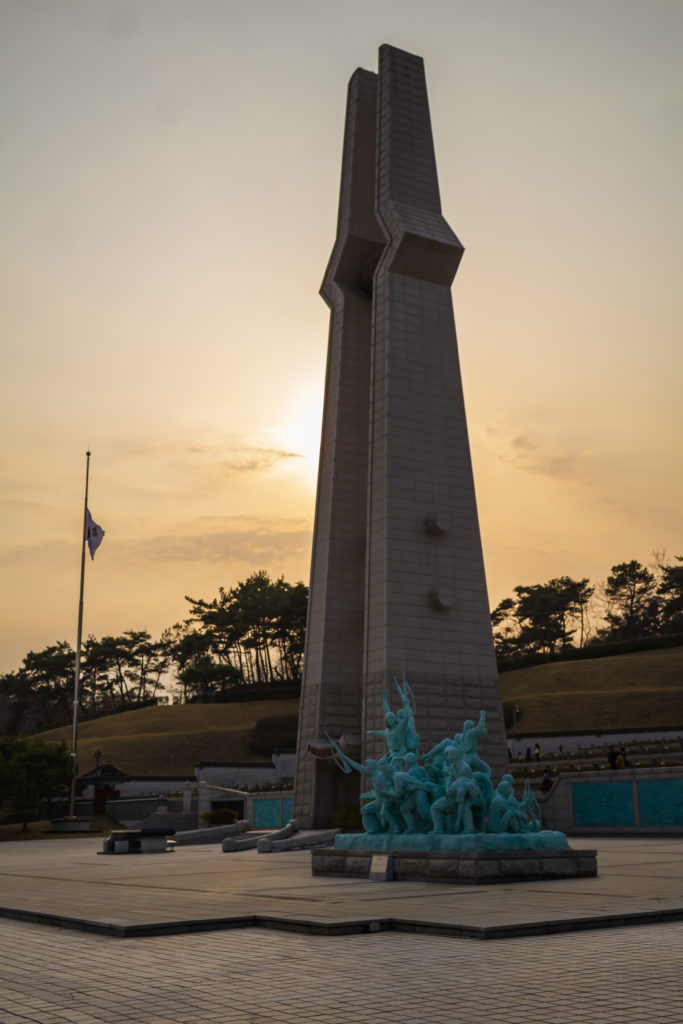
It’s quiet at the May 18 National Cemetery.
The sounds of the city fade here, in the hills. For once, you can hear the sound of birds, and of the wind.
The plaza stands silent, most of the time – the fountains that ring it are rarely on. It is dominated by the high tower of the eternal flame, just before the graves. On one side is a bronze sculpture of a group of citizens, their fists and ragged weapons raised in triumph, while one man rigs a flag of liberation to fly over their heads. At their feet are the baskets of food brought to the militia by the citizens of the city, and some of the men and women extend their hands, inviting others to join them. On the other side, a jeep commandeered by the sinmingun, still crewed by a dozen fighters, stands in bronze. And, of course, the graves stand there still, gradually filling as one by one the veterans of May come to the end of their lives and return home, to rejoin their comrades.


In front of each grave is a photo – usually a young man or woman, grinning out with that ragged haircut that was popular at the time. Their eyes are bright, the faces youthful, full of promise and potential. Every single grave was a person, usually one who wanted nothing more than to finish his or her education, find a good job, a good family, and settle down to live in peace. They traded the chance for that peaceful life – some willingly, others unwillingly – so that others would have the opportunity to live freely.

The June Uprising succeeded because the Gwangju Uprising failed. The Korean opposition learned from their mistakes in the May of 1980. Then, the students had protested alone, without hte support of labor or other sectors of society. Regionalism and division ahd paralyzed the opposition to a relatively shaky military regime still trying to find its feet after the coup. Gwangju had demonstrated what the citizens of the country could do when they were united – but Gwangju had been isolated, ignored, and, ultimately, crushed.
But the memory, especially of those brave souls who sacrificed their lives at the end, to seal the revolution in blood and ensure that their struggle would not be forgotten, lived on. Every year marches and protests marked the anniversary of May 18th, and never again did the Korean opposition allow itself to be divided and conquered as they had in 1980. Protests in the future ranged from Seoul to Busan. Leaders travelled around the country, students carefully coordinated with each other across provinces, and the student democracy movement banded with the labor movement to broaden its base of support. At the same time, the leaders targetted the regime abroad, too. In May of 1980, no one overseas had known what was happening in the backwater Jeolla province – President Carter himself received reports of “citizen’s tribunals” executing capitalists in the street. Through the 1980s, the opposition learned to appeal to overseas audiences, to ensure that the harsh spotlight of global public opinion was always on Chun – who found himself handicapped by the very ambitions he had for Korea.
Chun wanted Korea to be a proud, accepted member of the family of nations – that meant he had to act like a responsible head of state. With the Olympics looming, and the opposition annoying burning down American buildings, he didn’t have the same leeway to deploy paratroopers and helicopters as he did against Those Bastards in Gwangju. Especially when deploying the military meant a crackdown not of ONE isolated city, but all across the peninsula…
And so the stand in Gwangju was not in vain. The deaths of so many students and professors and workers and drivers and people who just happened to be in the wrong place at the wrong time mattered. WIth their lives, they defied the authority of the military regime – that just because one man in an expensive suit and a fancy desk willed it so did not mean that they were slaves. And with their deaths, they dealt a mortal wound to the dictatorial regime that had ruled their homeland for three decades. It was a wound a long time killing the beast, but kill it they did.
Today, most of the hundreds of dead are little more than faded black and white photos on little gravestones, in a quiet cemetery far away from the hustle and bustle of the city. But the people in those graves were important, and though today their struggle has been almost entirely forgotten by the West, the country that they fought to create is one of the richest and free-est in the world. If nothing else, I, at least, think that they are worth remembering.
 Gwangju Dreaming