Adventure Journal 7/12/21 – Coffee & Job

Another hot Monday in Yeosu. By now I have sufficient personal experience to recognize that the 31 C outside temperature is “hot as balls.” I’m not sure why it feels so much hotter than 90 F would be, but it is. It might be the humidity – with the East China Sea on three sides of Yeosu, there’s a constant blanket of moisture hanging over the city. The fine dust in the air gives convenient purchase to the water vapor, and as a result the sweat sticks to your body, giving absolutely no cooling effect whatsoever, and making you quite smelly in the bargain. Even more annoyingly, Koreans have no body odor even when they sweat like a long-tailed cat on a Cracker Barrel front porch, so deodorant is very difficult to come by in this country. So I get to be the hot, uncomfortable, smelly foreigner most of the time, too.

Anyway, the weekend was full of adventure – perhaps not in the places I went, but definitely in the person I spent it with. Kaj and I haven’t had the chance to spend time with each other in 11 months, and as I’ve said before I think that she is my true adventure. So, Friday night we went on a date – our first since August. We made our way to the Megabox theater (alas, no popcorn sold because everyone knows popcorn spreads COVID) to see Black Widow. It was my first time seeing a Marvel movie in the theater since…I wanna say Avengers 2, the entirely forgettable one* about the weird robot, and there’s like a flying city at one point. Anyway! Black Widow was enjoyable enough – I enjoyed the cold open a lot, Jim Hopper really carries a lot of scenes, some of the action scenes and cinematography were a bit creative (I particularly liked one rooftop chase), and the movie was groping towards a decent theme about family (Vin Diesel nodding in approval). Much more enjoyable was the person I was watching the movie with, which I imagine is true of most things.

Saturday, what was most memorable to me was she took me to a coffee shop called the Balcon de Yuel, a 5th-floor establishment overlooking Yeosu harbor. The shop had a huge, open floor plan with modern, spartan decor – lots of white, floor to ceiling windows, and eclectic furniture arranged near the windows to give views over the water. We nestled into a couch with tropical smoothies out on the namesake balcony, with books and time. I could see out for miles over the water, looking out on the bay, surrounded by little islands like pearls on a necklace – Baegyado, Jedo, Gaedo, Geumjukdo, and the ever-dear to my heart Dolsando, blue in the distance. On the water, jet skis, sailboats, and parasailers jostled for space, often tugging squealing young people on an inner tube (or, in one case, an inner kite that frequently leaped off the waves and glided through the air for seconds at a time). The breeze blew off the sea and for an hour I was perfectly content – one of those moments in life where you want absolutely nothing to change. 

Sunday, we rode the bus together to nearby Suncheon for church. I’d been attending online for months, so it was nice to finally meet many of the members in person. We talked about Job – my favorite book of the Old Testament, one of my favorite pieces of literature period, and one about which I have many Thoughts. I’ll set them down in this space sometime, but in my opinion, Job – which is perhaps rivalled only by the Epic of Gilgamesh or the works of Homer for sheer age – is one of the most comforting and reassuring poems ever written. 

Anyway, I’m settling into the rhythms of life here in Yeosu while we count down the days to South Africa. She is at work, while I busy myself fixing up minor defects in the apartment, planning for upcoming travels, and reading Prit Buttar’s history of the First World War’s Eastern Front, with the important side business of finishing my iced Americano in this coffee shop and writing this goofy diary. The Americano, alas, is exhausted, however, and so are my words, so I should probably venture out into the appalling open-air sauna of the streets of Yeosu and make my way home. 

Once more unto the breach, dear friends!

*Like that narrows it down

Adventure Journal 7/9/21

331 days.

That’s how long passed between leaving Kajal in Yeosu, at the time I thought probably forever, and returning to her yesterday. A long time – filled with lots of text messages, photos exchanged, and hundreds of video calls. 

It’s amazing to me how much video is no substitute for the reality of a human being. They can show you what she looks like, of course, and let you hear her words, but it’s nothing compared to being in a person’s presence. Video doesn’t capture the way they carry themselves, the little movements in their body as they walk, how big (or, in this case, how small!) they are compared to you. Truth is, video is fine for what it does, but it’s not a patch on the real thing.

She’s at work now, so she can’t watch over my shoulder as I write this (I’m in a coffee shop overlooking Yeosu’s central park, with a cup of tea and a book of World War I history next to me), so I can write about how special she is.


Getting to spend time with Kajal after 331 days apart is…hard to describe, though you can probably imagine it. Think, for a moment, of a hot room. I mean like an attic, or a shed, in the summer – no insulation, no breeze, no air conditioning. The air is stifling, each breath seeming to throw a heavy weight onto your lungs. You can feel the heat oppressing your skin, and it almost seems to press down on you, making every movement ten times as difficult. Now, imagine in that room, you throw open a window – and a cool breeze of fresh, spring air comes in. That’s what it’s like, seeing her again. Or you’re thirsty – hot, outside, hard work. But you’ve been thirsty for so long that you don’t even notice it anymore, your brain has compartmentalized the discomfort, and you forget about it – until you get that glass of cool water and can feel it flowing down into you. Just so – just walking next to her with Snowball in the park last night was a relief to me, when I had long since lost awareness of just how I missed her. Now I can hear her laugh, see the way she smiles (a bit shy, still) when I tease her, the little gestures where she’ll tuck her hair behind her ear, or her languid, easy pace as she walks. All the little things that you don’t notice you’re missing, on 331 days of video. Little things that you didn’t even know you loved about someone – until you see them again, after nearly a year.

I’m so relieved to be here at last. 

Adventure Journal 7/8/21

Freedom so far has been a lot of hurry up and wait. 

Right now I’m sitting in the Incheon Bus Terminal, waiting for the next bus to Yeosu. The bus doesn’t leave until 2 pm (it’s 10:30 now). It’s about a five hour drive down the length of the ROK, ending on a peninsula jutting off the southern tip into the East China Sea. So I’m looking at another 8 ½ hours until my long journey – which began more than 2 weeks ago, when I flew from KC to Denver – comes to an end. 

I think I made it through quarantine as well as could be expected. I stepped into my room at about 8 pm on Thursday, June 24th, and didn’t set foot in the hallway until 7 am, Thursday, July 8th (ie, today). In that time I didn’t go stir crazy, I didn’t tear up the walls, I only dreamed of escape once, and on the whole it was almost a relaxing vacation.

The key was routine. I woke up every day about 6 am, and, after lazing in bed with a book or the Internet, got up and looked outside (when I made my tick mark on the wall, so I didn’t lose track of days). The view was the same train station, a little patch of road with some buildings, an open field (where in the evenings men would practice their golf drives), and the end of Incheon Airport’s runway (where I watched the planes coming and going).

Then it was time to exercise. Had to stay fit since I spent most of my day sitting. I had a workout app on the phone and the robo-trainer drove me pretty hard, but between that and the diet I came out of quarantine in better shape than I’ve been in since I landed in the USA last August. I’d go for about an hour, putting on a YouTube video on the TV, then head into the bathroom. Unlimited hot water, so long hot showers and lazy starts to the day helped.

By 9 am, breakfast had been delivered. Three times a day, I’d open my door to find a little plastic grocery bag stuffed full of goodies to eat. Every meal included a packet of white rice, what I referred to as Korean fixin’s (a 4-tub container with some form of kimchi and other common Korean garnishes), a bottle of water, a sweet (yogurt or fruit at breakfast, fruit or a pastry at lunch and dinner), a salad or vegetable, and finally a meat. The meat could be fish (on the bone, often scaly, too), beef (usually spicy), pork (spicy), or chicken (mmm),* on a weekly rotation I worked out. I got curry twice and bibimbap twice, my favorite meals. 

After breakfast, until lunch I’d read my book or teach myself something on the Internet that I was curious about. I read 4 books during quarantine – Django Wexler’s Shadow Campaigns series, a fantasy series featuring an expy of the Napoleonic Wars, but with demons. Kajal would video call several times a day and make sure I had human contact. 

After lunch, until dinner I would play on my Switch – Breath of the WIld is an old standby, Paper Mario: The Origami King, Civilization VI could eat an entire day if I let it, and I played Assassin’s Creed: Rogue from start to finish. One morning I was able to play Among Us with friends 14 timezones away! Or I’d watch a movie – I watched all 3 Brendan Fraser Mummy movies for the first time in nearly a decade, I think. The original is still excellent, the second still a very solid sequel, and the third is still terrible. Alas. In The Heart of the Sea was an excellent naval adventure with Chris Hemsworth and Tom Holland. 

Dinner would come around 6, I’d eat it, clean up the debris of the day and place it in a bag just outside my door, and I’d spend the evening relaxing from another difficult day. I’d usually curl up in my chair facing out the window at the airport, and read while the sun set and the lights on the runway came on. Then at nine, get ready for bed, and read until I fell asleep. 

So this morning, at last, I was free. A hazmat-suited woman came to my door and asked if I was ready to check out – God, yes. I stepped into the hallway with my bags for the first time in two weeks, and surreally (but entirely logically) saw up and down the hallway about a half-dozen of the same people I had come into quarantine with, who had had their own private ordeals in rooms just a few feet from mine. We crowded into the elevator, were loaded onto a bus, and driven to the nearby subway station.

At Unseo, I worked out where the nearest bus terminal was, bought a ticket, and wrestled my bags up to the platform – on the wrong side. Damn. I wrestled them back down, across the station and up on the proper side. Wait, no, I had been on the right side to begin with, I wanted to go towards Seoul Station, not Incheon Cargo Terminal. Double damn. Down, across, and up one last time, and hten onto the train. 

Just needed one transfer – it took a few minutes to wrestle the bags across the new subway station, including a tricky business lifting one of my bags from the wrong side of the gate after I got cut off from it, but I managed to board an empty train heading to Incheon Bus Terminal, took over fully two seats with me and my baggage (there was no way to take up less space, sorry Koreans looking daggers at the inconsiderate waygook. -shrug-), and had 30 minutes to recover. At about 9, I got off at the Incheon Bus Terminal stop, wrestled my bags up two floors – to the wrong side of the street. Triple damn!

Back down, across the station – my arms are going to fall off, I think – and then up two more floors, and into a hot, humid day outside Incheon Bus Terminal. I made it halfway through the approach courtyard before I took a 5-minute break, my arms trembling from the strain and my whole body soaked in sweat. Jeez, it was hot. Then at last, at about 9:20, into the bus terminal and to the ticket stands. Next bus to Yeosu – 2:20 pm. I had missed the morning bus by about 50 minutes. Oh well.

So, my heavy bags are next to me in the concourse and I have an uncomfortable seat. It took me about 20 minutes to write this, so I’ve got 3.5 more hours to kill. Might seek some food – but that means either leaving the bags, or, worse, dragging them.

I need to find a way to fit a year’s worth of belongings into only 1 checked bag next time. No more of this two bag nonsense.

*yes, that was A Girl Worth Fighting For reference

5.18 Epilogue: The Quiet Cemetery

It’s quiet at the May 18 National Cemetery.

The sounds of the city fade here, in the hills. For once, you can hear the sound of birds, and of the wind.

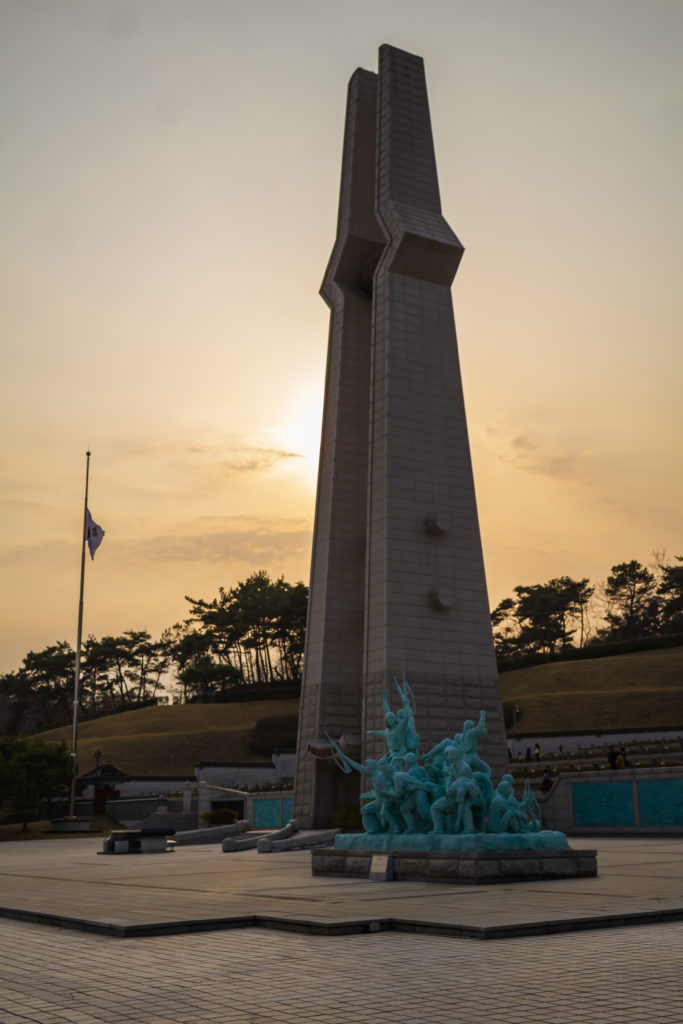
The plaza stands silent, most of the time – the fountains that ring it are rarely on. It is dominated by the high tower of the eternal flame, just before the graves. On one side is a bronze sculpture of a group of citizens, their fists and ragged weapons raised in triumph, while one man rigs a flag of liberation to fly over their heads. At their feet are the baskets of food brought to the militia by the citizens of the city, and some of the men and women extend their hands, inviting others to join them. On the other side, a jeep commandeered by the sinmingun, still crewed by a dozen fighters, stands in bronze. And, of course, the graves stand there still, gradually filling as one by one the veterans of May come to the end of their lives and return home, to rejoin their comrades.

In front of each grave is a photo – usually a young man or woman, grinning out with that ragged haircut that was popular at the time. Their eyes are bright, the faces youthful, full of promise and potential. Every single grave was a person, usually one who wanted nothing more than to finish his or her education, find a good job, a good family, and settle down to live in peace. They traded the chance for that peaceful life – some willingly, others unwillingly – so that others would have the opportunity to live freely.

The June Uprising succeeded because the Gwangju Uprising failed. The Korean opposition learned from their mistakes in the May of 1980. Then, the students had protested alone, without hte support of labor or other sectors of society. Regionalism and division ahd paralyzed the opposition to a relatively shaky military regime still trying to find its feet after the coup. Gwangju had demonstrated what the citizens of the country could do when they were united – but Gwangju had been isolated, ignored, and, ultimately, crushed.

But the memory, especially of those brave souls who sacrificed their lives at the end, to seal the revolution in blood and ensure that their struggle would not be forgotten, lived on. Every year marches and protests marked the anniversary of May 18th, and never again did the Korean opposition allow itself to be divided and conquered as they had in 1980. Protests in the future ranged from Seoul to Busan. Leaders travelled around the country, students carefully coordinated with each other across provinces, and the student democracy movement banded with the labor movement to broaden its base of support. At the same time, the leaders targetted the regime abroad, too. In May of 1980, no one overseas had known what was happening in the backwater Jeolla province – President Carter himself received reports of “citizen’s tribunals” executing capitalists in the street. Through the 1980s, the opposition learned to appeal to overseas audiences, to ensure that the harsh spotlight of global public opinion was always on Chun – who found himself handicapped by the very ambitions he had for Korea.

Chun wanted Korea to be a proud, accepted member of the family of nations – that meant he had to act like a responsible head of state. With the Olympics looming, and the opposition annoying burning down American buildings, he didn’t have the same leeway to deploy paratroopers and helicopters as he did against Those Bastards in Gwangju. Especially when deploying the military meant a crackdown not of ONE isolated city, but all across the peninsula…

And so the stand in Gwangju was not in vain. The deaths of so many students and professors and workers and drivers and people who just happened to be in the wrong place at the wrong time mattered. WIth their lives, they defied the authority of the military regime – that just because one man in an expensive suit and a fancy desk willed it so did not mean that they were slaves. And with their deaths, they dealt a mortal wound to the dictatorial regime that had ruled their homeland for three decades. It was a wound a long time killing the beast, but kill it they did.

Today, most of the hundreds of dead are little more than faded black and white photos on little gravestones, in a quiet cemetery far away from the hustle and bustle of the city. But the people in those graves were important, and though today their struggle has been almost entirely forgotten by the West, the country that they fought to create is one of the richest and free-est in the world. If nothing else, I, at least, think that they are worth remembering.

Don’t forget Gwangju’s May.