Part Fourteen: Tomorrow Comes
In the aftermath of the Uprising, Chun Doo-hwan moved quickly to consolidate his control over Korea. The dictator and his cronies pressured the Cabinet to declare a special tribunal investigating the incident, chaired by Chun himself. Before a month had passed, the tribunal had indicted opposition politician Kim Dae-jung (remember him? The perennial gadfly for the militarists) for inciting the rebellion and sentenced him to death, along with several dozen others. Waving the “need for stability” in the face of the Northern threat at the United States, the regime shuttered newspapers, closed down opposing political parties, and arrested or fired journalists who wouldn’t go along with the party line. Across the country, at the behest of the insecure Chun, police departments cracked down, bringing in more than 60,000 citizens for questioning, arresting some 3,000, and shipping tens of thousands off to military camps for ‘further education.’ By August, the puppet President Choi was gone and Chun was elected with a totally plausible 99.9% of the vote. In the face of this, the Carter administration more or less shrugged, the President saying in a televised address that he’d obviously prefer democracy, but we couldn’t choose our allies.
However, while Chun and the US foreign policy establishment would have liked nothing more than to sweep the Gwangju Incident, as they referred to it, under the rug and forget that the slaughter of thousands of citizens had ever happened, the people of Korea stubbornly refused to get with the program. The truth about what had happened in South Jeolla continued to leak out in the months and years to come, an ulcer eating away at the Chun regime. For example, on May 30th, just three days after Splendid Holiday, a young college student, Kim Ue-gi, climbed to the top of one of Seoul’s hundreds of skyscrapers – and hurled himself to his death. Along the way he scattered thousands of flyers proclaiming the truth of the massacre in Gwangju. It was an act of self-martyrdom to demonstrate his devotion to democracy, reminiscent of the Buddhist monks who immolated themselves to protest the Diem presidency in South Vietnam 15 years earlier. Indeed, two weeks later, on June 9th, a former labor organizer named Kim Jong-tae burned himself to death in Seoul after handing out more Gwangju leaflets. And every May thereafter, Chun had to deal with the headache of college kids hurling themselves off buildings while screaming denunciations of his regime, which made his insistence that he loved democracy, that he loved the Republic of Korea just a bit harder to swallow.
For the thousands of rebels – students rounded up in the inital fighting, rebels taken during the fall of the city, and ordinary citizens rounded up in the crackdown afterwards – the ordeal continued for months. They were kept in hot, overcrowded prison cells, poorly fed and poorly treated, around Jeolla. Eventually, most would be released, after months, sometimes years. Some never recovered. Many were tortured, as the regime obsessively tried to get each and every rebel to denounce Kim Dae-jung as the organizer of the rebellion. The Catholic Church, which took upon itself the duty of overseeing the welfare of the prisoners, documented in one letter about Kim Cheong-bae (For example):
Quote
“Mr. Kim was detained at dawn on the 27th of May by the Martial Law Command for having held the position of student representative on the Citizens’ Committee to Seek Solutions to the Kwangju Disturbance. He was tortured day and night, was hit on the head with an M-16 rifle butt, had two teeth broken, was beaten severely on the face and forehead, and still bears the scars from all of these beatings. Only after losing consciousnessthree times and having been subjected to forms of violence and torture beyond human imagination did he bend to his interrogators’ demands that he put his fingerprint on the false “confession” contained in the indictment (Communiqué, March 1, 1981, p. 40).”
Also the case of Park Yon-son, another university student:
Quote
“At the urging of his father, Mr. Park turned himself in to the Joint Investigative Command on June 3. From that time until June 7, he was beaten and tortured repeatedly, and on suffering severe damage to his spinal cord, he fell into a coma. Even after he was transferred to the army’s General Hospital in Kwangju and although he showed signs of mental disorder, he was not given appropriate treatment. Instead, he was made to take painkillers continuously and has lost his ability to speak. The indictment against him has been terminated for the present, yet his family’s request to have him released due to his severe physical ailment was refused. He is still being held in the intensive care ward of the hospital (Communiqué, March 1, 1981, p. 40).”

Most prisoners were released in 1981, after Chun announced an amnesty for all political prisoners and an end to martial law just before his visit with the newly inaugurated American President.
The final casualty count, as I have said, is difficult to know. Officially, based on the 1987 inquiries (see below), the government admitted to less than 200 deaths. The Injured Person’s association claims 284 dead and 2700 injured, which seems to be in the ballpark. A final count is difficult to determine, because so many lives were destroyed by the whirlwind of violence over those may days. Chang Pok-Son suffered a blow to her head during the fighting and was in and out of mental hospitals through the 1980s. She committed suicide in 1993. Kim Chon-sul saw his wife, Park Yon-ok, killed by paratroopers. He became an alcoholic and drank himself to death by 1984. Professor Myong No-gun was 46 years old when he supported the students of Chonnam University – he died 20 years later and was buried in the 5.18 Memorial cemetery. His wife sadly commented that those involved in the uprising all seemed to die too soon.
The Gwangju ulcer recurred every spring while Chun was in power. In May 1981, students in Seoul surged into the streets on the anniversary of the massacre. The secret police waded in, breaking skulls and arresting the biggest trouble makers, and hundreds of students were expelled. But the protests continued. In May 1983, Kim Young-sam, one of the two Kims in the opposition, began a hunger strike on the second anniversary of the Uprising. The other Kim, Kim Dae-jung (who had escaped execution and was living in exile in the United States), issued statements of sympathy. The two Kims joined forces thereafter, and on May 18, 1984, the third anniversary, they created a joint council agitating for democracy in Korea.
Chun was caught between two fires. On the one hand, he ached for nothing better than to crush these insects as he had Gwangju, and rule as Park and Rhee had before him. On the other, though, he was desperately attempting to modernize Korea. The economy had soared to never-before dreamed of heights under Park, and under Chun that continued. But he needed foreign investors for that. Furthermore, he was working hard to build Korea’s prestige abroad, hosting the 1986 Asian Games and successfully bidding to host the 1988 Olympics – a huge project for a country that had been mostly peasant rice farmers ten years before. But while those projects brought prestige and glamour to the nation (and by extension, the government), they also brought scrutiny – and the damnable students would not let that whole Gwangju thing go. It was a lingering source of embarrassment for the regime with no good solutions for Chun.

By 1984, 4 years after the massacre, Chun thought he might try a lighter hand as the parliamentary elections loomed. The military government had the two main opposition parties well in hand (they supposed), and the economy had continued to boom under Chun, to say nothing of his successes abroad – even the North had seen a thawing of relations and there were talks of reunification on the peninsula for the first time in years. So, he permitted the elections to proceed – and got egg on his face when the two Kims converted their council into a political party – the New Democratic Party – and won more votes than Chun’s Democratic Justice Party. The DJP clung to power anyway, claiming a narrow parliamentary majority, but Kim Dae-jung felt safe enough to return from exile and all the momentum was clearly in the direction of democracy.
While the truth of the massacre had been surprised in a way that, ten years later, with CNN and fax machines, Tiananmen could not be, it still spread among underground circles – whisper by whisper, the story was made known to all of Korea. Lee Jae-eui, who had escaped the final downfall of the city, crept out of hiding and was pressed by his friends to write down his experiences. Haltingly, tentatively, he wrote down everything he had seen, found all the survivors he could, and wrote down what they saw, too. His Gwangju Diary is still the definitive account in any language of the uprising. It circulated in the Korean underground for nearly three years before it could be openly published in 1987.
Again and again, the Uprising proved to be a fatal weakness in Chun’s quest for legitimacy. With political representation, again students surged into the streets, forming committees on the 5th anniversary of the massacre to demand truth and justice – and they did not confine their criticisms to Chun. American culture centers in Korea came under attack, being burned in Gwangju itself, in Busan, Seoul, and other cities. Students demanded answers for the role of the United States in the massacre.* When the students occupied the US Information Service in Seoul, the press abroad took note and Chun found himself under heat from the Reagan administration. Chun attempted, over the summer break that year, to force through new legislation letting him crack down on the damned kids, but his position had grown so weak that Parliament balked – no longer a puppet – and the government was forced to back down.
Matters came to a head in 1987. When Chun had finally had himself elected President in the late summer of 1980, he had been in such an uncertain state due to lingering resentment over hte massacre in Gwangju that he had limited himself to a single 7-year term under the revised Constitution. That term would expire in ‘87. The last three years had seen the regime reeling, lacking the popular support or the foreign support to truly crack down on an emboldened and fast-growing democratization movement, galvanized and united by the memory of that May in Gwangju. Both sides prepared for an all-out battle over the Presidential election.
The straw that broke the back of the Chun regime, and with it the more than 3 decades of authoritarian rule in the Republic of Korea, was the death of another student. Just as the murder of a high school student had toppled Synghman Rhee in 1960, now in January of 1987 another student, Park Jong-cheol, died in police custody. The police lamely claimed that the boy had died suddenly when an investigator pounded the table while he was being interrogated, but during a memorial mass for victims of the Gwangju massacre, one of the policemen involved revealed the truth: That Park had died under torture. Through February and March tens of thousands of citizens marched in the streets, protesting police torture of innocent civilians. More than 40 cities participated in the marces, and the public began to sense that the regime could no longer stop them.
Desperate, Chun tried his last gambit. He announced in April of 1987 that no further talk could be had of amending the constitution, or of democracy. Such things would have to wait until after the Olympics in 1988. The election in 1987 would proceed under the current Constitution – which provided for only one candidate, the hand-picked successor of Chun (Roh Tae-woo, a participant in the 1980 War of the Stars). The announcement jolted the growing democratic movement, and students, laborers, journalists, politicians, and all the disparate members of the unwieldy coalition put their differences aside to face down this last, greatest challenge from Chun.

On May 18, 1987, tens of thousands of students marched in Seoul in memory of the Uprising, and laid the groundwork for future protests. In the weeks to come, the students took to the streets again and again, joined by more and more common citizens who protested the brutality of the Chun regime and the latest power grab by the President. In Seoul, the Catholic church joined the protests to defend marchers from police teargas. In Busan, over 300,000 citizens were in the streets, utterly beyond the power of the police to halt. In Gwangju, where Chun’s name had been mud for 7 years, the people were once again rallying in the Provincial Hall plaza. By the 26th – 24 years ago this week – over one and a half million Koreans were marching for democracy, in more than 16 major cities. The police were swept away, literally running out of tear gas in some places. As a last-ditch Chun met with Kim Young-sam, hoping to find a negotiated solution. But Young-sam was firm: free elections, or nothing.
Only two options remained for Chun Doo-hwan: to call on his last base of support, the military, and attempt to crush the protests through main force, or to bow to the will of the people. The United States had made its position clear: no more Gwangjus. And the Olympic Games were scheduled to open in Seoul in only a year’s time. A bloody fight in the streets of Seoul…it was impossible. Chun relented. On June 29th, Roh Tae-woo, the designated successor to Chun Doo-hwan, announced that there would be free elections, that the political prisoners would be released, and a new constitution written for Korea. More than forty years after the end of the Japanese empire, and seven after the bloody rebellion in Gwangju, democracy had at last come to the Republic of Korea.
——
Since 1987, the ROK has had regular Presidential elections every 4 years. Kim Young-sam and Kim Tae-jung, flush with the heady thrill of victory in 1987, were unable to agree on a joint candidacy and split most of the vote between themselves, letting militarist candidate Roh Tae-woo achieve an improbable victory in the first free election in Korea – well, ever. In 1991, though, the goobers got their act together and Kim Young-sam became the first civilian head of government since Rhee’s fall 30 years before.
Under President Roh, the first parliamentary investigations had been permitted into the Gwangju Massacre – most of the official documentation of the uprising, siege, and final battle comes from this time. Kim Young-sam made the trial of former presidents Chun and Roh a centerpiece of his administration, both men tried for corruption. Chun was also convicted for his role in the Gwangju massacre and in 1996, was sent to prison. Young-sam ruled until the Korean financial crisis in 1998 led to his ouster by Kim Dae-jung, and the normal cycle of democratic politics has dominated Korea ever since.**
Chun Doo-hwan served very little of his prison term for bribery and corruption, and he never paid the massive fine levied against him – pleading poverty. He was pardoned by Young-sam in 1997 and has lived a private life since. His memoirs have never been published due to protest by the 5.18 memorial foundation.
Jimmy Carter and other US officials have never spoken publicly about their roles in the massacre.
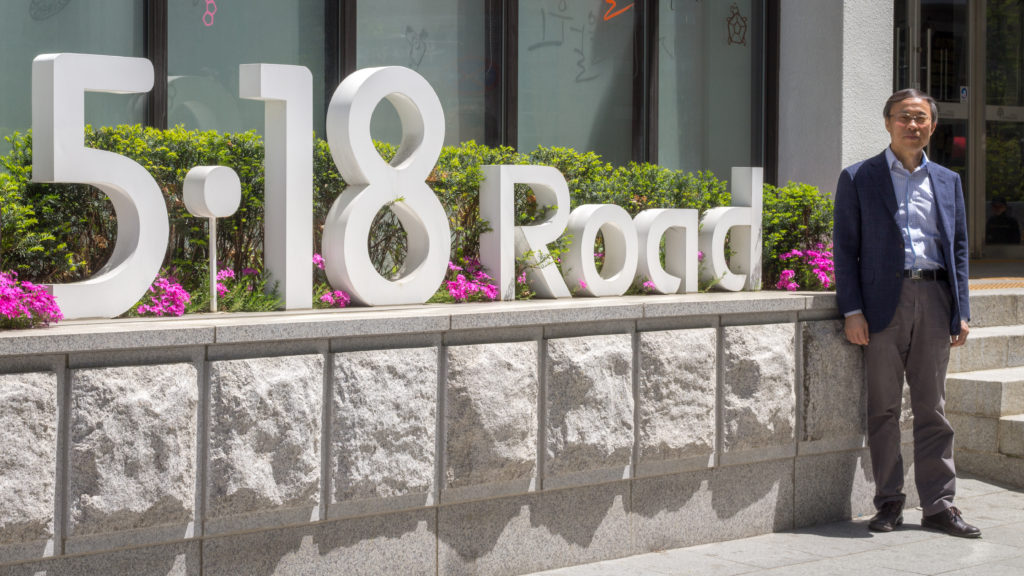
Lee Jae-eui devoted most of his life to speaking and writing about Gwangju, in memory of his slain friends. He served in teh city government and today lives quietly in the city.
Linda Sue-Lewis left Gwangju that summer, but she returned the next year. She has written extensively about the memory of Gwangju in Korean politics and frequently visits the city.

The city itself today is peaceful and pleasant. Buses ply the streets, pulling right up to the old Provincial Hall square – now the 5.18 Memorial Plaza. The fountain still stands and still runs, and the old government office where the rebels made their last stand has become a museum devoted to the Uprising. Around the city you can find little plaques remembering the days of violence back in 1980 – here the taxi drivers gathered, there is a bullet hole from the helicopter, here is the spot the students first protested.
And just north of the city, in the quiet hills that still surround the City of Light, lies the cemetery.
*in fact, most modern Korean anti-Americanism can be traced back to the way the USA facilitated the suppression of the Gwangju Uprising.
** Probably the most interesting facet since the arrival of democracy in the ‘90s was the presidency of Park Geun-hye. Geun-hye is the daughter, of course, of Park Chung-hee, who dominated the country in the ‘60s and ‘70s, and whose assassination set in motion the chain of events that culminated in the Gwangju uprising. She fell from power after a scandal involving her influence by a cult – cults are rampant in Korea these days, I myself was approached by at least four while I’ve lived here.


 Gwangju Dreaming