I. The Ofrenda

I don’t think it would surprise anyone who knows me that I cry at movies. Like, all the time. I maintain my crusty, sarcastic exterior – mustn’t let anyone know I care – but as soon as Carl Fredrickson looks through Ellie’s Adventure Book, or when Tom Hanks pleads with Ryan to “Earn this…”, or the Iron Giant whispers to himself, “Superman…”, I go completely to pieces. At heart, I’m a huge softie. I empathize so strongly with these fictional characters, and my heart breaks alongside theirs, whether they’re being heroic, or devastated, or even just happy and satisfied.
Lately, one of the movies that’s always gotten me is the ending Pixar’s 2017 Coco (spoilers). The film concludes on el Dia de Los Muertos, the one day a year when departed family members can return to visit their relatives in the land of the living. Mexican families built beautiful shrines with flowers and candles revering photos of their loved ones. It’s called an ofrenda, and it reminds us that those we’ve lost aren’t really lost, not truly gone, not yet – not as long as we remember them.
And as Miguel explains all this to his new baby sister, a single wistful guitar chord plays, we see his relatives in the Land of the Dead gathering to visit him, and Miguel sings,
Say that I’m crazy, or call me a fool,
But last night it seemed that I dreamed about you…
He’s not just Hector in that moment, he’s my grandpa, too.
I’ve been dreaming of my beloved grandfather and now my grandmother a lot lately.
The thing about ofrendas is that they remind us that our loved ones are still with us – as long as we keep their memories alive, as long as we tell their stories, they’re still here. I watch the ending of Coco, and I think of Papa, and Mugga, and, well, yeah. I fall apart. But I will still dream of them, and I can still tell their stories. Let me tell you grandma’s story.
II. Grandmas
To be honest, I struggled with writing this. I’ve been trying all week, and each time I start, and then stop, then start again, then erase everything and pace the room some more. No matter how hard I try, the words seem to come out all wrong. The only thing I can think to do is to take the best of writing advice I got: when in doubt, just tell the truth.
Because it’s hard, right? It’s hard to capture my grandmother in words. Everyone’s got a grandma, of course. And so everyone – or many people, anyway – know what it’s like when you lose yours. The words of sympathy come in – so sorry for your loss, let me know if there’s anything I can do, take all the time you need – and they are appreciated, but at the same time it feels like no one really understands. Most of them have lost grandparents, of course, but none of them were my grandma. I want to try and show today who my grandma was.
Every grandmother is alike, and every grandmother is unique. Grandmas are warm, and caring, and kind. They knit you quilts to keep the cold nights away, they fill their house with the warm smell of cookies or pies baking, and your every success they celebrate like you’re the greatest person in the world. To those lucky enough to know them, grandmas become the essence of goodness.
My grandma, of course, was all of those things. I remember so many days of pulling up to their house, and tumbling out of the van as soon as my parents would open the door. We’d race in through their garage – cluttered with the detritus of long lives: a dusty old motorcycle, ancient lawn toys, cloths covering mysterious tools, a broken down old sewing machine, yellowed and flaking magazines – and up the steep stairs to the main house. The stairs spilled you into the kitchen, bright and warm (and cluttered). The house rambled out on either side, filled with more old furniture, pillows and blankets strewn about, and a thousand knick-knacks of all kinds that grandma loved to collect and to hoard.
Every time, without fail, Grandma would give a bright, “Hi!”, enfold me in her arms, and kiss my cheek – and expect one in return. Every time, without fail, whether I was a bratty 4-year old or a bratty 24-year old, I would return both. Of course you kiss your grandmother. To do otherwise is unthinkable.
But Grandma was more than just my grandma. She was her own person, with her own life, her own likes and dislikes, triumphs and tragedies. As kids, we only ever see our elders in their relationship to us – my mom, my teacher, my grandma. Their lives may as well have begun on the day that we entered the picture. But for those of us lucky enough to know our parents, or our teachers, or our grandparents as adults, we get to know them as people, too. I was blessed to get to know some of my grandma as a person.
One of the best summers I ever had was the summer of 2010. It was long, and it was hot. My grandfather was getting a little up there in years, and couldn’t quite mow the lawn like he used to, not in that heat. So I volunteered. Every Wednesday I’d drive out to their house in Raymore, Missouri, dig out the little tractor-style mower, and take care of things.
It was scorching hot, every day. I don’t think I saw a single cloud that summer. The mower would jostle and vibrate and rattle the teeth in my skull, and I’d come inside hot, sweaty, and deafened from the roar of the motor. But inside was the reason I came, cheerfully, every week.
Grandma would have prepared a lunch – a fried egg sandwich and cold peach tea. Now, to be honest, I don’t care for fried egg that much, but she’d gotten it into her head somehow that it was my favorite, and how on earth are you supposed to say, “Actually, Grandma, I really don’t like this?”, especially after she’s made it?* But the peach tea was cold, and delicious, and I knew she always had a jug of it in her house.
We would eat, and talk, and then sit in the air conditioning in the living room and talk, or read, or watch TV, or just sit and enjoy each other’s company. Grandma and Grandpa would tell me stories of their lives from before I was born (stories where Mom got in trouble were my favorite), of the petty politics at church, or of what my cousins were up to. Eventually, the sun would get low in the sky, and I would head home.
Those summer afternoons were when I got to know my grandparents not as Grandma and Grandpa, but as people. I am so, so grateful that I was blessed with that time. Let me share some of them with you.
*Sorry for only just now mentioning this, Grandma. I figure you’ll forgive me by the time we meet again.
III. Janie
Everyone, at one time or another, is young and beautiful.* So, too, was my grandma. She was born Marcia Jane Hogin in the cold January of 1942, the youngest of four sisters. Abroad, the Nazis shivered at the gates of Moscow and the Japanese rampaged through the Pacific, but Kansas City, at least, was peaceful. Grandma would tell me stories of her youth – her tumble out the window at two, when she hit her head and was never the same after. Her childhood scraps and fights with Andy and Margot, the two nearest sisters.
Most of all, I remember how her eyes would light up as she told me, half a century later, stories of her oldest sister Christine. Christine Hogin was a writer, she would tell me, who wrote such beautiful articles and poems for the college she worked at. She had died when Grandma was still very young – I don’t remember how – and so I never met her, but was clear to me that she was still well-loved, and well-missed, by her little sister.
As she grew up, Marcia Jane grew tired of everyone mispronouncing her first name – which is not “Marsha” but “Mar-see-a” – and gradually went by her middle name, Jane – or Janie. Janie was young, and beautiful, and having the time of her life as a senior in high school, in the spring of 1960. She dated, of course – it was on one such date that a bold, whip-thin young man approached her. I don’t know what he said to convince her, but somehow this skinny little guy convinced her to leave her date and to ride home with him.

A few years later, Janie married that slender young man, Roark, and for the rest of her life her name was Janie Wagner – well, she acquired one more name, much later, but I’ll save that story for now.
I know only snapshots of the long years that followed. Married in 1960, Roark joined the Air Force. He was away in Oregon when in 1962, Janie gave birth to the couple’s first child – a daughter, Sherri. Roark tried desperately to get home for the birth, but the Air Force dumped him for days in New Mexico with naught to live out of but his single small suitcase. Nevertheless, Janie forgave her young husband missing the birth and two more children – Bill, and then Traci – followed.

I know of family vacations, and family fights (Sherri, in particular, was a handful, tormenting her younger siblings and throwing pets out of the window), of poor family hair choices (It WAS the 1970s and the Wagners were not immune)

In years to come, I would sit and have lunch with Janie and Roark (although of course I didn’t call them that) and listen to the tales of this time – of her winning the employee of the year award, of his quitting the police force in frustration when they continually denied his transfer to the K9 squad. The couple were open and active in the community, making friends wherever they went. More, the pair that had met at that diner in 1960 were still very much in love – they would be all their lives.
A decade, or two, or three rolled by in the quiet adventures of life. Sherri, and Bill, and Traci grew up, one after the other. Sherri met a guy, and married him. A few years later, in 1989, Janie and Roark’s first grandchild, a grandson, was born. And so Janie became a grandma for the first time – and got a new name in the process.
*I think everyone grows to be old and beautiful, but that is a story for another time.
IV. Mugga
Of all the names she went by – Marcia, Janie, Mom, Grandma – I think to think that Mugga was the one she liked best.
My toddler’s tongue got tripped up and confused by the complicated syllables of “Grandma,” you see. Couldn’t handle it. Mangled and bruised, the word came out “Mugga” every time. I was always eager, then, to go and visit “Mugga and Papa.”
Mugga was Mugga for 31 of her 78 years, not quite half her life. But I like to think it was her happiest.
This is the part I struggle with the most. How do I convey in words how important she was to me, how much a part of my life she was, of everyone in her family’s life? She was so, so much more than an old lady sick in a hospital somewhere. She was vibrant, and active, and energetic into her last days.
Mugga worked hard all the time. She grew to love quilting – she and Roark passed through 3 different houses in these 30 years, and each one had an entire room filled with bolts and scraps of fabric, with paper patterns and thread and sewing machines. The quilt that I have slept under almost every night for 10 years was made by her. She thrived in all forms of craft, delighted in seeing what she could create, and even won awards for her accomplishments.

She was active at church. She and Roark volunteered often, were leaders in the community, gave as much as they could both in time and in money. I remember going to church lunches with them and being swarmed by their friends. They weren’t interested in bragging, much, though – except about me. They reminded me every day that they were proud to be my grandparents.

Mugga was mischievous. She had to be, to survive being married to my grandfather, who was a stinker. She had a sly sense of humor, never stopping teasing me, or my mother, or my grandfather. Her arts and crafts were always playful, and I think the sound I heard from her more than anything else (Other than “love you” of course) was her laughter.

She loved dogs. To the end of her life, my grandma always had at least one and frequently more Shih Tzus running around the house. They had names like Gizzy & Gizmo, or Shannah, or Poko, or Rowdy, or Snickers. They were spoiled rotten, suffered only when the numerous young grandchildren would come to chase them around the house, and were Mugga and Papa’s constant companions. The one surefire way to irritate my grandpa was to irritate one of the Shih Tzus. He would glower at you, and growl out, “You bein’ mean to my dawg?”
It was from Mugga and Papa that I adopted Rowdy, to give him a good home when she struggled to take care of him alone after Papa’s passing.

She was adventurous. In the last decade of her life, she adopted a Heifer, rode a zipline, moved to Florida, cruised for trouble in an open convertible with her older sister Andy, even managed a hurricane shelter for 2,000 people (in her very first hurricane, to boot).

But the most important part of her life, I think, and her greatest joy, was being a grandmother.
V. Legacy
It’s been said that “legacy is planting seeds in a garden you never get to see.” Mugga surely had one of the largest, most vibrant gardens of anyone when her time with us finally came to an end. She delighted her grandkids, in being “Mugga,” from the moment I was born all the way to last Sunday.
She came to my cousin Shelby’s volleyball games, and of course then her younger sister Claire’s games, too.
She taught my brother to play Rummikub while she, he, and Papa fished at Bennett springs.
She attended cousin Robert’s plays as he blossomed into a talented performer.
And of course, she never missed a wedding, or a graduation, or a birthday.


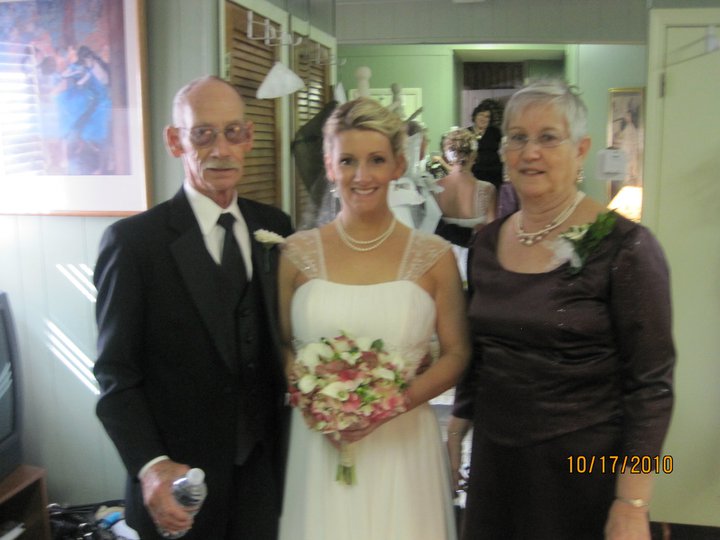
As her grandchildren increased, from one to four to (at last count) 14 grandkids, 11 greatgrandkids, and I believe 1 greatgreatgrandchild, so too did Mugga’s joy. She called me, often. “When are you coming to visit next?” When she talked with her friends, she would brag, “Guess what my grandkid did?” Even in the last days, I’m told, all she wanted to know was what we were up to, would we be happy, etc.
Grandma was always planting the seeds of trees whose shade she would never enjoy. She taught me to always be kind, to always take joy in life. To work hard, to try your best, to never stop giving – and that you’re never too old to have another adventure. Papa was the best man I ever knew. Mugga was the best woman. I wish you, reader – if you’re still here – had known her, because she would have liked you. Mugga loved everyone. If you knew her for ten minutes, you were family, and she would remember you, and make sure you knew you were cared for. She was the best grandmother in the world. Her legacy is all of us, all her family.
But, I think the quote is wrong. I think she will see her seeds flower, someday.
Brothers and sisters, we do not want you to be uninformed about those who sleep in death, so that you do not grieve like the rest of mankind, who have no hope. For we believe that Jesus died and rose again, and so we believe that God will bring with Jesus those who have fallen asleep in him. According to the Lord’s word, we tell you that we who are still alive, who are left until the coming of the Lord, will certainly not precede those who have fallen asleep. For the Lord himself will come down from heaven, with a loud command, with the voice of the archangel and with the trumpet call of God, and the dead in Christ will rise first. After that, we who are still alive and are left will be caught up together with them in the clouds to meet the Lord in the air. And so we will be with the Lord forever. Therefore encourage one another with these words.
– from Paul’s first letter to the Thessalonians, 4:13-18
Let me encourage you with these words: Mugga will see her legacy, someday. Someday we’ll get to meet, and share a peach tea and a fried egg sandwich, and I can show her whatever I’ve accomplished. No matter how little my victories may be, she will praise me like I’m the greatest grandson in the world, and I will hug her, and give her a kiss on the cheek.
Because you always kiss your grandma.
Goodbye, Mugga. I love you so much. I will make you proud.

 Gwangju Dreaming
This was beautifully written. I am sure your Grandmother was honored to read your words in Heaven next to her Savior. I stumbled on a link to your blog somewhere and somehow, I enjoyed reading your retelling of the events in Korea. I have no idea why you are writing about those events but you are very good at story telling. I have been checking this blog every once in a while to see if you posted a new part of the series when I saw your memorial. I understand if you don’t ever have time to finish the series as writing takes a ton of work. But I did enjoy it.
Take care brother.
LikeLike