It takes a special sort of man to become a paratrooper. You need to be strong, to carry the amount of gear necessary to survive jumping into an environment with lots of bad guys who are very unhappy with your presence and more than willing to solve that particular problem with lots and lots of bullets. You need to be independent minded, since there’s a fair chance your commanding officer will land three counties over and now whose job is it to decide what to do about the squad of Nazis hiding on the other side of the hedgerow, eh? You need to be slightly crazy, since you are, after all, jumping out of an airplane armed only with what you can carry and essentially surrounding yourself and basically just hoping that the ground guys will get to you before you’re all shot or captured (which will take a week, tops).
The paratrooper was developed in the days leading up to the Second World War, as strategists racked their brains to come up with ways to avoid the bloody stalemate of the Western Front. Some egghead had the bright idea of flinging guys out of airplanes to raise hell generally behind enemy lines. Possibly to his great surprise, men actually volunteered for the duty. Initially, paratroopers were initially used mainly as distraction forces in support of larger offensives, the theory being that a lunatic dropping out of the sky and doing his best to murder you was generally pretty distracting.* The Nazis used paratroopers to launch surprise attacks on defended islands like the Netherlands behind its flood barriers in 1940 and in Crete in 1941. After this, their use of paratroops generally fell off, for the significant reason that most of Germany’s paratroopers were now dead. Oops. The Allies made somewhat more cautious use of their paratroops, using them to pave the way for attacks in Sicily, in Normandy, and in the Netherlands.
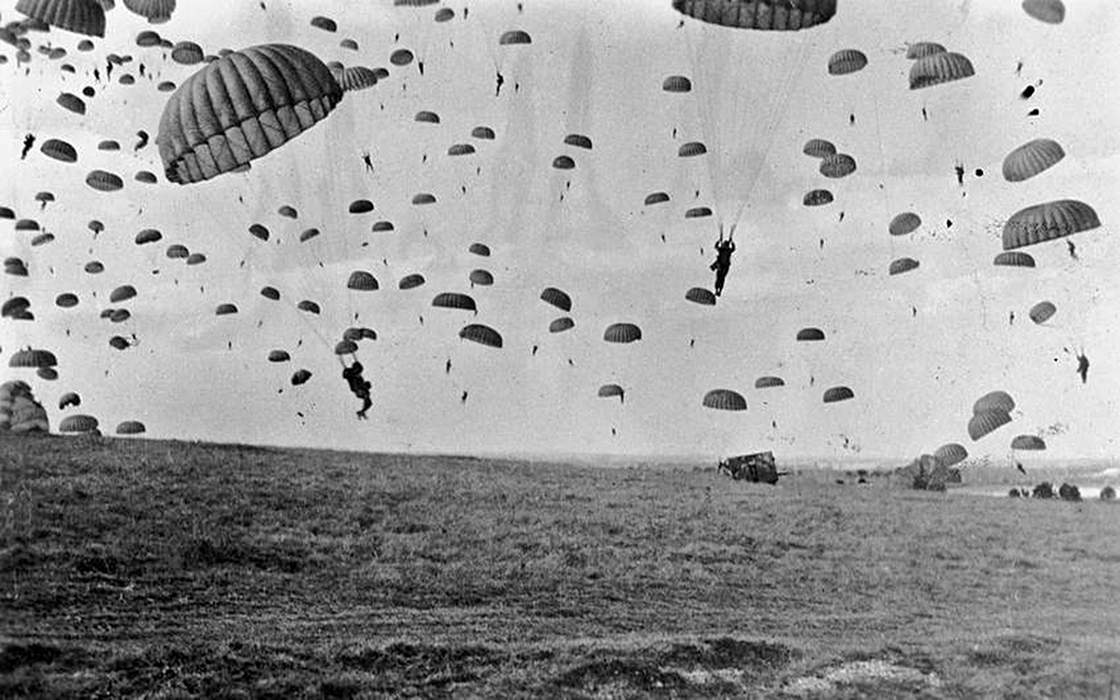
Following the war, the advent of the helicopter made the continued use of paratroops more or less obsolete,** and most countries abandoned their use. Not the Republic of Korea, though. Initially, they hadn’t had the helicopters, and Park Chung-hee had seized power partially through the use of paratroopers. He had a fondness for the units, then, and made the ROKA paratroop brigades a sort of Praetorian Guard. Chun Doo-hwan employed them in the same fashion.
Thus, in Gwangju that May, the troops charged with occupying the universities were the men of the 33rd and 35th Battalions, 7th Parachute Brigade. The Brigade fielded 885 men in 2 battalions, to pacify a march that the previous day boasted 50,000 participants. Now, the troopers were good, but I’m not certain they were 50 to 1 good. Standard Korean doctrine said one policeman could handle about 4 protestors. But the Brigade was confident. They were large, tough, well-trained, aggressive, and just slightly crazy. They had been trained for months to go after protestors like rabid dogs, and now they were given the go-ahead to break faces. Putting them opposite unarmed but stupidly brave college students was a recipe for bloodshed.
This was the students’ first encounter with True Heart anti-riot tactics and they were shocked that their peaceful march was so swiftly met with aggressive violence. The soldiers of the 7th charged in, striking out with batons, rifle butts, even bayonets. The exact numbers of student protestors I do not know – some of my sources have said ~200, others have said as many as 500.*** However, the 366 men of the 33rd battalion had more than enough numbers to do the job. There was brief but bloody fighting and the students were driven off, with 10 injured.

This might also be from the confrontations in the week prior, and those would be riot police instead of soldiers.
The word “injured” can gloss over a lot there. This isn’t a black eye or a bruise on the knee. The paratroopers’ method was to grab their victim, beat students over the head with a heavy ash baton about 18 inches in length, and then give them a solid kicking for good measure once they were on the ground. The May 18 Archive says that blood literally “pooled in the streets” in the wake of the martial law forces.
If the students had stayed scattered, things might have ended there. Chun’s coup of May 18 would go down as just another dimly remembered episode in a long history dimly remembered authoritarian episodes in the history of the ROK. The soldiers had occupied universities in every city in Korea. In none of them did they face any resistance at all. Except in Gwangju. The new tactics there had scattered the protests inside an hour, though.
Except the students didn’t stay scattered.
As they fled, news spread by word of mouth to regroup at Gwangju Station, the city’s main train terminal a few blocks north and west of the campus. Several hundred students were already gathering at the plaza there. Around noon, May 18, the victims of the initial confrontation at Chonnam arrived, bringing word of the bloody confrontation. The students were shocked at the aggressive tactics of the military, and decided to carry out another protest march to the Provincial Office on Guemnamno. They set out and marched south, then turned east along the boulevard to head towards the Provincial Office a few blocks away.
In the meantime, a few blocks west of the demonstrators, bus after bus full of army troops was pulling into the Gwangju Bus Terminal. The terminal sits squarely between City Hall in western downtown Gwangju and the Provincial office, in the eastern portion. Early that afternoon, Linda Sue Lewis, an American law student, arrived at the station.
She looked around in bewilderment at the masses and masses of soldiers filling the station as she arrived. Lewis had been living in Gwangju for several months, studying the actions of Korean civil court judges as part of a study abroad program. She lived with a family in a small home in the city and she had never seen so many troops – not even in Seoul, where she was newly arrived from. She had gone there to give a lecture on Friday and had seen the massive student demonstrations, and was sad to leave the center of political action in Korea to return to her peaceful southwestern city. But all these soldiers made her uneasy. She heard rumors of unrest a few blocks away, near the Provincial Office, and she nervously hurried home.
Also at the bus station that afternoon was a young man, Kim Gyeong-chul. In his photos, Kim appears as a serious, dignified young man of 28. He wears a suit and a dress shirt, and his hair is neatly cut – perhaps longer than the fashion today, but not the wild manes many of the students sported. In his day job, he was a shoe salesman. His free time he spent volunteering as administrative officer for the Gwangju Committee of the Deaf & Mute. Kim himself was deaf and mute, since childhood – the result of a bad reaction to some medicine he had been given.

Kim was at the bus station that day to see off his brother in law, who had been visiting from Seoul. It’s possible he also looked around, and saw the numbers of soldiers pouring in. But Kim didn’t head straight home. It was a beautiful Sunday afternoon, and he paused for lunch with some friends first. He then headed down Guemnamno to rejoin his young wife, mute herself, at home.
As Kim headed down the road, hundreds of miles away, worried military men were meeting at Army Headquarters in Seoul. Major General Kim Jae Myeong, head of Operations, had listened to worried telephone reports from his field commanders in Gwangju that morning. The 7th was the only unit in the entire country that had met resistance. Remembering the massive demonstrations reported from Gwangju in the previous days, General Kim was anxious that the paratroopers might not have the manpower to fully suppress things if they – well, if things to out of hand.
Shortly after lunch, he telephoned General Jeong Ho Yong, head of the Special Combat Unit, that “they had decided to dispatch the 3rd Special Combat Brigade as reinforcements because there were indications that the situation in Gwangju would take a turn for the worse.” Jeong protested – such work was not for his special combat troops. Why not send the 11th Paratroopers instead? Since the two 7th Brigade battalions were paratroopers themselves, it would help maintain cohesion if they were reinforced by paratoopers. Kim agreed, and the 11th was mobilized shortly after 3 pm. By the next morning they would be deployed throughout Gwangju.***
Back in the city, early in the afternoon the 7th had pulled out of Chonnam and regrouped at an elementary school a few blocks away. They were briefly confronted by students chanting slogans (university students, not 4th graders!), but the soldiers quickly and aggressively drove them off again. Then word reached them of the students marching down Guennamno for the Provincial Office, and the unit moved south to intercept them short of their goal.
The confrontation came around the Catholic Center, a few blocks west of the Provincial Office. The soldiers, now en masse, came upon the group of students, and immediately set upon them. They charged in, beating, kicking, dragging people out to be tossed into the back of waiting military trucks. Most people detained were given a thorough working over before being stripped to their underwear and arrested.****

A beating on Guemnamno 
The thing is, Guemnamno is a very, very busy road. It’s the main thoroughfare in the heart of Gwangju, in fact. It is lined with shops, restaurants, an underground shopping mall was then under construction, and most importantly, it was filled with ordinary citizens. Hundreds of passersby were going about their day in this public place – but the soldiers did not discriminate. Anyone their glance fell on was liable to attack and arrest, especially anyone of university age. Soon, dozens of bystanders were sucked into the melee whether they were protesting or not.
Into this swirling mass of escalating violence came Kim Gyeong Chul, now walking home from his lunch. He was deaf, and unable to hear the commands of the soldiers or the warnings of the passersby. He was mute, and so he was unable to explain himself. Worst of all, he was young – he looked young enough to be a student himself.
A group of soldiers roughly seized Kim and dragged him into the street. Confused, Kim attempted to plead his innocence – but of course as a mute he could hardly do that. The soldiers grew increasingly agitated as they peppered Kim with questions he was unable to answer, then, when their rage reached a peak, began to beat him. He fell, and they began to kick him, then stomp him. The claims that he was deaf and mute were obviously a lie so he could ignore their orders, so he could disguise his participation in this sedition of the regime.
When Kim did not return home that night, his wife and his mother, Im Gun-Tan, went out the next day to look for him. Im canvassed the military prisons, now bulging with hundreds of detainees, while his young wife (whose name I do not have, I am sorry) searched the hospitals. It was late before they found him – not in a hospital, but in a morgue. Im later recalled,
“He had been beaten like a dog and his eyes has been gouged out. He was naked and covered in just a white sheet when I first saw him at the military hospital mortuary. When I returned with some clothes, I caught sight of a guard hosing down the corpses while another recorded their names.”
Im Gun Tan, “Gwangju Biennale honours sacrifice that brought democracy to South Korea”
Kim was the first recorded death in the Uprising. Today, his grave stands first in line of the hundreds at the memorial cemetery. His neat, dignified portrait, surrounded by flowers, still smiles out at the plaza there.

The military’s indiscriminate response, though, was perhaps the greatest strategic blunder anyone had made in the entire crisis. Rather than intimidating the people of Gwangju into silence, the brutal suppression instead had the opposite effect. After years – decades – of subjugation, the people of Gwangju had had enough. Suppression of democracy, they could accept. Neglect by the government in Seoul? What else was new, the bastards never changed. But now, to be murdered walking their own streets? It turns out you can only push a people so far before they snap, and start to fight back.
The melee in front of the Catholic center was only the start of a running street battle that lasted the rest of the afternoon and into the evening. First at the Catholic Center, then by 5:30 at the Labor Bureau next to the Provincial Hall, then by 7 at Gwangju High School, and at 8 again at the Catholic Center. The demonstrators never numbered more than a thousand, usually closer to around 500, but more and more of them were no longer students but instead ordinary men and women, people whose silent consent had been one of the key supports of the Rhee, Park, and now Chun regimes.

The troopers were indiscriminate. They pursued “agitators” wherever they could be found. One couple was dragged out of a taxi. The man was beaten, and his young wife had her dress torn off her. Another man was bayoneted, then tossed into a police van, still bleeding. An American, Tim Warnberg, was in the city. He had volunteered with the Peace Corps. He describes his experience:
“We ran with the panicked crowd and I ended up in a small store along with about fifteen other people, including one other PCV. A soldier came into the store and proceeded to club everyone over the head with his truncheon until he came to the other volunteer and me. He stopped startled, hesitated a moment, then ran out. We went out into the side street and found that the troops had retreated to the main street, leaving behind wounded people everywhere. . . . Two volunteers and I picked up a delivery boy for a Chinese restaurant who had been knocked off his bike with a blow to his head. We brought him to a clinic and managed to convince the reluctant doctor to open his door. He said he feared retaliation from the military. Other wounded people filled the streets and tried to push their way in, but he only let about ten people in before he locked the door again. People banged on the door cursing and screaming.”
-Tim Warnberg, Recovering the Memory of 1980
At a nearby hospital, Ahn Sung-Rye, a young nurse, was beginning her afternoon shift when suddenly bodies started pouring in the doors. Mostly young men, all bloody, many of them limp and unresponsive. As the casualties mounted, the hospital descended into chaos.
“There were bodies strewn across the corridors and mothers screaming as they searched for their children, but it was so chaotic, there was nothing I could do to help them,” she said. “We didn’t even have time to sterilise the medical instruments before taking patients into surgery.”
Ahn Sung-Rye, Gwangju Biennale
In other places, soldiers kicked down doors. Eun-cheol Jung was a secretary in a nearby office when soldiers burst in and beat him and two companions (including an unlucky delivery boy). When Jung fell limp and unresponsive, the soldiers hurled him down the stairs. Lee Jae-eui, whose Gwangju Diary***** would become one of the best testaments to the massacre, escaped only by seizing a hammer and hiding amongst a group of workers at the underground mall construction site. Other witnesses at the bus terminal saw a group of students being held for arrest. Suddenly, one young man leapt up, screaming, “Feet, don’t fail me now!” and he fled into a nearby market, cheered on by passersby. The soldiers, frustrated at the loss of one of their prizes, fell on the rest, beating and kicking – and were in turn set upon by the bystanders. By the day’s end, the protestors were fighting back across the city, hurling rocks at the paratroopers.

Things were getting out of hand (obviously). The city-wide curfew was extended from midnight to 4 am to 9 pm to 6 am. More reinforcements were hurried on the way. Gwangju passed an uneasy night.
Monday, May 19 dawned with an air of stillness and anticipation over the city. People were shocked by the violence of the day just passed, but were uncertain what would come next. Cautiously, in ones and twos and threes, they poked their heads out of their apartments and began to venture into the streets to feel out the situation. Lewis, the law student, wrote in her diary:
“They’re killing people down here today—again. Lots died yesterday, too, al though I didn’t find out about it until today. After all the gas and ruckus in Seoul on Thursday, then nothing on Friday and Saturday, then the an nouncement of more martial law on Sunday morning—Seoul was quiet. But Kwangju….today I knew something would happen—the streets looked tense. Started at 11 a.m. for the ACC [American Cultural Center], got as far as the street where they are building the underwalk, and it was blocked by soldiers—not riot police, special forces soldiers. People were going through and crowds were gathering, but I decided not to venture forth.”
Linda Sue Lewis, Laying Claim to the Memory of May
Again, people began gathering on Guemnamno. By ten in the morning, nearly 3,000 people had gathered – far more than had been present at any one time on May 18. Word of the brutal suppression of the previous day’s protest had spread, though, and the crowd was in a restive, angry mood. Most worrisome for the regime – there were a minority of students. The protests had spread to the common people and were in danger of becoming a widespread democratic uprising, if not suppressed.
Commanders of praetorian guard units like the 7th Parachute Brigade are not chosen for their imagination. Imagination might mean imagning yourself sitting in the Blue House after a successful coup, after all. No, they were chosen for their loyalty and their adherence to orders. The man in charge of the 7th – again, I regret that I do not have his name – was evidently a man of no imagination. His heavyhanded tactics of the day before had so far only succeeded in murdering harmless young people and enraging the whole city against him, more or less the opposite of what his superiors had asked him to do in Gwangju. Today, he decided the best way to handle matters was, well, with more suppression. Near 11, the soldiers started unleashing tear gas and batons to disperse the “rioters.”
But the rioters would not be so easily dealt with. They were angry, and not going to lie down for the dictator anymore. The crowd fought back, with taunts and with stones, and the confrontation swayed back and forth over Guemnamno for hours. The stalemate was broken when the 11th Brigade, ordered in from Seoul the previous afternoon, arrived. More than a thousand paratroopers reinforced the outnumbered 7th, and again the soldiers began an indiscriminate assault on the citizens they had sworn an oath to defend. Again, the soldiers poured into private homes to ransack the places. Any young man they found was beaten, stripped, bound, and tossed into a truck to be hauled off to military prison. The wounded poured into the hospitals.

In Seoul, the nervous authorities were – sort of – aware of the situation. They ordered a news blackout – only scattered references to “riots” in Gwangju were made. The 7th and the 11th were two of three brigades in the 31st Division (nominally, although they answered directly to the New Military Power). The last brigade, the 3rd, was alerted early in the morning on the 19th to move to Gwangju. The commander of the 31st, concerned by reports of brutality by “his” paratroopers, issued an order advising the division to avoid bloodshed. However, neitehr the 7th nor the 11th were actually bothering to report to him, so you can imagine how effective that order was. At the same time, the New Miltiary Power instructed the brigades that “a resolute blow must be delivered.” They must prevent the escape of the demonstrators, divide them, and arrest them at an early stage. The fact that they deluded themselves into thinking that these orders were in any way possible shows how out-of-touch the national command authority was growing with the situation in Gwangju.
In fact, most of the country knew nothing about it. The NMP had acted quickly to isolate the region. Phone lines were cut, media reports were censored, and travel to and from the province was restricted. Americans telephoned the consulate in Seoul to let them know they were safe, while the bewildered ambassador hadn’t known there was any violence at all. Some people were able to call their relatives, but most had no idea of what was happening. People in Jeolla were stunned and heartsick at the news.
In Gwangju, the people were shifting from defending themselves against the paratroopers to taking the offensive against the occupiers of their city. Barricades (which have a long history in urban insurrection that I will get into another time) started to go up around the city. Small police stations were isolated, overwhelmed, and burned. The local TV station, which had been busily broadcasting regime propaganda of seditious traitors and North Korean infiltrators, was forced off the air by expedient of being burned to the ground.

Across the city, the students who had instigated the revolt were by now largely forced into hiding. Three high school students, unable to safely return home, took shelter with the law student Lewis’s host family. In typical Korean fashion, one girl lamented that she’d be unable to study for her exams and would fall behind her classmates in other parts of the country. Other student leaders similarly would law low for most of the next 10 days. The uprising had passed now from a student movement to a democratic movement embracing the entire populace.
In years to come, the military would recognize that it had blundered horribly in these two days in Gwangju. They would issue an analysis detailing their mistakes, which had taken a serious but manageable movement of students and inflamed it into full-scale urban insurrection. The army concluded that the citizens in Gwangju had fought the army so defiantly because:
“The Martial Law Forces attacked people from all sides rather than simply breaking them up, violent clashes took place in front of bystanders, they entered private residences, destroyed private property, and intimidated family members while chasing demonstrators. These actions all served to incite the crowd into a primitive passion. …the army was [also] slow to deal with both the casualties and the arrestees incurred during the suppression of the riots and left the dead in the road for a long time. These scenes further incited the crowd.”
An Anaylsis of the Gwangju Disturbance: A Collection of Lessons
Good thing the United States would never make such egregious mistakes. Oops, was that too political? Sorry.
Next time: the protests became city-wide.
*The theory was correct.
** By dropping men from a helicopter instead of a plane, you can deploy them in coherent units trained to work and fight together, instead of scattered all to hell and back. Plus, you can pick them up again before they’re all murdered by Nazis, a capability the 1st Airborne Division at Arnhem would have found highly useful indeed.
***A note here. My sources are very vague and difficult to make sense of at this point. Lewis wrote that police only had handled the earlier protests, and that military units were not dispatched to the city until later in the afternoon. The May 18 Archive’s book also claims that the 7th did not arrive in Gwangju until the afternoon. However, the Archives also clearly write that the students at Chonnam in the morning were confronted with soldiers (although the exact number is reported differently – some say only 30 soldiers, about 1 platoon, were there, others claim the entire battalion was present). The Archives’ book also erroneously reports the 7th brigade being dispatched to Gwangju over the evening of the 18th when they clearly are referring to the 11th. How to make sense of this? My own belief is that initially the soldiers were only at the universities, and perhaps in lower numbers – in keeping with Chun’s order to close the universities. They did not, however, enter the streets to deal with those protests, leaving them initially to the police. Only when things continued to grow out of hand did the 7th, now at full strength, enter the streets and begin to take a direct hand. This is my best reconstruction of events – remember I can’t read Korean so 95% of the May 18 material is unavailable to me! Any errors are mine alone.
**** Humiliation is a frequent tactic of control used by authoritarian regimes the world over. Cf. similar incidents recently in the United States. Female students were included in this treatment, and there are reports of sexual assaults and rapes by the soldiers. Some accounts say that people attempting to come to the aid of women being abused by the soldiers were themselves beaten bloody and detained.
***** Regrettably the English edition is out of print and can’t be had for less than $200, so I was unable to use it for this work. 😦 Maybe a second edition, someday.
 Gwangju Dreaming