
More than 200 miles south of Seoul, the Taebaek mountains, the great spinal mountain range that runs down the entire eastern coast of the peninsula, throw out a massive spur. A line of monoliths leaves the company of the larger chain and meanders off into a dead end in southwestern Korea. This baby range, the Soebaek mountains, divides the southwest into a land of broad valleys separated from each other by the high mountains. The hills are high and forested, dotted with old temples and monasteries as Buddhists sought to distance themselves from the world. The valleys are broad and terraced, covered in rice paddies and small farms. It is the sleepiest, most rural province in the Republic of Korea. This is Jeolla province.

The wide and shallow Yeongsan river winds lazily through one of these valleys. It rises from the little streamlets that run along the slope of Mount Byeongpung, flows through the bamboo forests outside Damyang, and swerves and curves and switches its way down the valley to the Yellow Sea. More than a thousand years ago, where several little rivers join the gentle Yeongsan, an anonymous peasant saw this ground and thought it would make a fine farm for him and his family. Others agreed, and the farm grew into a hamlet, the hamlet into a village, and ultimately, into the largest city in Jeolla. At some point, people began referring to the city along the Yeongsan as the “Province of Light” – in Korean, Gwangju.
Gwangju and Jeolla had always been the neglected backwater of Korea (itself a backwater, remember, to the rest of the world). There were few great wars or battles in its history (thank goodness), apart from a brief flurry of excitement when Japanese marauders attempted to maraude through the dense array of tiny islands splayed like water droplets along Jeolla’s coast.* When the Japanese returned 300 years later – this time with battleships and bolt action rifles – Jeolla had been the scene of a brief but brutal peasant uprising in resistance to the invaders.
Perhaps it was then that Jeolla began to develop its reputation. See, Jeolla today has the reputation of marching to the beat of a different drum. Things are different there than in the rest of Korea. Perhaps it was because of the centuries of neglect? As the Japanese solidified their hold and pursued further imperial glory in distant Manchuria, most traffic on the peninsula ran from the beautiful deepwater port at Busan in the southeast up the roads and (later) railroads to Seoul, and from there through the northern coastal plain and on into China. Jeolla was ignored and neglected, apart from a small Japanese garrison in the port city of Mokpo.

Things hadn’t gotten better for Gwangju in the decades since independence. Rhee had been caught up in palace politics in Seoul and never really bothered to develop the republic he dominated. And Park? Well, Park was from the region around Busan – Gyeongsang. Since ancient times, when they were not known as Jeolla and Gyeongsan provinces but as Baekje and Silla kingdoms, the two regions had been rivals. Park lavished his Han River Miracle on his home province. Busan, Daegu, and Ulsan grew into thriving, modern cities. Money and jobs flowed into the southeast, while Jeolla stagnated.
In contrast to Park, Jeolla’s favorite son was Kim Dae-jung, Park’s constant opponent, the one who had nearly beaten Park in 1971, who had been nearly assassinated and forced to flee to Japan. Under the leadership of men like Kim, Jeolla had always been a bit more liberal, a bit more democratic, a bit more critical of the military regime in Seoul.

Gwangju is beautiful in May. The city sits in a bowl, surrounded on nearly all sides by mountains, except the southwest, where the Yeongsan runs (more like meanders gently) off to the Yellow Sea. The trees bloom with cherry blossoms, the city’s many parks and campuses are covered in flowers, and the air is pleasant and warm (when it’s not weighed down with humidity rolling in from the sea, that it is). To the southeast looms the large mountain of Mudeungsan, one of Korea’s tallest, which dominates the city’s skyline. By that May of 1980 Gwangju had grown into the provincial capital and was home to a thriving countercultural scene. The local art was vibrant and not strictly in line with the tastes of the Winter Republic – but as the city on the peninsula most distant from the capital Gwangju was left largely in a state of benign neglect, as long as they didn’t abuse the privilege too flagrantly. In keeping with Koreans’ love of strong education, there were many universities dotting the streets of Gwangju. Of those, the two most prominent were Chonnam University, just north of the provincial capital offices in the city center, and Chosun University, which sat further to the southeast, in the shadow of Mudeungsan.
The students had been enthusiastic participants in the Seoul Spring of 1980. The fall of President Park and the brief promise of democratic freedom were perfectly in keeping with the unruly spirit of the city. The students began to organize after the December 12 coup. Initially their radical activism was confined to such rebellious activities as organizing their own student government, and demanding the resignation of certain professors implicated in the Yushin system.** Chonnam elected a young law student to lead the student body, Park Gwan Hyeon. I do believe that most political troubles in the world ultimately stems from the actions of young law students.
As the Chun regime battled to maintain its legitimacy that spring, rumors reached the students early in May that the New Military Power was plotting to fully overthrow Acting President Choi and seize power for themselves. The students decided that this demanded a response from them, military dictatorship or no, and the Council decided on fixing the next week – May 8 to May 14th – as a solid week of rallies in favor of democracy, in solidarity with the hundreds of thousands protesting in Seoul. For 7 days, they would confine their actions to campus – which in their naievete the students imagined would defuse potential government charges that they were “destabilizing” the country and opening the door to the Norks – and then on the 8th day, May 15, they would peacefully march down the road a mile or two to the provincial office.
The week of the rallies arrived, and Chonnam and Chosun students banded together, issuing a joint declaration demanding the end of martial law and pleading to resist any school closures. There was one short confrontation with the Gwangju police, but the officers decided discretion was the better part of valor and backed down. Energized, thousands more students poured out to join the protests.
May 14, a Wednesday, arrived.*** The enthusiastic students, impatient and not wanting to wait a full day for the off-campus march, successfully lobbied the Council, and at 2:00 that day 7,000 college kids (a drop in the bucket compared to the 100,000 that would march in Seoul the next day) flooded out the gates, through the cordon of riot police. An hour later they were in front of the Provincial Hall.

The provincial hall, center of the administrative officers for Jeolla in those days, sat in front of a large traffic circle. The main street in Gwangju, Gueumnamno, is a long, straight boulevard lined with trees and tall buildings that runs straight to the office. As it approaches, Guemnamno swerves to the left and flows around the hall. Right where the street curves there was a large traffic circle, and in the center of the circle was a fountain. The student demonstrators seized the fountain as a handy speaking platform and spent a while exhorting each other with slogans and rousing speeches in favor of democracy. The citizens of Gwangju, though, were unswayed by the enthusiasm of the young people, and kept away. Eventually, the last speaker’s voice grew tired, and he hopped off the fountain so the group to could wander home. They vowed, though, that if the government tried to close the university they would meet in front of their gates and again march on the provincial hall.
The next day, Thursday, May 15, they did the proper march which they had planned all along. More than 20,000 students and professors from the two universities again trooped off campus and marched to the traffic circle plaza. Everyone agreed it was such a rousing success that they ought to repeat it, and so on the 16th the stunt was repeated – this time fully 50,000 students and professors joined in. That’s half as many as marched in Seoul, in a city a tenth the size of the capital.
As night fell on the 16th, the massive crowd trooped off in a torchlit procession (my sources do not tell me exactly where they processed, but a likely candidate is a return march to Chonnam’s main gates). The police, badly outnumbered, had not interfered, but rather had supported the marchers, kept the streets clear, ensured there were no violent incidents, and in turn had been treated to water and refreshments by the marching students. Concluding that the whole affair had been a splendid victory, the Council decided to sit quietly through the 17th and the 18th to await the New Military Power’s response.
It was not long in coming.
Saturday, May 17th – as previously described, the streets of Seoul were quiet as the student leaders there were worried about the confrontational turn things were taking with the police. Meanwhile, Chun Doo-hwan and his cronies met and privately resolved that the time was ripe to put down the student movement once and for all. While the students in Gwangju rested on their laurels, orders flashed out from Seoul, and quietly army units began to mobilize around the city. In Seoul, the universities were raided, ringleaders rounded up, and opposition leaders – including Gwangju favorite son Kim Dae-jung – were arrested. It was essentially a second coup. Chun would seize power in a single, stunning blow before the opposition could organize, smash the brats in the streets, and then work out a new Constitution with himself as President For Life.
That night, special army units – including the True Heart paratroopers, specially trained in new anti-protest tactics – left their barracks. They waited for the cover of darkness, presumably intending to confront the students with a fait accompli. By 2:00 am, Chonnam, Chosun, and most of Gwangju’s other universities were occupied. Prominent members of the Student Council who could be identified and located were rounded up, while others caught wind somehow or another and fled into hiding. Like Seoul, the student movement in Gwangju was now leaderless and totally unable to respond to Chun’s coup.
Or…well, that was the plan. But as anyone who’s ever tried to plan anything knows, no plan survives contact with the enemy. It turned out the Gwangju student movement didn’t need leaders.
Sunday, May 18, a bright, sunny, beautiful spring day in the city, dawned. That morning a small group of students had entered Chonnam campus and tried to access the library. Soldiers turned them away and coldly informed them that campus was closed. Confused and frightened, the students withdrew a short distance to the main gate. Soon, a small knot of students gathered there and began talking among themselves, trying to work out what was going on. It was around this time that the commander in charge of the troops – the 33rd Battalion of the 7th Paratrooper Brigade – decided to put a stop to things before they went too far. He ordered the students to disperse.
It was about 9:30. The students, facing this paratrooper telling them that campus was closed, to go home, remembered the glorious days at the fountain the week before. The plan had been – if campus was closed, gather at the main gate at ten. They glanced at the clock, and refused.
The commander grew increasingly angry and more florid in his gestures. He warned of dire consequences if the students refused to disperse****. But the kids were unmoved, and they were being reinforced. Others remembered the 10:00 am meetup, and more and more students were flowing in. By now, there were between 100-500 there (my sources differ on the actual numbers at the initial confrontation).
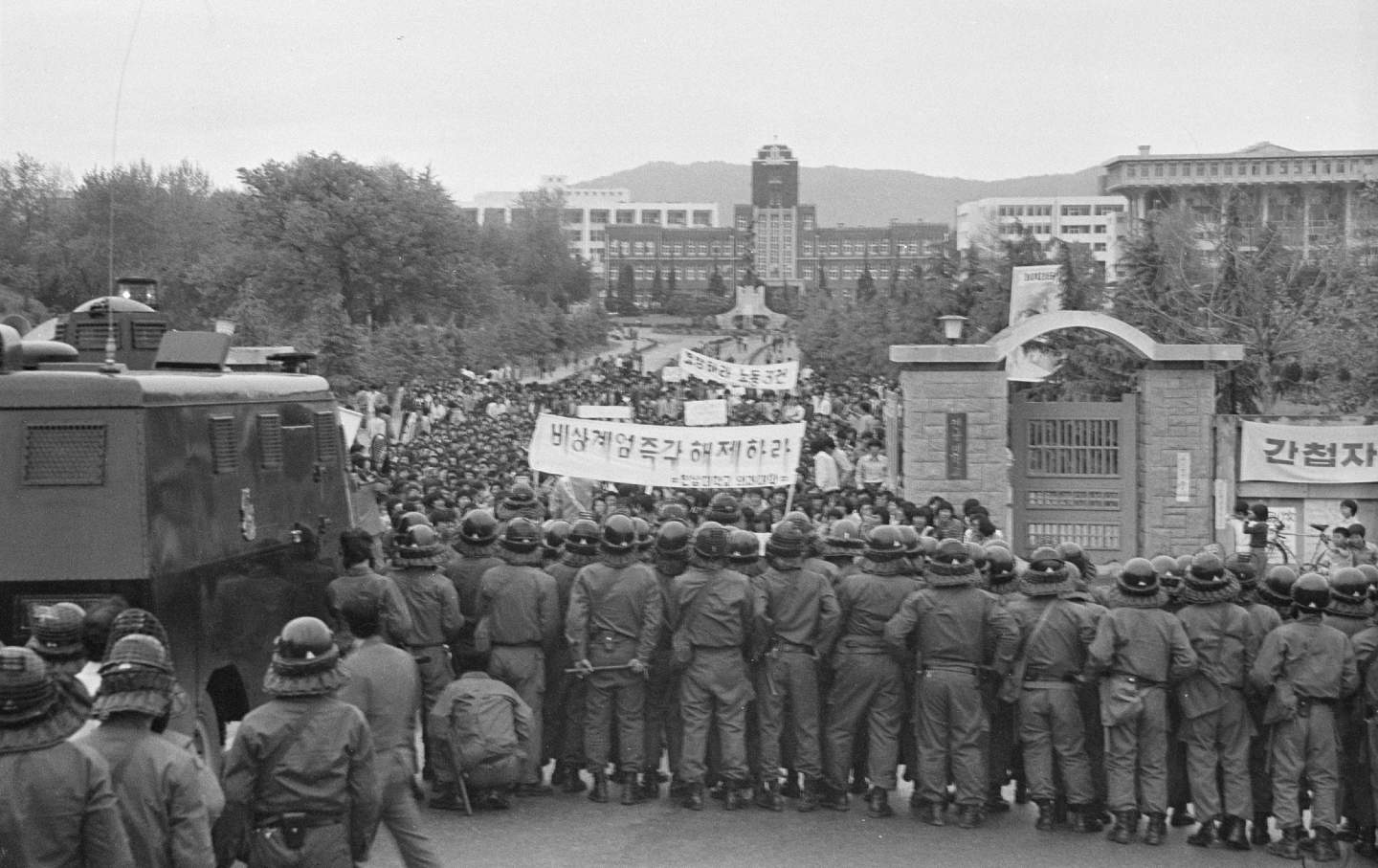
In 1980, just behind the entrance of Chonnam University lay a small lake or pool, crossed by a wide bridge. The students used this as a useful place to gather and stand in defiance of the several hundred armed paratroopers confronting them. As their numbers swelled past 10 am, they began to sing and chant slogans. They had successfully stood up to the police all the week before. Things had been peaceable and friendly. Why should now be different?
These were not friendly provincial cops, though. These were not men drawn from the peaceful city, who knew the students, who knew the professors, who lived and worked alongside them in Gwangju every day. These were paratroopers, hard men selected for their loyalty to the regime and their ruthless aggression. More, they had spent the last 6 months in True Heart training: to meet protests with sudden, sharp violence, to break up and drive off the malcontents, and squash any opposition flat before it could organize. The student gathering was all the incentive the 33rd Battalion needed to put its new training into practice for the first time.
When the students started singing, the soldiers drew their batons and charged.
*The Korean historical war epic The Admiral: Roaring Currents covers this time and place in Jeolla history.
** Park Chung-hee’s system of political oppression in the ROK.
*** No, I don’t know why the students decided their week of resistance would run from Thursday to Wednesday either.
**** If only he knew.
 Gwangju Dreaming