5.18 Chapter Eight: Drivers of Democracy

Tuesday, May 20th, dawned with an uneasy tension looming over embattled Gwangju.

The morning was calm. It was overcast and raining lightly. Overnight, the Chun regime had transferred still more paratroopers to the city, bringing the troop numbers up to more than 3,000. They were badly outnumbered by the actively protesting citizens – more joined every hour, angered by the violence of the soldiers – but with the support of the city police Chun was confident that the movement could be stamped out before things got out of hand. At the same time, the chain of command seemed to realize that it had badly miscalculated with the True Heart tactics and was actively taking steps to de-escalate and defuse tensions. In the previous days, the citizens had muttered that the soldiers – most of whom came from outside Jeolla province – spoke with foreign accents and reeked of alcohol on their breath. Today, they noticed, the soldiers were sober, spoke politely, and conspicuously lacked the bayonets they had carried the previous two days.

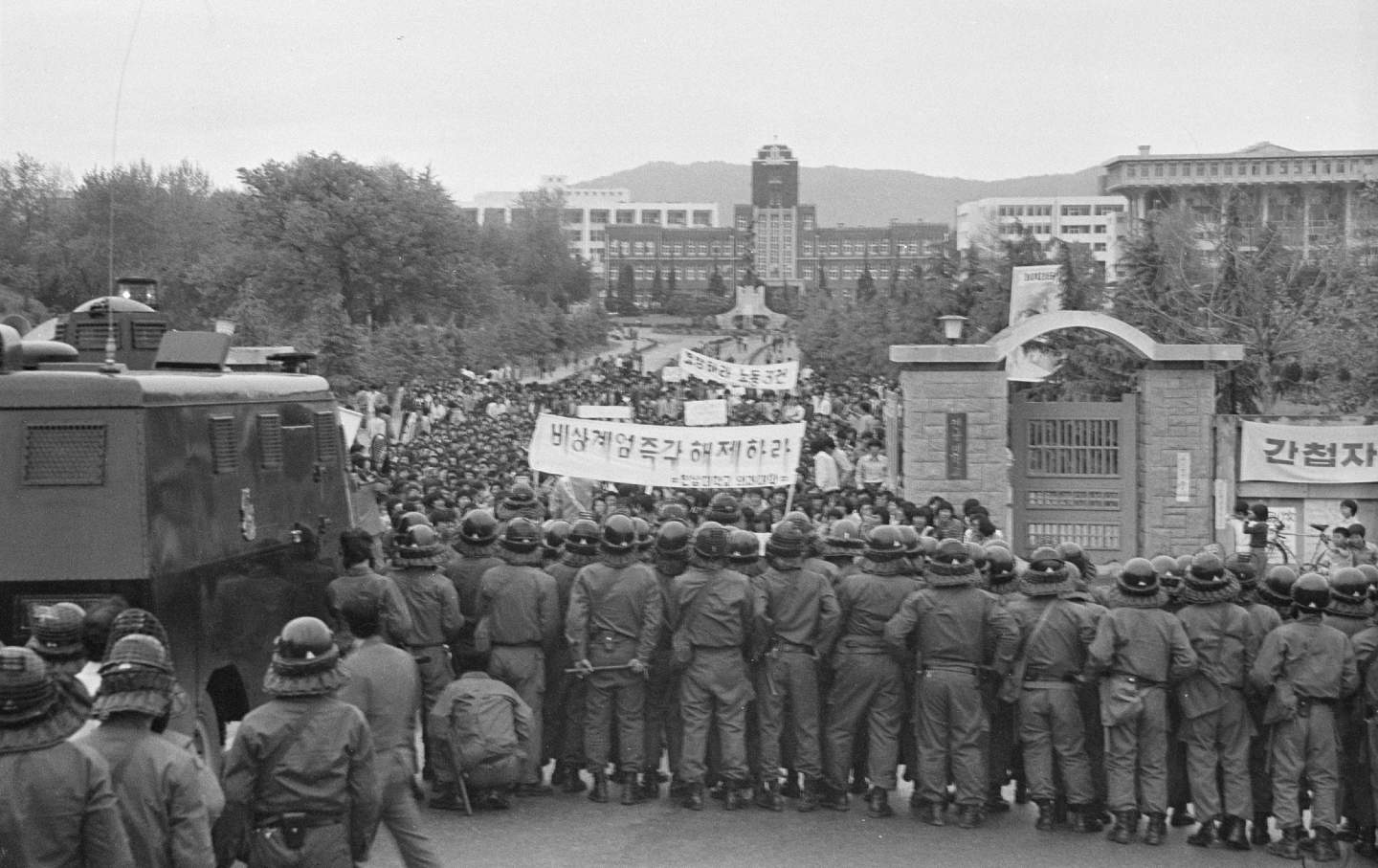
But it was far too late now for mere courtesy to stop things. Events had taken on a momentum all their own, and Gwangju was barrelling towards a bloody confrontation. Away from the main streets, it was quiet. Shops were open, soldiers were absent – the busses were even still running. You could almost forget there was a revolution on. Downtown, though, things were different. Throughout the morning, crowds again gathered on Guemnamno, and by noon there were fully 100,000 citizens filling the boulevard. The rain slackened and was gone by lunch and soon an increasingly nervous line of police and soldiers was eyeing an enormous mass of people. Trigger fingers got itchy. At first everyone contented themselves with shouting and slogans, but as the afternoon wore on again the police resorted to tear gas in an effort to disperse the demonstrators.

The result was a running street battle that in the end lasted more than a day. A pattern developed to the fighting: The police and soldiers would fire gas, then wade in with their batons, driving the crowd back. The crowd would stumble backwards a few blocks. As they did, the crowd would sweep up curious souls who had come out to look at the ruckus, or people who were searching for missing friends and family members. Reinforced, the protestors would sweep back and as the gas dispersed drive the government forces back in turn. Up and down Guemnamno, as the afternoon wore into evening, this continued. 

For many in Gwangju, there was a sense of frustration. The domestic media, tightly controlled by Chun and his cronies, made little mention of the violence in the city, beyond mention of riots promoted by North Korean agitators. Regional resentment ran high – once again, no one much cared what happened in Jeolla, it seemed. No one would have tolerated such violence against the citizens of Seoul or Busan. But those hicks in Gwangju? Probably had it coming. Everyone know that only a baton could get through their thick skulls anyway. 

In addition, there was confusion and dismay about the role of the United States. For many protestors, the endgame depended on US intervention. The Americans supported democracy, loudly, and had constantly reigned in the excesses of Seoul before. When they saw what Chun was doing to the people of Gwangju, they would order him to put a stop to it, and Chun would have no choice but to comply. And yet…three days in, and the US had still done nothing. No soldiers had come to protect the citizens.

They concluded, naively, that the US most likely simply didn’t know enough about what was happening in the city. This impression was largely correct. There was only one American official in the city – David Miller, who worked at the American Cultural Center. The Embassy in Seoul had ordered him to remain indoors for his own safety. Shut away in his office, he knew little about what was happening in the streets outside, and only fragmentary reports of violence and bayonetings of students by paratroopers reached the embassy. Official Korean sources downplayed the violence, as mentioned. The atmosphere in Seoul was sullen and tense, but non-violent, and so through these days the embassy missed the significance of the developing events in the southwest.*

The citizens could, at least, take matters into their own hands regarding domestic news. Some began to print and distribute leaflets of their own around th city, countering the regime propaganda. Yun Sang Won had previously been a teacher of night classes. Now he put his writing skills to good use, writing and distributing these “Fighters’ Circulars”, which served to unite and inform most of the protestors. Yun would be among those killed during the fighting.

Tear gas on Guemnamno

The climax on May 20 came at 7 pm.  By early evening, the city police had been deserting to the side of the protestors in droves and the paratroopers had been driven back into a tight cordon around the Provincial Office itself. They held their perimeter there, for awhile, terribly outnumbered but much better armed than the protestors, who had no real way to break through their lines, no heavy equipment of their own. Then, in the distance, both sides heard a horrible din, loud of enough to drown out even the noise of the crowd. It was honking – the sound of hundreds and hundreds of bus, truck, and car horns repeatedly leaning on the horn, over and over again. It was loud, and growing louder, and soon, behind the crowd, headlights became visible – hundreds of headlights, all moving steadily towards the Provincial Hall. The drivers of Gwangju had chosen a side. 

Taxi drivers had been instrumental throughout the early days of the uprising. Their little cars were indispensable, shuttling protestors back and forth, delivering supplies, and, most importantly, carrying the wounded (and dead) to hospitals for treatment. The job was not without risk, as some of the soldiers didn’t take kindly to the wounded being treated. Their policy had generally been to leave them lying in the street while they pushed on in search of more heads to break, more arrests to make. So, some drivers had been assaulted and injured as they attempted to carry off the injured for aid. 

This did not sit well with a small group of cab drivers (again, I share names when I have them. English sources are so spotty and unreliable). They sent word flashing out along the driver network, calling for an assembly of all the cab and bus drivers of Gwangju at Mudeung Stadium, one of the largest outdoor venues downtown, a short drive from the battle on Guemnamno. As the sun sank towards the horizon on May 20, hundreds assembled – the parking lot was filled with dozens of busses and hundreds of cabs. The cab drivers spoke persuasively, arguing that the drivers of the city could no longer remain neutral. The soldiers wouldn’t let them. They had to pick a side and fight for their rights, just as much as the students did. 

A few minutes later, a massive convoy departed from the stadium. They drove south, down what is today Gwangju’s Baseball street, a quiet avenue lined with plaques and portraits celebrating heroes of the Kia Tigers. A few blocks later, the convoy, city and express busses in the lead, taxis coming behind, turned left and advanced towards the still-surging crowds and violence around Provincial Hall. In the early twilight, they switched on their headlights, and leaned on the horns. The din could be heard for miles around, it is said. 

As the convoy eased through the crowd of protestors, the citizens celebrated, waving flags, leaping among the cars – one brave young man even mounted the lead bus as they drove straight at the paratroopers. A photographer caught him, standing there, preserved for all time as one of the most iconic images of the Uprising. 

It was not without risk. The soldiers fired more tear gas at the drivers. Some vehicles lost control and drove through the cordon of troops. The paratroopers smashed at the headlights with their batons, dragged drivers out and beat them. When the drivers kept coming, one or another of the jumpy troops finally lost his nerve. He leveled his rifle, and opened fire. The first shots of the uprising had been fired.

Smashed and ruined vehicles after the vehicle demonstration

Among the drivers that day was Kim Pong-man. A quiet, middle-aged man, Kim worked for the Hyundai Transportation Company. He had been transporting the injured to hospitals for days now. At the moment, he lived alone – his mother in law had just died, so his wife was out of town with their two children, a 3-year old and a 1-month old. He kept in touch with his landlady to let her know when he was going out into the chaos, in case anything happened to him.

Kim had attended the rally at Mudeung Stadium, and he was afire with determination for the cause. It wasn’t right, what the soldiers were doing. He’d tried to live quietly, to keep his head down and out of politics – but people were dying now, and Kim could sit out no longer. He had never been a great man. He never would be a great man – the councils of the wise and mighty would never be troubled about the life of one bus driver in one small city. But he didn’t have to be great to do this. When the convoy left, Kim’s bus was in the lead. 

That night, Kim never called in to report to his land lady. 

His wife rushed home when she heard. It took her more than 3 days to slip through the complex network of roadblocks around Gwangju and enter the city, which by that time was under a full state of siege. How she navigated that journey with a toddler and an infant in tow must have been an epic in itself – but the details, sadly, are known only to her. What is known is that when she returned on the 24th, she found Kim’s body already placed in a coffin, in a gymnasium with the other dead across from the Provincial Hall. He had been shot. Kim’s memorial record states,

“After confirming he was dead, she wailed, venting her resentment. Nothing could completely rid her of her sorrow short of her desire to follow after her dead husband. But her two children were too young for her to do that…Whenever she is reminded of the uncertainty of life, Mrs. Kang Song Sun, who has lost her husband, goes with her two children to the [5.18 Memorial] cemetery.” 

– 5.18 Memorial Foundation

 Kang Song Sun was not the only one wailing that day. Around the city, sporadic gunfire had broken out as isolated pockets of troops were overwhelmed by protestors. There were shootings at Chosun University, and at the Tax Office. At the train station, the soldiers killed two more protestors and left their bodies to rot in the building. 

Mourning the dead.

The protestors themselves were rapidly becoming more organized and fighting back. Young men in Korea are universally conscripted, and so most of the young male protestors had army experience. These veterans became rallying points, organizing small groups of people and leading them to strategic points, fighting back with whatever weapons came to hand – bricks, stones, vehicles. That night, the fighting in the city was general. Key supports of the regime – the television stations broadcasting propaganda, the tax offices, government administration buildings – were targeted and burned. The paratroopers were safe only moving in large groups, and gradually overnight they were increasingly driven solely into the blocks around the Provincial Office downtown. Fires blazed all around town, and the sound of gunfire was general. Gwangju was in a state of full insurrection, and outside the city the army was already putting into place roadblocks to cut the unruly city off from the rest of the country.

Regime troopers confront a barricade of busses across Guemnamno

The intervention of the drivers was a decisive moment in Gwangju – for many, it was the moment that it went from the May 18 protests to the May 18 Uprising. An entire profession and social class had abruptly thrown their weight to the side of the revolution – in so doing, they made the uprising general. No longer was it just a matter of students and ordinary citizens caught up in the whirlwind. Now the common populace increasingly joined, so that the evening of May 20 saw most of the population in arms against the soldiers. Today, May 20 is remembered as Drivers of Democracy day in Gwangju. They paid for their intervention – the drivers made up 14% of all the dead during the Uprising, most from this single demonstration.

The situation for the regime was extremely precarious. There were no more reserves immediately available to reinforce the paratroopers already in Gwangju. Any further troops would require drawdowns elsewhere – which would in turn create the danger of uprisings in the cities with weakened garrisons, or would require US approval to move troops guarding the DMZ. Publicly, the military command remained defiant, and would make every effort to hold the city the next day. Quietly, though, they began to draw up plans for a full-scale abandonment of Gwangju.

*The US also had a lot on its plate at the time. Around the same time that the paratroopers started bayonetting college students, Mt. St. Helens, in northwest Washington, dramatically erupted, killing some 50 odd Americans in the most deadly volcanic eruption in American history. Most American news networks were occupied with the domestic news and had no time for protests in an obscure Asian city halfway around the world. 
5.18 Chapter Seven: The Student Uprising

It takes a special sort of man to become a paratrooper. You need to be strong, to carry the amount of gear necessary to survive jumping into an environment with lots of bad guys who are very unhappy with your presence and more than willing to solve that particular problem with lots and lots of bullets. You need to be independent minded, since there’s a fair chance your commanding officer will land three counties over and now whose job is it to decide what to do about the squad of Nazis hiding on the other side of the hedgerow, eh? You need to be slightly crazy, since you are, after all, jumping out of an airplane armed only with what you can carry and essentially surrounding yourself and basically just hoping that the ground guys will get to you before you’re all shot or captured (which will take a week, tops). 

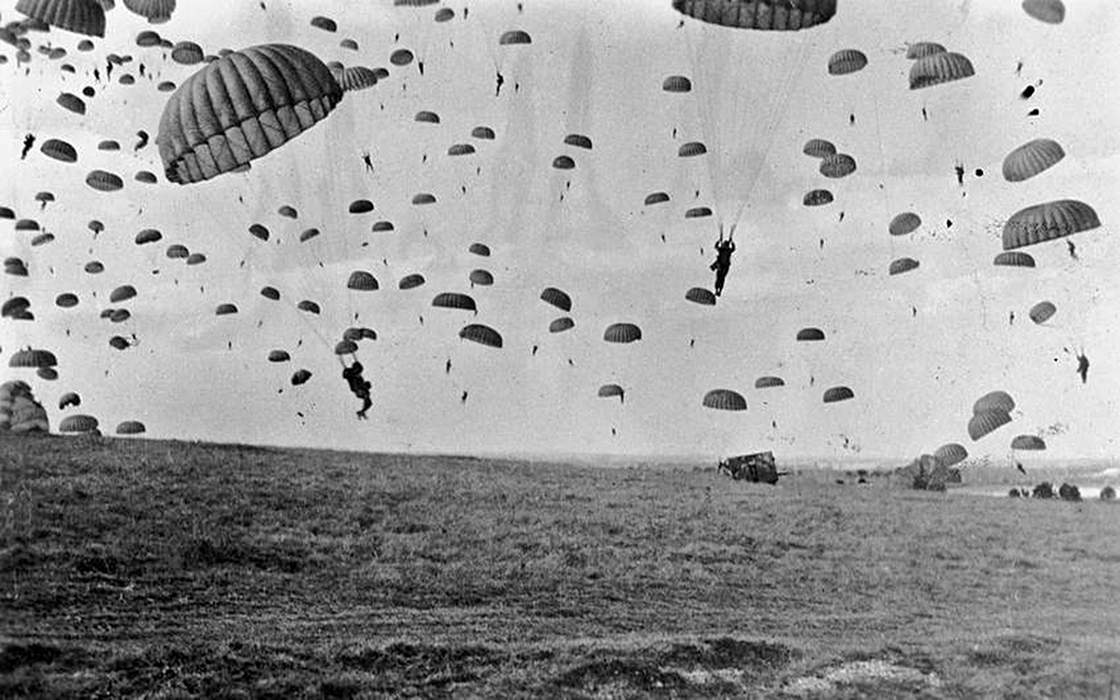
The paratrooper was developed in the days leading up to the Second World War, as strategists racked their brains to come up with ways to avoid the bloody stalemate of the Western Front. Some egghead had the bright idea of flinging guys out of airplanes to raise hell generally behind enemy lines. Possibly to his great surprise, men actually volunteered for the duty. Initially, paratroopers were initially used mainly as distraction forces in support of larger offensives, the theory being that a lunatic dropping out of the sky and doing his best to murder you was generally pretty distracting.* The Nazis used paratroopers to launch surprise attacks on defended islands like the Netherlands behind its flood barriers in 1940 and in Crete in 1941. After this, their use of paratroops generally fell off, for the significant reason that most of Germany’s paratroopers were now dead. Oops. The Allies made somewhat more cautious use of their paratroops, using them to pave the way for attacks in Sicily, in Normandy, and in the Netherlands.

Paratroopers in Holland, 1944

Following the war, the advent of the helicopter made the continued use of paratroops more or less obsolete,** and most countries abandoned their use. Not the Republic of Korea, though. Initially, they hadn’t had the helicopters, and Park Chung-hee had seized power partially through the use of paratroopers. He had a fondness for the units, then, and made the ROKA paratroop brigades a sort of Praetorian Guard. Chun Doo-hwan employed them in the same fashion. 

Thus, in Gwangju that May, the troops charged with occupying the universities were the men of the 33rd and 35th Battalions, 7th Parachute Brigade. The Brigade fielded 885 men in 2 battalions, to pacify a march that the previous day boasted 50,000 participants. Now, the troopers were good, but I’m not certain they were 50 to 1 good. Standard Korean doctrine said one policeman could handle about 4 protestors. But the Brigade was confident. They were large, tough, well-trained, aggressive, and just slightly crazy. They had been trained for months to go after protestors like rabid dogs, and now they were given the go-ahead to break faces. Putting them opposite unarmed but stupidly brave college students was a recipe for bloodshed.

This was the students’ first encounter with True Heart anti-riot tactics and they were shocked that their peaceful march was so swiftly met with aggressive violence. The soldiers of the 7th charged in, striking out with batons, rifle butts, even bayonets. The exact numbers of student protestors I do not know – some of my sources have said ~200, others have said as many as 500.*** However, the 366 men of the 33rd battalion had more than enough numbers to do the job. There was brief but bloody fighting and the students were driven off, with 10 injured.

The first confrontation at Chonnam. I have to say, it looks more like 500 or even more than the reported 100 in some sources.

This might also be from the confrontations in the week prior, and those would be riot police instead of soldiers.

The word “injured” can gloss over a lot there. This isn’t a black eye or a bruise on the knee. The paratroopers’ method was to grab their victim, beat students over the head with a heavy ash baton about 18 inches in length, and then give them a solid kicking for good measure once they were on the ground. The May 18 Archive says that blood literally “pooled in the streets” in the wake of the martial law forces. 

If the students had stayed scattered, things might have ended there. Chun’s coup of May 18 would go down as just another dimly remembered episode in a long history dimly remembered authoritarian episodes in the history of the ROK. The soldiers had occupied universities in every city in Korea. In none of them did they face any resistance at all. Except in Gwangju. The new tactics there had scattered the protests inside an hour, though.

Except the students didn’t stay scattered.

As they fled, news spread by word of mouth to regroup at Gwangju Station, the city’s main train terminal a few blocks north and west of the campus. Several hundred students were already gathering at the plaza there. Around noon, May 18, the victims of the initial confrontation at Chonnam arrived, bringing word of the bloody confrontation. The students were shocked at the aggressive tactics of the military, and decided to carry out another protest march to the Provincial Office on Guemnamno. They set out and marched south, then turned east along the boulevard to head towards the Provincial Office a few blocks away.

In the meantime, a few blocks west of the demonstrators, bus after bus full of army troops was pulling into the Gwangju Bus Terminal. The terminal sits squarely between City Hall in western downtown Gwangju and the Provincial office, in the eastern portion. Early that afternoon, Linda Sue Lewis, an American law student, arrived at the station.

She looked around in bewilderment at the masses and masses of soldiers filling the station as she arrived. Lewis had been living in Gwangju for several months, studying the actions of Korean civil court judges as part of a study abroad program. She lived with a family in a small home in the city and she had never seen so many troops – not even in Seoul, where she was newly arrived from. She had gone there to give a lecture on Friday and had seen the massive student demonstrations, and was sad to leave the center of political action in Korea to return to her peaceful southwestern city. But all these soldiers made her uneasy. She heard rumors of unrest a few blocks away, near the Provincial Office, and she nervously hurried home.

Also at the bus station that afternoon was a young man, Kim Gyeong-chul. In his photos, Kim appears as a serious, dignified young man of 28. He wears a suit and a dress shirt, and his hair is neatly cut – perhaps longer than the fashion today, but not the wild manes many of the students sported. In his day job, he was a shoe salesman. His free time he spent volunteering as administrative officer for the Gwangju Committee of the Deaf & Mute. Kim himself was deaf and mute, since childhood – the result of a bad reaction to some medicine he had been given.

A portrait of Kim Gyeong-chul

Kim was at the bus station that day to see off his brother in law, who had been visiting from Seoul. It’s possible he also looked around, and saw the numbers of soldiers pouring in. But Kim didn’t head straight home. It was a beautiful Sunday afternoon, and he paused for lunch with some friends first. He then headed down Guemnamno to rejoin his young wife, mute herself, at home. 

As Kim headed down the road, hundreds of miles away, worried military men were meeting at Army Headquarters in Seoul. Major General Kim Jae Myeong, head of Operations, had listened to worried telephone reports from his field commanders in Gwangju that morning. The 7th was the only unit in the entire country that had met resistance. Remembering the massive demonstrations reported from Gwangju in the previous days, General Kim was anxious that the paratroopers might not have the manpower to fully suppress things if they – well, if things to out of hand.

Shortly after lunch, he telephoned General Jeong Ho Yong, head of the Special Combat Unit, that “they had decided to dispatch the 3rd Special Combat Brigade as reinforcements because there were indications that the situation in Gwangju would take a turn for the worse.” Jeong protested – such work was not for his special combat troops. Why not send the 11th Paratroopers instead? Since the two 7th Brigade battalions were paratroopers themselves, it would help maintain cohesion if they were reinforced by paratoopers. Kim agreed, and the 11th was mobilized shortly after 3 pm. By the next morning they would be deployed throughout Gwangju.***

Back in the city, early in the afternoon the 7th had pulled out of Chonnam and regrouped at an elementary school a few blocks away. They were briefly confronted by students chanting slogans (university students, not 4th graders!), but the soldiers quickly and aggressively drove them off again. Then word reached them of the students marching down Guennamno for the Provincial Office, and the unit moved south to intercept them short of their goal.

The confrontation came around the Catholic Center, a few blocks west of the Provincial Office. The soldiers, now en masse, came upon the group of students, and immediately set upon them. They charged in, beating, kicking, dragging people out to be tossed into the back of waiting military trucks. Most people detained were given a thorough working over before being stripped to their underwear and arrested.**** 

The thing is, Guemnamno is a very, very busy road. It’s the main thoroughfare in the heart of Gwangju, in fact. It is lined with shops, restaurants, an underground shopping mall was then under construction, and most importantly, it was filled with ordinary citizens. Hundreds of passersby were going about their day in this public place – but the soldiers did not discriminate. Anyone their glance fell on was liable to attack and arrest, especially anyone of university age. Soon, dozens of bystanders were sucked into the melee whether they were protesting or not.

Into this swirling mass of escalating violence came Kim Gyeong Chul, now walking home from his lunch. He was deaf, and unable to hear the commands of the soldiers or the warnings of the passersby. He was mute, and so he was unable to explain himself. Worst of all, he was young – he looked young enough to be a student himself. 

A group of soldiers roughly seized Kim and dragged him into the street. Confused, Kim attempted to plead his innocence – but of course as a mute he could hardly do that. The soldiers grew increasingly agitated as they peppered Kim with questions he was unable to answer, then, when their rage reached a peak, began to beat him. He fell, and they began to kick him, then stomp him. The claims that he was deaf and mute were obviously a lie so he could ignore their orders, so he could disguise his participation in this sedition of the regime. 

When Kim did not return home that night, his wife and his mother, Im Gun-Tan, went out the next day to look for him. Im canvassed the military prisons, now bulging with hundreds of detainees, while his young wife (whose name I do not have, I am sorry) searched the hospitals. It was late before they found him – not in a hospital, but in a morgue. Im later recalled,

“He had been beaten like a dog and his eyes has been gouged out. He was naked and covered in just a white sheet when I first saw him at the military hospital mortuary. When I returned with some clothes, I caught sight of a guard hosing down the corpses while another recorded their names.”

Im Gun Tan, “Gwangju Biennale honours sacrifice that brought democracy to South Korea”

Kim was the first recorded death in the Uprising. Today, his grave stands first in line of the hundreds at the memorial cemetery. His neat, dignified portrait, surrounded by flowers, still smiles out at the plaza there.

Kim Gyeong Chul, 1952-1980

The military’s indiscriminate response, though, was perhaps the greatest strategic blunder anyone had made in the entire crisis. Rather than intimidating the people of Gwangju into silence, the brutal suppression instead had the opposite effect. After years – decades – of subjugation, the people of Gwangju had had enough. Suppression of democracy, they could accept. Neglect by the government in Seoul? What else was new, the bastards never changed. But now, to be murdered walking their own streets? It turns out you can only push a people so far before they snap, and start to fight back.

The melee in front of the Catholic center was only the start of a running street battle that lasted the rest of the afternoon and into the evening. First at the Catholic Center, then by 5:30 at the Labor Bureau next to the Provincial Hall, then by 7 at Gwangju High School, and at 8 again at the Catholic Center. The demonstrators never numbered more than a thousand, usually closer to around 500, but more and more of them were no longer students but instead ordinary men and women, people whose silent consent had been one of the key supports of the Rhee, Park, and now Chun regimes. 

The troopers were indiscriminate. They pursued “agitators” wherever they could be found. One couple was dragged out of a taxi. The man was beaten, and his young wife had her dress torn off her. Another man was bayoneted, then tossed into a police van, still bleeding. An American, Tim Warnberg, was in the city. He had volunteered with the Peace Corps. He describes his experience:

“We ran with the panicked crowd and I ended up in a small store along with about fifteen other people, including one other PCV. A soldier came into the store and proceeded to club everyone over the head with his truncheon until he came to the other volunteer and me. He stopped startled, hesitated a moment, then ran out. We went out into the side street and found that the troops had retreated to the main street, leaving behind wounded people everywhere. . . . Two volunteers and I picked up a delivery boy for a Chinese restaurant who had been knocked off his bike with a blow to his head. We brought him to a clinic and managed to convince the reluctant doctor to open his door. He said he feared retaliation from the military. Other wounded people ­filled the streets and tried to push their way in, but he only let about ten people in before he locked the door again. People banged on the door cursing and screaming.” 

-Tim Warnberg, Recovering the Memory of 1980

At a nearby hospital, Ahn Sung-Rye, a young nurse, was beginning her afternoon shift when suddenly bodies started pouring in the doors. Mostly young men, all bloody, many of them limp and unresponsive. As the casualties mounted, the hospital descended into chaos.

“There were bodies strewn across the corridors and mothers screaming as they searched for their children, but it was so chaotic, there was nothing I could do to help them,” she said. “We didn’t even have time to sterilise the medical instruments before taking patients into surgery.”

Ahn Sung-Rye, Gwangju Biennale

In other places, soldiers kicked down doors. Eun-cheol Jung was a secretary in a nearby office when soldiers burst in and beat him and two companions (including an unlucky delivery boy). When Jung fell limp and unresponsive, the soldiers hurled him down the stairs. Lee Jae-eui, whose Gwangju Diary***** would become one of the best testaments to the massacre, escaped only by seizing a hammer and hiding amongst a group of workers at the underground mall construction site. Other witnesses at the bus terminal saw a group of students being held for arrest. Suddenly, one young man leapt up, screaming, “Feet, don’t fail me now!” and he fled into a nearby market, cheered on by passersby. The soldiers, frustrated at the loss of one of their prizes, fell on the rest, beating and kicking – and were in turn set upon by the bystanders. By the day’s end, the protestors were fighting back across the city, hurling rocks at the paratroopers. 

Things were getting out of hand (obviously). The city-wide curfew was extended from midnight to 4 am to 9 pm to 6 am. More reinforcements were hurried on the way. Gwangju passed an uneasy night.

Monday, May 19 dawned with an air of stillness and anticipation over the city. People were shocked by the violence of the day just passed, but were uncertain what would come next. Cautiously, in ones and twos and threes, they poked their heads out of their apartments and began to venture into the streets to feel out the situation. Lewis, the law student, wrote in her diary:

“They’re killing people down here today—again. Lots died yesterday, too, al though I didn’t ­find out about it until today. After all the gas and ruckus in Seoul on Thursday, then nothing on Friday and Saturday, then the an nouncement of more martial law on Sunday morning—Seoul was quiet. But Kwangju….today I knew something would happen—the streets looked tense. Started at 11 a.m. for the ACC [American Cultural Center], got as far as the street where they are building the underwalk, and it was blocked by soldiers—not riot police, special forces soldiers. People were going through and crowds were gathering, but I decided not to venture forth.”

Linda Sue Lewis, Laying Claim to the Memory of May

Again, people began gathering on Guemnamno. By ten in the morning, nearly 3,000 people had gathered – far more than had been present at any one time on May 18. Word of the brutal suppression of the previous day’s protest had spread, though, and the crowd was in a restive, angry mood. Most worrisome for the regime – there were a minority of students. The protests had spread to the common people and were in danger of becoming a widespread democratic uprising, if not suppressed. 

Commanders of praetorian guard units like the 7th Parachute Brigade are not chosen for their imagination. Imagination might mean imagning yourself sitting in the Blue House after a successful coup, after all. No, they were chosen for their loyalty and their adherence to orders. The man in charge of the 7th – again, I regret that I do not have his name – was evidently a man of no imagination. His heavyhanded tactics of the day before had so far only succeeded in murdering harmless young people and enraging the whole city against him, more or less the opposite of what his superiors had asked him to do in Gwangju. Today, he decided the best way to handle matters was, well, with more suppression. Near 11, the soldiers started unleashing tear gas and batons to disperse the “rioters.”

But the rioters would not be so easily dealt with. They were angry, and not going to lie down for the dictator anymore. The crowd fought back, with taunts and with stones, and the confrontation swayed back and forth over Guemnamno for hours. The stalemate was broken when the 11th Brigade, ordered in from Seoul the previous afternoon, arrived. More than a thousand paratroopers reinforced the outnumbered 7th, and again the soldiers began an indiscriminate assault on the citizens they had sworn an oath to defend. Again, the soldiers poured into private homes to ransack the places. Any young man they found was beaten, stripped, bound, and tossed into a truck to be hauled off to military prison. The wounded poured into the hospitals. 

In Seoul, the nervous authorities were – sort of – aware of the situation. They ordered a news blackout – only scattered references to “riots” in Gwangju were made. The 7th and the 11th were two of three brigades in the 31st Division (nominally, although they answered directly to the New Military Power). The last brigade, the 3rd, was alerted early in the morning on the 19th to move to Gwangju. The commander of the 31st, concerned by reports of brutality by “his” paratroopers, issued an order advising the division to avoid bloodshed. However, neitehr the 7th nor the 11th were actually bothering to report to him, so you can imagine how effective that order was. At the same time, the New Miltiary Power instructed the brigades that “a resolute blow must be delivered.” They must prevent the escape of the demonstrators, divide them, and arrest them at an early stage. The fact that they deluded themselves into thinking that these orders were in any way possible shows how out-of-touch the national command authority was growing with the situation in Gwangju.

In fact, most of the country knew nothing about it. The NMP had acted quickly to isolate the region. Phone lines were cut, media reports were censored, and travel to and from the province was restricted. Americans telephoned the consulate in Seoul to let them know they were safe, while the bewildered ambassador hadn’t known there was any violence at all. Some people were able to call their relatives, but most had no idea of what was happening. People in Jeolla were stunned and heartsick at the news. 

In Gwangju, the people were shifting from defending themselves against the paratroopers to taking the offensive against the occupiers of their city. Barricades (which have a long history in urban insurrection that I will get into another time) started to go up around the city. Small police stations were isolated, overwhelmed, and burned. The local TV station, which had been busily broadcasting regime propaganda of seditious traitors and North Korean infiltrators, was forced off the air by expedient of being burned to the ground. 

Dozens of buildings associated with the regime burned in Gwangju in those days.

Across the city, the students who had instigated the revolt were by now largely forced into hiding. Three high school students, unable to safely return home, took shelter with the law student Lewis’s host family. In typical Korean fashion, one girl lamented that she’d be unable to study for her exams and would fall behind her classmates in other parts of the country. Other student leaders similarly would law low for most of the next 10 days. The uprising had passed now from a student movement to a democratic movement embracing the entire populace. 

In years to come, the military would recognize that it had blundered horribly in these two days in Gwangju. They would issue an analysis detailing their mistakes, which had taken a serious but manageable movement of students and inflamed it into full-scale urban insurrection. The army concluded that the citizens in Gwangju had fought the army so defiantly because:

“The Martial Law Forces attacked people from all sides rather than simply breaking them up, violent clashes took place in front of bystanders, they entered private residences, destroyed private property, and intimidated family members while chasing demonstrators. These actions all served to incite the crowd into a primitive passion. …the army was [also] slow to deal with both the casualties and the arrestees incurred during the suppression of the riots and left the dead in the road for a long time. These scenes further incited the crowd.”

An Anaylsis of the Gwangju Disturbance: A Collection of Lessons

Good thing the United States would never make such egregious mistakes. Oops, was that too political? Sorry. 

Next time: the protests became city-wide. 

*The theory was correct.

** By dropping men from a helicopter instead of a plane, you can deploy them in coherent units trained to work and fight together, instead of scattered all to hell and back. Plus, you can pick them up again before they’re all murdered by Nazis, a capability the 1st Airborne Division at Arnhem would have found highly useful indeed. 

***A note here. My sources are very vague and difficult to make sense of at this point. Lewis wrote that police only had handled the earlier protests, and that military units were not dispatched to the city until later in the afternoon. The May 18 Archive’s book also claims that the 7th did not arrive in Gwangju until the afternoon. However, the Archives also clearly write that the students at Chonnam in the morning were confronted with soldiers (although the exact number is reported differently – some say only 30 soldiers, about 1 platoon, were there, others claim the entire battalion was present). The Archives’ book also erroneously reports the 7th brigade being dispatched to Gwangju over the evening of the 18th when they clearly are referring to the 11th. How to make sense of this? My own belief is that initially the soldiers were only at the universities, and perhaps in lower numbers – in keeping with Chun’s order to close the universities. They did not, however, enter the streets to deal with those protests, leaving them initially to the police. Only when things continued to grow out of hand did the 7th, now at full strength, enter the streets and begin to take a direct hand. This is my best reconstruction of events – remember I can’t read Korean so 95% of the May 18 material is unavailable to me! Any errors are mine alone. 

**** Humiliation is a frequent tactic of control used by authoritarian regimes the world over. Cf. similar incidents recently in the United States. Female students were included in this treatment, and there are reports of sexual assaults and rapes by the soldiers. Some accounts say that people attempting to come to the aid of women being abused by the soldiers were themselves beaten bloody and detained. 

***** Regrettably the English edition is out of print and can’t be had for less than $200, so I was unable to use it for this work. 😦 Maybe a second edition, someday. 

5.18 Chapter Six: City of Light

More than 200 miles south of Seoul, the Taebaek mountains, the great spinal mountain range that runs down the entire eastern coast of the peninsula, throw out a massive spur. A line of monoliths leaves the company of the larger chain and meanders off into a dead end in southwestern Korea. This baby range, the Soebaek mountains, divides the southwest into a land of broad valleys separated from each other by the high mountains. The hills are high and forested, dotted with old temples and monasteries as Buddhists sought to distance themselves from the world. The valleys are broad and terraced, covered in rice paddies and small farms. It is the sleepiest, most rural province in the Republic of Korea. This is Jeolla province. 

Damyang

The wide and shallow Yeongsan river winds lazily through one of these valleys. It rises from the little streamlets that run along the slope of Mount Byeongpung, flows through the bamboo forests outside Damyang, and swerves and curves and switches its way down the valley to the Yellow Sea. More than a thousand years ago, where several little rivers join the gentle Yeongsan, an anonymous peasant saw this ground and thought it would make a fine farm for him and his family. Others agreed, and the farm grew into a hamlet, the hamlet into a village, and ultimately, into the largest city in Jeolla. At some point, people began referring to the city along the Yeongsan as the “Province of Light” – in Korean, Gwangju. 

Gwangju and Jeolla had always been the neglected backwater of Korea (itself a backwater, remember, to the rest of the world). There were few great wars or battles in its history (thank goodness), apart from a brief flurry of excitement when Japanese marauders attempted to maraude through the dense array of tiny islands splayed like water droplets along Jeolla’s coast.* When the Japanese returned 300 years later – this time with battleships and bolt action rifles – Jeolla had been the scene of a brief but brutal peasant uprising in resistance to the invaders. 

Perhaps it was then that Jeolla began to develop its reputation. See, Jeolla today has the reputation of marching to the beat of a different drum. Things are different there than in the rest of Korea. Perhaps it was because of the centuries of neglect? As the Japanese solidified their hold and pursued further imperial glory in distant Manchuria, most traffic on the peninsula ran from the beautiful deepwater port at Busan in the southeast up the roads and (later) railroads to Seoul, and from there through the northern coastal plain and on into China. Jeolla was ignored and neglected, apart from a small Japanese garrison in the port city of Mokpo. 

Again, the Miracle on the Han River. Look at how much more densely lit the southeast is compared with the southwest.

Things hadn’t gotten better for Gwangju in the decades since independence. Rhee had been caught up in palace politics in Seoul and never really bothered to develop the republic he dominated. And Park? Well, Park was from the region around Busan – Gyeongsang. Since ancient times, when they were not known as Jeolla and Gyeongsan provinces but as Baekje and Silla kingdoms, the two regions had been rivals. Park lavished his Han River Miracle on his home province. Busan, Daegu, and Ulsan grew into thriving, modern cities. Money and jobs flowed into the southeast, while Jeolla stagnated.

In contrast to Park, Jeolla’s favorite son was Kim Dae-jung, Park’s constant opponent, the one who had nearly beaten Park in 1971, who had been nearly assassinated and forced to flee to Japan. Under the leadership of men like Kim, Jeolla had always been a bit more liberal, a bit more democratic, a bit more critical of the military regime in Seoul. 

Gwangju & Mudeungsan

Gwangju is beautiful in May. The city sits in a bowl, surrounded on nearly all sides by mountains, except the southwest, where the Yeongsan runs (more like meanders gently) off to the Yellow Sea. The trees bloom with cherry blossoms, the city’s many parks and campuses are covered in flowers, and the air is pleasant and warm (when it’s not weighed down with humidity rolling in from the sea, that it is). To the southeast looms the large mountain of Mudeungsan, one of Korea’s tallest, which dominates the city’s skyline. By that May of 1980 Gwangju had grown into the provincial capital and was home to a thriving countercultural scene. The local art was vibrant and not strictly in line with the tastes of the Winter Republic – but as the city on the peninsula most distant from the capital Gwangju was left largely in a state of benign neglect, as long as they didn’t abuse the privilege too flagrantly. In keeping with Koreans’ love of strong education, there were many universities dotting the streets of Gwangju. Of those, the two most prominent were Chonnam University, just north of the provincial capital offices in the city center, and Chosun University, which sat further to the southeast, in the shadow of Mudeungsan. 

The students had been enthusiastic participants in the Seoul Spring of 1980. The fall of President Park and the brief promise of democratic freedom were perfectly in keeping with the unruly spirit of the city. The students began to organize after the December 12 coup. Initially their radical activism was confined to such rebellious activities as organizing their own student government, and demanding the resignation of certain professors implicated in the Yushin system.** Chonnam elected a young law student to lead the student body, Park Gwan Hyeon. I do believe that most political troubles in the world ultimately stems from the actions of young law students.

As the Chun regime battled to maintain its legitimacy that spring, rumors reached the students early in May that the New Military Power was plotting to fully overthrow Acting President Choi and seize power for themselves. The students decided that this demanded a response from them, military dictatorship or no, and the Council decided on fixing the next week – May 8 to May 14th – as a solid week of rallies in favor of democracy, in solidarity with the hundreds of thousands protesting in Seoul. For 7 days, they would confine their actions to campus – which in their naievete the students imagined would defuse potential government charges that they were “destabilizing” the country and opening the door to the Norks – and then on the 8th day, May 15, they would peacefully march down the road a mile or two to the provincial office. 

The week of the rallies arrived, and Chonnam and Chosun students banded together, issuing a joint declaration demanding the end of martial law and pleading to resist any school closures. There was one short confrontation with the Gwangju police, but the officers decided discretion was the better part of valor and backed down. Energized, thousands more students poured out to join the protests. 

May 14, a Wednesday, arrived.*** The enthusiastic students, impatient and not wanting to wait a full day for the off-campus march, successfully lobbied the Council, and at 2:00 that day 7,000 college kids (a drop in the bucket compared to the 100,000 that would march in Seoul the next day) flooded out the gates, through the cordon of riot police. An hour later they were in front of the Provincial Hall.

The former provincial hall, with fountain and Guemnamno. The traffic circle is long gone today.

The provincial hall, center of the administrative officers for Jeolla in those days, sat in front of a large traffic circle. The main street in Gwangju, Gueumnamno, is a long, straight boulevard lined with trees and tall buildings that runs straight to the office. As it approaches, Guemnamno swerves to the left and flows around the hall. Right where the street curves there was a large traffic circle, and in the center of the circle was a fountain. The student demonstrators seized the fountain as a handy speaking platform and spent a while exhorting each other with slogans and rousing speeches in favor of democracy. The citizens of Gwangju, though, were unswayed by the enthusiasm of the young people, and kept away. Eventually, the last speaker’s voice grew tired, and he hopped off the fountain so the group to could wander home. They vowed, though, that if the government tried to close the university they would meet in front of their gates and again march on the provincial hall.

The next day, Thursday, May 15, they did the proper march which they had planned all along. More than 20,000 students and professors from the two universities again trooped off campus and marched to the traffic circle plaza. Everyone agreed it was such a rousing success that they ought to repeat it, and so on the 16th the stunt was repeated – this time fully 50,000 students and professors joined in. That’s half as many as marched in Seoul, in a city a tenth the size of the capital. 

As night fell on the 16th, the massive crowd trooped off in a torchlit procession (my sources do not tell me exactly where they processed, but a likely candidate is a return march to Chonnam’s main gates). The police, badly outnumbered, had not interfered, but rather had supported the marchers, kept the streets clear, ensured there were no violent incidents, and in turn had been treated to water and refreshments by the marching students. Concluding that the whole affair had been a splendid victory, the Council decided to sit quietly through the 17th and the 18th to await the New Military Power’s response.

It was not long in coming.

Saturday, May 17th – as previously described, the streets of Seoul were quiet as the student leaders there were worried about the confrontational turn things were taking with the police. Meanwhile, Chun Doo-hwan and his cronies met and privately resolved that the time was ripe to put down the student movement once and for all. While the students in Gwangju rested on their laurels, orders flashed out from Seoul, and quietly army units began to mobilize around the city. In Seoul, the universities were raided, ringleaders rounded up, and opposition leaders – including Gwangju favorite son Kim Dae-jung – were arrested. It was essentially a second coup. Chun would seize power in a single, stunning blow before the opposition could organize, smash the brats in the streets, and then work out a new Constitution with himself as President For Life. 

That night, special army units – including the True Heart paratroopers, specially trained in new anti-protest tactics – left their barracks. They waited for the cover of darkness, presumably intending to confront the students with a fait accompli. By 2:00 am, Chonnam, Chosun, and most of Gwangju’s other universities were occupied. Prominent members of the Student Council who could be identified and located were rounded up, while others caught wind somehow or another and fled into hiding. Like Seoul, the student movement in Gwangju was now leaderless and totally unable to respond to Chun’s coup.

Or…well, that was the plan. But as anyone who’s ever tried to plan anything knows, no plan survives contact with the enemy. It turned out the Gwangju student movement didn’t need leaders.

Sunday, May 18, a bright, sunny, beautiful spring day in the city, dawned. That morning a small group of students had entered Chonnam campus and tried to access the library. Soldiers turned them away and coldly informed them that campus was closed. Confused and frightened, the students withdrew a short distance to the main gate. Soon, a small knot of students gathered there and began talking among themselves, trying to work out what was going on. It was around this time that the commander in charge of the troops – the 33rd Battalion of the 7th Paratrooper Brigade – decided to put a stop to things before they went too far. He ordered the students to disperse.

It was about 9:30. The students, facing this paratrooper telling them that campus was closed, to go home, remembered the glorious days at the fountain the week before. The plan had been – if campus was closed, gather at the main gate at ten. They glanced at the clock, and refused. 

The commander grew increasingly angry and more florid in his gestures. He warned of dire consequences if the students refused to disperse****. But the kids were unmoved, and they were being reinforced. Others remembered the 10:00 am meetup, and more and more students were flowing in. By now, there were between 100-500 there (my sources differ on the actual numbers at the initial confrontation). 

Confrontation at Chonnam, May 18

In 1980, just behind the entrance of Chonnam University lay a small lake or pool, crossed by a wide bridge. The students used this as a useful place to gather and stand in defiance of the several hundred armed paratroopers confronting them. As their numbers swelled past 10 am, they began to sing and chant slogans. They had successfully stood up to the police all the week before. Things had been peaceable and friendly. Why should now be different? 

These were not friendly provincial cops, though. These were not men drawn from the peaceful city, who knew the students, who knew the professors, who lived and worked alongside them in Gwangju every day. These were paratroopers, hard men selected for their loyalty to the regime and their ruthless aggression. More, they had spent the last 6 months in True Heart training: to meet protests with sudden, sharp violence, to break up and drive off the malcontents, and squash any opposition flat before it could organize. The student gathering was all the incentive the 33rd Battalion needed to put its new training into practice for the first time.

When the students started singing, the soldiers drew their batons and charged. 

*The Korean historical war epic The Admiral: Roaring Currents covers this time and place in Jeolla history. 

** Park Chung-hee’s system of political oppression in the ROK. 

*** No, I don’t know why the students decided their week of resistance would run from Thursday to Wednesday either. 

**** If only he knew.