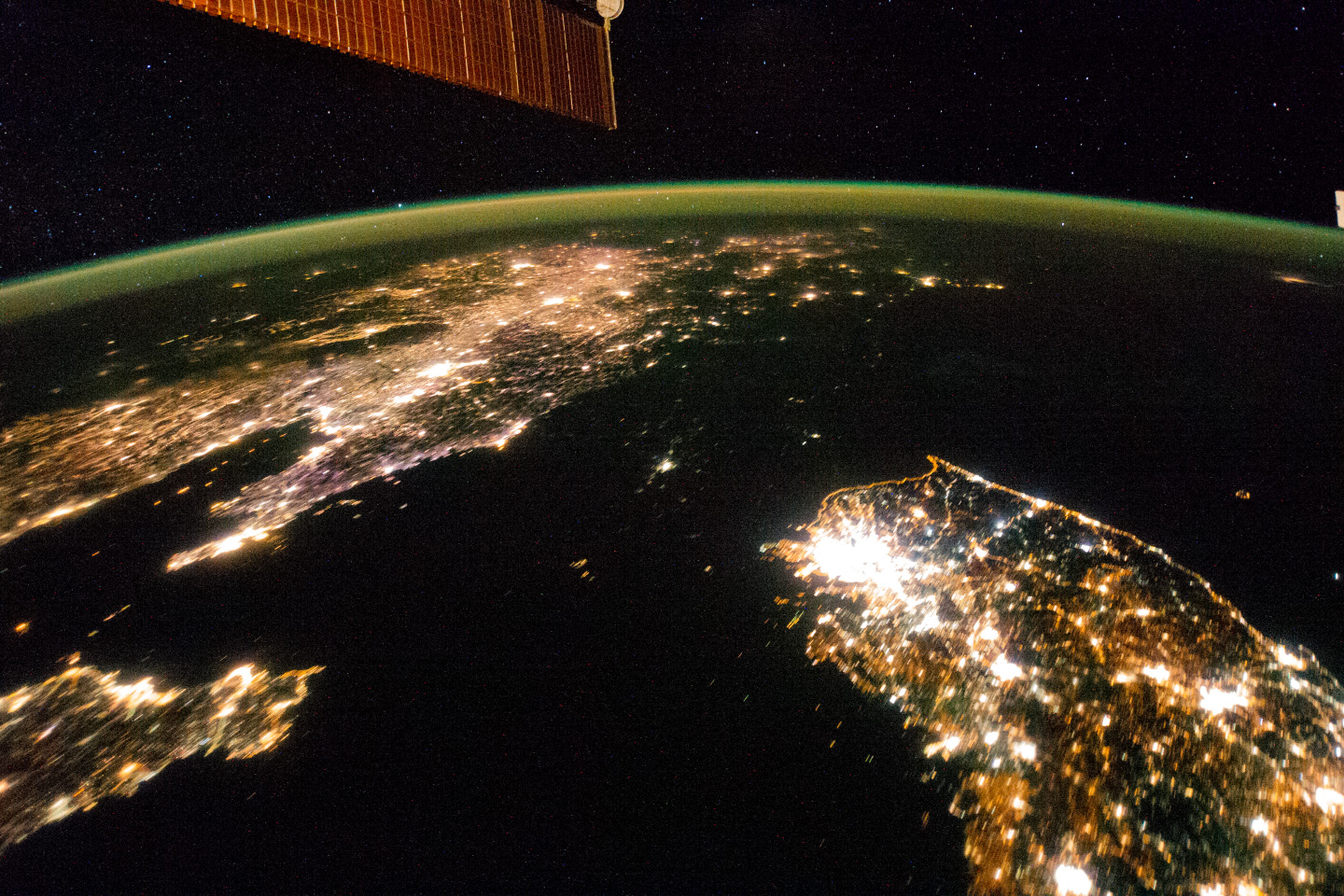
The Korean peninsula at night is one of the most powerful images most people have seen.
In the north, from the Yalu all the way to the DMZ there is only blackness. Nearly 50,000 square miles of blackness, in a nation of 25 million people. Pyongyang alone is visible, a tiny point of light hunched defensively in the middle of the sea of dark, a stark illustration of the haves and the have-nots in the DPRK.
But south of the DMZ…to the south, the Republic of Korea blazes forth. The warm glow of lights representing human enterprise and endeavor spread all over every inch of ground from the Imjin all the way to Busan. Even the most distant mountains are illuminated. And Seoul…Seoul is a shining beacon, almost blinding in its brilliance, representing light and life and energy, a chaotic burst of joy in defiance of the hulking monster to its north. There is no image that so profoundly illustrates the different courses the two Koreas have followed; no clearer example of the stark difference that human freedom can make for a people.
One thing that gets forgotten, though, is that it was not always this way. I don’t even mean that the two Koreas used to be similar (although they were). No, what is forgotten is that in the early years, North Korea was the richer of the two brothers.
That’s right.*
In the years following Japan’s occupation, North Korea had the best industry (at Wonsan), a massive, modern hydroelectric infrastructure around its chilly northern reservoirs, some of the best ports in Korea (as at Hamhung), and a higher per capita income. The South was more rural and agrarian, outside of Seoul. Sure, it had a decent port at Busan, but that was about it. Following the war, and through Rhee’s years of corruption and mismanagement, the North, not the South, seemed to provide a vision of a future.
It was the presidency of Park Chung-Hee that changed that. The Winter Republic.

In many ways, Park’s ‘presidency’ was the most transformative in the history of the nation. He would rule for 18 years and firmly establish his imprint on every facet of Korean life. He would restructure the Korean economy, morals, the government, the military – all of it. When he seized power in 1961, Korea was poor, backwards, and constantly under threat from the north. By the time of his murder in 1979, the nation was wealthy, with a rapidly developing technological industry, and even more rapidly outgrowing any real threat from beyond the 38th parallel.
To analyze Park, you have to always keep in mind his two heroes: the emperors Napoleon and Meiji, of France and Japan, respectively. These two provided the model that Park based his own reign on.
Napoleon, you will recall, was born a poor boy on Elba. He joined the military, and rose through the ranks in the chaos of revolution, making his name as a general of artillery in battles like the siege of Toulon and the attempted royalist coup of 1795 (the “whiff of grapeshot”). Given command of the poorly armed, poorly trained, and poorly supplied Army of Italy in 1796, Napoleon had risen like lightning, rapidly winning battle after battle, then war after war, until he was the master of nearly all Europe, and Emperor of France.
But apart from his military genius, Napoleon was a reformer. It was he who at last broke down the tangled mess of France’s laws, a convoluted rat’s nest of regulations and decrees and ordinances from sources as diverse as the medieval French kings, the personal rule of Louis XIV, the Ancien Regime, and the myriad Revolutionary governments from over 400 years of history. Napoleon swept those aside and created the Napoleonic Code. He rationalized France’s provinces and administration, modernized the French army, and created a new glittering court in Paris to rival the days of the Bourbons. For the ten years of his rule he was the state of France.

Meiji was similar. His reign became known to history as the Meiji Restoration. When Japan, medieval and backwards after years of self-imposed isolation by the Edo shogunate, was threatened by European expansionism, Meiji had become the first emperor in centuries to assert his personal authority, overthrowing the shogun, moving the imperial court and capital from Kyoto to Edo (known forever after as Tokyo), and initiating the most successful program of Westernization in the known world. Meiji’s son and grandson had allowed Japan to be dominated by its military, but the military continued the hard charge of modernization and authoritarian economic development – and it was this same military that had plucked Park from obscurity in the Korean countryside and molded him into a talented and ambitious officer.
It was said of Park:
“In the Imperial Japanese Army, there was the belief that Bushido would give Japanese soldiers enough “spirit” as to make them invincible in battle, as the Japanese regarded war as simply a matter of willpower with the side with the stronger will always prevailing. Reflecting his background as a man trained by Japanese officers, one of Park’s favorite sayings was “we can do anything if we try” as Park argued that all problems could be overcome by sheer willpower.
Eckert, Carter Park Chung Hee and Modern Korea The Roots of Militarism, Cambridge: Harvard University Press, 2016
You cannot understand Park without appreciating the impact his training as a Japanese officer had on him. He, and all his clique, had come up through the Japanese war academy in Manchuria. They had imbibed the bushido spirit the Japanese militarists instilled in all their soldiers: problems were all to be overcome with will. The surest path to national success was through the firm and decisive leadership of the military – the people needed to be led to the right way of belief.
The years the Japanese army had ruled Korea were brutal and hard for the Korean people, but they had also been a time of rapid development as the Japanese built railroads, telegraph wires, hydroelectric plants, and factories to fuel their further conquests on the Asian mainland. It had seen more Korean economic growth than any other period in the nation’s history, and Park, a fervent Japanophile (a rarity in Korea), remembered those days with fondness. The militarist system of centrally directed economic development would be the model for the Winter Republic.
Park maintained the veneer of democracy over his regime. Under pressure from the Kennedy administration, he had restored “free elections” in 1962 – only to promptly resign from his post as head of the Supreme Council for National Reconstruction and win election as President in 1963, then re-election in 1967, then an amendment to the Constitution to allow him to run for a third term in 1971, followed by a brand new Constitution in 1972.
Park argued that the Korean people were not ready for democracy. “Democracy cannot be realized without an economic revolution,” he said. With a shaky economy and a dangerous ideological enemy bent on their destruction, a strong hand at the tiller was needed to steer the ship of state. The North Korean threat wasn’t entirely imaginary, either – through the late 1960’s, border raids and skirmishes were common along the DMZ, with the most dramatic incident being a DPRK raid on Seoul itself, with a squad of commandos coming within a few blocks of the Blue House** before being repulsed. Park was a staunch anti-communist and gravely feared the threat of Communist agitation from within.
To be fair, it seems likely that Park believed his own justifications for his dictatorship. Korea had been obviously mismanaged under Rhee and the Second Republic. His heroes, Napoleon and Meiji, had created strong, vibrant states that dominated their places and times.*** Park intended to do the same – and throughout his presidency, he worked hard to create the vision of Korea.

In the later years of the 20th century, it became fashionable to talk about the Four Asian Tigers: Singapore, Hong Kong, Taiwan, and Korea. These were four previously poor states that experienced some of the most dramatic economic growth of any nation in the world in those days. The Republic of Korea, in particular, exploded past its northern rival for the first time and never looked back.
Park immediately began his presidency in 1962 with the first of many Five Year Plans. Investment from the United States and Japan was ploughed into the economy, as he initiated large-scale infrastructure projects across the country for the first time since the Japanese occupation. Roads, railways, and airports spread across the nation from Seoul. Seoul itself became a boomtown, growing from a provincial, undistinguished city to one of the great metropolises of the world (the Seoul Olympics, in 1988, came less than 10 years after the Park regime). Corporations such as LG, Samsung, and Hyundai were founded in these days, and many began to refer to the “Miracle on the Han River.”
As Korea grew rich on light industry, Park turned his attention to heavy industry, and as the ‘60s rolled into the ‘70s the next series of Five Year Plans attacked that problem. Relations were normalized with Japan, and a massive $800 million settlement from the country was poured into the effort to build Korea’s own industrial capacity. It was necessary to be able to supply their own army to defend from the North, Park argued, and obviously no labor strikes or protests from workers could be tolerated. Such strikes as did happen were ruthlessly broken up, and the Miracle on the Han continued.

The boom was not confined just to the cities. As a boy, Park had despised the thatched roof of his Korean village. To him, the simple peasant homes symbolized his nation’s backwardness and poverty, especially compared with Japanese modernity. Now, he had the power to do something about it. The New Village Movement brought paved roads and running water to every village in the republic. Most especially, it brought electricity. The power lines spread from Seoul to a thousand tiny hamlets scattered around the rice paddies and mountain vailleys, and with the power lines came the lanterns. No longer would night enfold the peninsula, but the city streets would glow as brightly as daytime at all hours. Under President Park Chung-hee, South Korea became the glittering nation of light so starkly visible in those Internet photos.
But this roaring economic growth came at a cost. Park emphasized Korean industry, science, and technology, yes, but he also believed that the Korean family model should extend to all areas of society. Park instituted strict morality laws, and censorship became the order of the day. Korean novels, poetry, TV, and movies were all held to high standards of “public decency.” Attire was tightly controlled, with a selection of approved haircuts available for men and women. Music, naturally, could not be left unregulated – who knows what the kids these days would listen to if left to their own devices? – creating a fussy, conservative operatic style of Korean music that is still popular with the ajummas and ajosshis today.
Korean culture and art stagnated under President Park. Creative expression was discouraged, and what efforts still existed were held to tightly constrained channels. The result was what Korean historians would later call “the Winter Republic” – a nation barren of culture, of life and light and music.

As the years of Park’s presidency dragged on, and the increasingly formal presidential elections rolled by, one after the other, opposition to the Korean Napoleon began to grow. Initially, Park had enjoyed the support of the people for his firm leadership after the corruption of Rhee and the incompetence of the Second Republic. But his heavy-handed tactics, his drive for economic efficiency at the expense of human rights, his constant excuse-making that the people just weren’t ready for democracy yet, were wearing thin. His Korean Central Intelligence Agency, the anti-coup KCIA he had created following his own seizure of power, was given a free hand to arrest anyone suspected of speaking against the government, with the usual beatings and torture to follow. Nevertheless, periodic protests, especially by college students, often unruly, occasionally violent, continued.
Political opposition, never quite outlawed since Korea was a “democracy,” gained in power. After a comfortable Presidential win in 1967, Parks’ 1971 opponent, Kim Dae-jung, had the gall to actually run a semi-competitive race. Troubled by such an unexpected display of spine, Park declared a state of emergency that fall, then, citing the threat from the North, tossed out his own Constitution and created the Yushin constitution instead.
The new Constitution, after Park essentially launched a coup against his own government in October of 1972, centralized even more power in President Park’s hands. It abolished all term limits and extended presidential terms to six years. Further, the public – obviously not to be trusted any longer – no longer voted for the president, but instead for an electoral college, which was granted a slate of candidates to vote for. The maximum number of candidates allowed on the slate was, naturally, one. The old national assembly was dissolved and a new one elected in its place – with the president having the power to appoint ⅓ of the members. The constitution was termed the Yushin Constitution, or “Restoration Constitution” – an obvious allusion to the Meiji Restoration of Japan.
The Yushin system swept away all trappings of democratic government in the Republic of Korea. Freedom of speech, of assembly, of the press, of association, of scholarship, of thought, of conscience, were nonexistent. Arrests and beatings were commonplace to maintain the authority of the regime.

The Yushin years, though, were marked by growing instability as Park increasingly teetered on his throne. The economic growth slowed, the arrests and beatings picked up pace, and still he insisted that the Korean people could not handle democracy. Park himself was frequently the target of assassination attempts, most of which he blamed on the North Koreans. The worst moment, perhaps, of his Presidency, before the end, came on August 15, 1974 – the 29th anniversary of the Japanese surrender. Park was in the National Theater in Seoul to give a speech commemorating the occasion. Hundreds of people flooded in, most of the capital’s best and brightest. A dazzling array of dignitaries filled the stage, including, significantly, Yuk Young-soo, the First Lady and the love of Park’s life.
As the President began his speech, a man near the rear abruptly fired a pistol. The would-be assassin realized his cover was blown and charged down the aisle, firing wildly in the President’s direction. One of Park’s bodyguards responded quickly, returning fire. As the bullets flew back and forth, one – fired by the bodyguard – glanced off the wall and struck Jang Bong-hwa, a high school student. He did not survive.
Park ducked, but the assassin’s zeal exceeded his marksmanship and he was unhurt. But as he picked himself up off the floor and looked around, he saw the aftermath: a stray bullet had struck Young-soo. As his injured wife was taken off stage and rushed to a hospital, a shaken Park finished his speech hurriedly, then, grabbing his wife’s shoes and handbag, dashed off after her.
She died early the next morning.

A year later, Park wrote in his diary,
I felt as though I had lost everything in the world. All things became a burden and I lost my courage and will. A year has passed since then. And during that year I have cried alone in secret too many times to count.
Don Oberdorfer, The Two Koreas, 1997, p. 56
At the same time, the usual petty rivalries, jealosies, and jockeying for power had increased among the men of Park’s court, and as the Korean Napoleon aged, the second-rankers of his administration began to increasingly think about the issues of succession.
Soap box time. Feel free to skip: It’s difficult to evaluate the legacy of Park Chung-hee. There is, I think, a too-great demand for simple verdicts from the public on historical figures. The French Revolution – good thing or bad thing? Was the New Deal a good idea, or a bad idea? George W. Bush: Good president or bad president? I think the desire to slap a single label “good” or “bad”, to weigh the entire legacy of a person or event and reduce it to a single judgment, is misplaced, especially when it comes to judging human beings. Human beings are not simply good or simply bad. They are a complex knot of emotions, motivations, actions, triumphs, mistakes, moments of heroism and moments of cowardice. A man can be a devoted husband and loving father, and can casually order murder at work. A woman could be a brilliant CEO, guiding her corporation into a wonderful era of prosperity and stability, but have her own home life be a terrific mess.
World leaders do all manner of good things and bad things – they can start wars in the Middle East, but also deliver aid and comfort to millions in Africa. Do you weigh these in the scale, determine which side slightly (or overwhelmingly) outweighs the other, and pronounce “Good President!” or “Bad President!”? Well, maybe, but I never feel comfortable making such judgments.
Park Chung-hee was an authoritarian despot. He seized power illegally and maintained it through steadily increasing brutality and oppression for nearly two decades. He tramped the rights of political opponents, of workers, of students, and of artists, and cared little for the human costs of his policies. But he also created modern Korea. He took an agrarian, impoverished country and set it on the road to being one of the wealthiest nations in the world by the turn of the millennium. Koreans have enough to eat, have roofs over the heads, and have the best utilities, Internet, and technological toys in the world due in no small part to President Park.
– Brad’s thoughts on historical judgment
Even today, he is a controversial figure. Many Koreans remember his time with fondness – “Ah, those were the days!” His daughter, Park Guen-hye, whose mother was murdered that day in August 1974, rose to become President herself one day – and also fell from power in the largest political scandal in modern Korean history.
Was Park a loving family man, a strong leader doing what was best for his country, a petty tyrant clinging to his own power, or a brutal thug willing to do anything in pursuit of his own ends? All of these at once? Feel free to make your own judgment, but for my part, I will simply let my words here, uh, speak for themselves, if I can be permitted to mix a metaphor.
As the ‘70s entered their final year. Park was slouching towards retirement, perhaps – since the murder of his wife 5 years before he no longer had the same fire, the same drive that had animated him through the early years of his dictatorship. He still continued to issue “emergency decrees,” still had his opposition leaders arrested and tortured regularly, but his heart no longer seemed to be in it.
Still, his regime was increasingly unstable. In the parliamentary elections, despite all that bribery and threats could achieve, his own party won 31% of the vote. All well and good- except Those Bastards in the opposition New Democratic Party won 32%. In September of that year, as part of the ongoing political spat, he had his old opponent, Kim Dae-jung, chairman of the NDP, who had nearly beaten him in the last sort-of free election of 1971****, thrown out of Kim’s own political party. All 66 NDP members of parliament resigned in protest…and soon the protests became nationwide. Park didn’t know it, but he had inadvertently set in motion the chain of events that would lead to his own downfall, and, 9 months later, the bloody showdown in Gwangju. After 18 years, the end of the Winter Republic was at hand.
Next time: the President’s Last Bang!
*It’s another example of a strange phenomenon I’ve noticed the world over: Generally, the northern half of a country is more industrious and prosperous than the southern half. Compare northern Italy with southern Italy. One is the thriving industrial cities of the Po valley, the other is Naples and Sicily and the slow life of the countryside (and the Mafia. Lots and lots of Mafia). Northern Germany: Berlin, Hamburg, the hustle and bustle of modern commerce. Southern Germany: Bavaria, beer gardens, and the Alps. Northern Spain: Busy, thriving Catalonia and Barcelona. Southern Spain: Slower paced, calmer Andalucia. The pattern is true the world over: Northern Europe vs. Southern Europe. The Northern United States vs. the South. Northern China vs. Southern China. And, for a while, North Korea vs. South Korea. I don’t know why this pattern exists – if it’s related to the climate, the work of a strange wizard, or what. But it does seem real.
**The official residence of the President of Korea
***admittedly both states also wound up in disastrous expansionist wars against coalitions of all their neighbors that ultimately resulted in their own ruin and occupation. It is unknown what Park thought of those particular details.
**** Kim had bounced in and out of exile, house arrest, and outright imprisonment in the intervening decade, but he stubbornly insisted on continuing his opposition to Park’s regime. Park apparently felt that the murder of such a prominent public figure would cost him too heavily in the public eye, so he contented himself with this (relatively) low-level harassment of Kim. He did take a shot at him once, in 1973, when he had the KCIA kidnap Kim, but the USA (and, according to Kim, a devout Christian, the Good Lord Himself) intervened and Kim fled to Japan for a few years instead.
 Gwangju Dreaming