5.18 Chapter Five: The War of the Stars

The six weeks between the assassination of Park Chung-hee and the coup of December 12 were the most uncertain Korea had faced since Syngman Rhee had fled to Hawaii, 20 years before. Then, the faltering and uncertain Second Republic had been overthrown by General Park. Now, the upper reaches of power were split between two men: Jeong Seung-hwa, Army Chief of Staff, and Chun Doo-hwan, head of the Security Command of internal military police. That November saw a short but sharp power struggle between the two generals, “the war of the stars,”* referencing the generals’ stars each wore on their shoulder, to determine the future of Korea.

You know you can just *buy* vintage portraits of former ROKA Chiefs of Staff on Amazon? Get ’em while they’re hot!

Jeong Seung-hwa had been offered the presidency by Kim Jae-gyu, the Director of KCIA and assassin of President Park, but instead Jeong had gone to the prime minister, Choi Kyu-hah. Now, under the Yushin Constitution, all power had been invested with the president and the prime minister was mostly useful for keeping seats warm, and accordingly the office was held by a series of non-entities. Prime Minister Choi was another grey and forgettable bureaucrat, or he should have been, but he actually had the temerity to show a spine now that Park was safely six feet under the earth and no longer capable of objecting. Jeung and Choi had collaborated, seen Director Kim arrested, and made noises about possibly, maybe, eventually but not too soon, having real and open democratic elections in the country. 

In the other camp was Chun Doo-hwan. This joker had graduated from the academy a few years after Park, and in the wake of Park’s coup, no doubt sniffing which way the wind was blowing, he had led a series of demonstrations in support of the new dictator. Chun’s toadyism was rewarded with a series of military commands, and he even saw shots fired in anger in Vietnam.** Chun led a faction of officers, nicknamed the Hanahoe, “Group of One,” fanatically devoted to Park’s vision of authoritarian rule. Most of the members of this secret club were Chun’s own drinking buddies and cronies from his rise up through the ranks. By 1979, despite the best efforts of KCIA Director Kim (who trusted Chun about as much as he trusted North Korean promises of peace and reconciliation if the South would just see the light on Communism), Chun was in command of the Security Command , one of the quietly most powerful positions in the army due to its role of policing the army and preventing coups. In theory, Security Command was checked by the KCIA, which was also in charge of preventing coups, but in the wake of the assassination Chun had arrested Kim and seized power over that agency, too. It was an extremely dangerous situation for the Republic, one that Choi and Jeong were not blind to.

Like I said, Joeng had made noises about “the Yushin system must end,” and had moved to exclude “politically minded” officers from positions of power. He steadily worked his way through the ranks, re-assigning or demoting officers he considered insufficiently reliable, while Choi attempted to actually move towards becoming something like a leader for the country. Choi won provisional elections on December 6, 1979, to finish out Park’s term, and Jeong felt secure enough to move against Chun himself. Two days later, on December 8, he quietly spoke with the Minister of Defense about getting Chun reassigned to the Eastern Coast Guard command, a safely backwater assignment if there ever was one.

Rumors reached Chun of his upcoming free trip to the chilly Taebaek mountains, and surprisingly he did not react well to the prospect of being exiled from the wealth and power of Seoul to the frozen, rugged shoreline to the east. With his strong power base in the city, he moved quickly. He immediately spoke with a key division head and made a completely plausible-and-definitely-not-made-up-on-the-spot case why Jeong was clearly mad with power and needed to be arrested:

1)He had been friendly with Kim Jae-gyu, the presidential assassin (highly suspicious if you ask me)***

2)He had been “present” at Park’s assassination (in that yes, he was in the general neighborhood)

3)He had received money from Kim at one point (imagine the KCIA clandestinely spending money)

4)He had recommended that some of Kim’s murder charges be reduced (covering for his buddy, eh?)

5)he had asked that the murder trial be quickly concluded, if possible (trying to subvert the wheels of justice, eh? Well, they may grind fine, but they grind slowly, buddy, and you’ll sit there and like it, by Buddha)

6)Also some of the officers just plain didn’t like him (no I am not kidding this was seriously proposed as a reason for the arrest of the Chief of Staff of the entire Korean army).

With these facts laid out in front of him, presumably accompanied by lots of suggestive eyebrow waggling, the 9th Division commander agreed that it only made sense to arrest Jeong. The date was set for December 12. In the meantime, Chun went to his buddies in the Hanahoe and quickly recruited their support for his scheme. Through his friendship with park, most of the upper ranks of the military were seeded with his supporters, and he could pull upon several combat divisions, paratroop brigades, and capital guards for his plot. 

The Hanahoe pauses for a rare group photo

On the appointed day, Chun and a couple flunkies entered army headquarters using the pre-arranged password “A birthday party in the house,” and got the festivities started. Two officers hurried to Jeong’s residence, arriving just before 7, where they unaccountably faffed about for 25 minutes before getting around to telling Jeong that they had a presidential order to arrest him to record his “statement concerning Kim Jae-gyu.”  Jeong inexplicably grew upset at this and demanded to speak to the president personally about this arrest order, which as you can imagine would have been super awkward since of course President Choi had made no such order (and in fact hadn’t yet even been informed of the arrest in progress). When the officers refused, Jeong called his aide into the room with some of his guards. A short but sharp firefight broke out between the arresting squad and Jeong’s reinforcements, and Jeong’s aide was killed. The conspirators were victorious when one of their squad, no doubt incredibly excited to act out a scenario he’d rehearsed many times in his head during the long hours of boring guard duty, blasted his M16 through a window before crashing through himself to get the drop on General Jeong. Jeong was taken into custody.

Meanwhile, Chun and some other bigwigs headed to President Choi’s official residence and got around to asking permission to arrest Jeong. And here their troubles began: Choi refused to grant that permission. That made matters a tad delicate, since of course the conspirators had already gone ahead and done the thing. Choi argued that such a move needed the consent of the defense minister. Chun pleaded and persisted, but the Official Chair-warmer had grown into his role as President and held out, demanding to see the minister. He also ordered Chun to return to his post. Chun shrugged and casually ordered his men to disarm the presidential guard and blockade the President in his home until he saw reason.

The Blue House, official residence of the President of Korea

He rounded up some reinforcements – impressive looking military commanders, a handful of privates with big guns to look intimidating, and then stormed back into the President’s office to try and strongarm him into legitimizing hte arrest, claiming that all the senior military officers (look, I went to a lot of time and effort to round up all these generals and colonels and you will respect that!) were behind him. Unaccountably, Choi’s backbone held, even with the guns being waved around in his office, and he still refused. Chun Doo-hwan was now in a very awkward position of his own making. He couldn’t exactly un-arrest Jeong, but to persist would make him guilty of mutiny. His attempt to neutralize General Jeong would have to escalate to a full-blown coup.

Around the capital, other members of the military were catching wind of the situation. Jeong’s deputy, Vice-Chief of Staff Yun Seong-min ordered Chun and his cohorts to return to their posts, and while they were at it to release his boss. Chun ignored him. Officers around Seoul started to hurry to their posts.

By 10:30, more than 3 hours of bluster had failed to sway Choi. In desperation, the coup leaders knuckled under to his demands and phoned the Defense Minister, asking him to come over, hoping – I guess? – that he would legitimize their move. The Defense Minister hadn’t been born yesterday, despite Chun’s assumptions, and refused to come, instead saying that Jeong had to be released. At that point, Chun concluded approximately, “Fuck it,” and ordered in the paratroopers. 

The conspirators’ armed muscle flooded into the streets as the clock turned to December 13, and quickly seized most of the key military headquarters and took everyone who wasn’t on board with the program into custody. By dawn the citizens of Seoul woke up to tanks in the streets and Chun Doo-hwan firmly in control of the levers of government. He and his buddies, showing the imagination military officers are famous for, began styling themselves the New Military Power. The entire coup had taken only about 10 hours from start to finish.

Or had it? 

In later years, historians would call this the slowest coup in recorded history. It took more than 8 months for Chun to secure power, because there was an unexpected snag in hsi plan: Fucking Choi had a backbone. 

Choi had just been elected president, and actually commanded some level of popular support, more or less. Furthermore, the illusion of the Republic of Korea as a democracy was critical to maintaining the vital alliance with the United States. So while Jeong was neatly squirreled away in a prison for his role in the assassination of President Park****, Chun couldn’t just arrest or shoot Choi out of hand.

It wasn’t that Choi actually mattered. The entire country was under martial law, and Chun was effectively running things. But without Choi, Chun lacked any sort of legitimacy, and he needed that legitimacy to stabilize his rule. As long as Choi held out, Chun’s regime teetered atop a volcano of public protest and outrage. So, Chun worked quietly to undermine and sideline Choi, until he could be neatly placed aside. 

The New Military Power worked all through that winter and spring to consolidate the new regime, the 5th Republic.***** The army’s information warfare section was expanded and initiated “K-Operations,” a policy aimed at suppressing the public’s desire for democratization and increasing their desire for safety, playing up the North Korean threat and the threat from internal subversion. Another, more significant measure was “True Heart” training.

Chun had seen what a friggin’ mess of things college students could make, if given the opportunity, and he was sick to death of the kid glove tactics the police employed that let things get out of hand. He hated images of long lines of police standing around with their thumbs in their belts while idiot college kids burned down the city. If he’d been in charge there would have been no Bu-Ma protests, no sir! Hell, there wouldn’t have been an April Revolution, like the one that brought down President Rhee. Chun would avoid their mistakes.

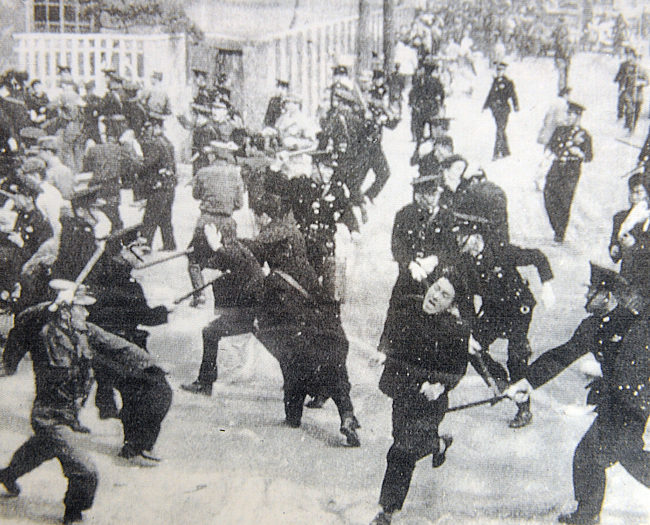
He took his most reliable troops, the paratrooper brigades that had won him the capital, and started training them in new counter-protest tactics. These new skullbreakers were taught to charge in and aggressively break up demonstrations. They’d punch the protestors right in the mouth and then kick their asses again as they ran off home. The True Heart units would harass and continually break up new groups of protestors, take ringleaders into custody, and prevent any mass movement from organizing. They were given swanky new batons, ash, about 70 centimeters long, and fully capable of bashing in the head of some Physics major from Seoul University with a minimum of fuss. Any demonstrators they caught would be stripped, tossed in a truck, and shipped off to a prison to be roughed up for a few more days before they were turned loose, having learned a very valuable lesson about Respect For Authority.

There was a certain sense of urgency around the True Heart program, since Chun had a lot of angry Physics majors in the streets in those days. 

Students had long been a source of headaches for which ever authoritarian regime was the latest to slouch into Seoul. Rhee had been toppled by protests over the death of a student, and the little brats had been such a headache for Park that in 1975 he banned student organizations altogether and imposed his own program, the Student Defense Corps. That had gone by the wayside with his death, though, and the next generation began to once again slink back out onto the streets. 

Tentatively, starting around April in Seoul and then spreading to other universities nationwide, the students started such radical measures as having Student Council elections and suggesting that perhaps all male college students shouldn’t be required to give several years of their lives to the military. The New Military Regime denounced this behavior as obviously unpatriotic and said that the students “lacked security consciousness,” since clearly the thin blue line of drafted gawky teenagers was the only thing holding back the ravening hordes of Communist supermen to the North. Confrontations and clashes between the kids and the military became increasingly common.

The students tried to avoid criticisms that they were “destablizing” the country and opening a window for an invasion by limiting their protests mostly to campus. But at the same time, their demands grew from the modest request that they be allowed to elect their own student governments to full blown demands for the democratization of the country. Choi still refused to give his assent to the New Military Regime, and that refusal fueled the students. The protests spread and became general in universities across the country as April turned to May.

It was a time of hope for the students. Choi still talked about democracy. For many of them, it was the first time in their lives they had known any regime except that of Park Chung-hee. Anything seemed possible – even a democratic future for Korea. They started calling it the “Seoul Spring,” in memory of another hopeful springtime twelve years before, in Prague, 1968.

Of course, that spring had ended bloodily.

The protesters demanded an end to martial law and that power be rested from the hands of Director Chun (who had, in the meantime, resigned from the army so that he could be appointed director of the KCIA, now reformed in his image). And all the while various units completed True Heart training and were quietly spread around the country.

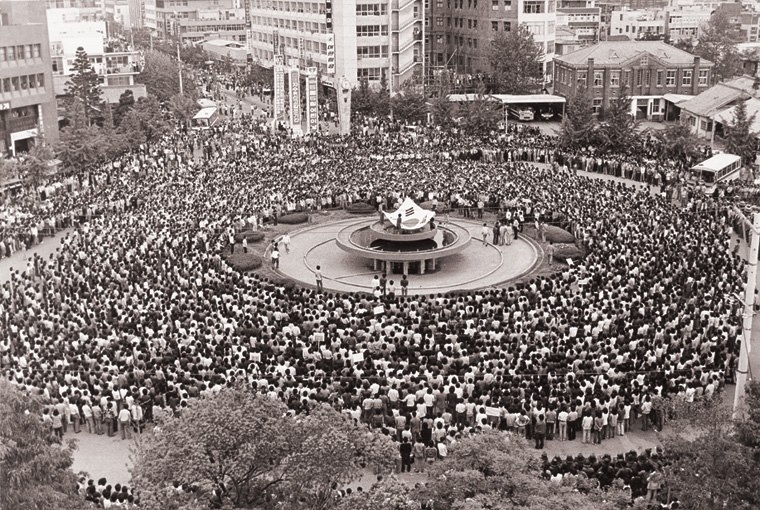
The first two weeks of May saw things rapidly approaching a climax. 27 student groups from universities across Seoul met quietly, and then returned to their campuses with a unified plan of action. 70,000 students poured into the streets (I know, I can hardly believe it, either – students who pay attention to their student council!), marching and chanting slogans calling for the downfall of Chun and the ‘remnants of the Yushin system.’ The next day, May 15, 100,000 students joined – and the protests were going nationwide. Every city with a major university saw students surging into the streets.
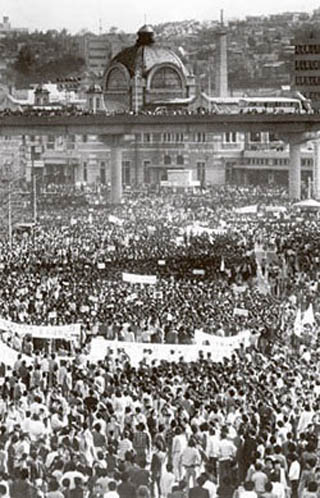
Hundreds of thousands gather in front of Seoul Station, May 15, 1980

However, the general population was reluctant to join in. With no popular support, the students for once in their lives did the prudent thing and toned things down. May 16 and 17 were quiet, mostly, as the students quietly withdraw and plotted their next move in their ongoing confrontation with Chun. 

And it was here that Chun completely screwed the pooch. After more than 6 months of wrangling, he had had it with Choi’s continued refusal to get with the program. The growing flame of the student movement finally ran out his patience. At an emergency meeting on May 17, he and his cronies in the New Military Power sat down with ‘president’ Choi. Demonstrating the growing unrest in the streets, Chun browbeat Choi into accepting an extension of martial law: Now campuses, too, after their brief flirtation of freedom following the Park assassination, would be firmly placed under the control of the military. True Heart units were even then en route to every university in Seoul, as well as detachments sent to major universities in the provinces. The universities would be closed until all that could be sorted out, the ringleaders of the little jerks in the streets would be arrested, oh, as would most of the ringleaders of the political opposition in the National Assembly, who had been gleefully making hay of the whole situation. Oh, and Chun was fed up with Choi’s antics: He would resign as soon as things calmed down and Chun would become president. 

Satisfied, Chun left the meeting, which had been effectively a legal coup. The longest coup in the history of the world, stretching from December 12, 1979 to May 18, 1980, was over. He went to bed that night satisfied that he cut the head off the student movement, that his True Heart units would mop up any lingering dead-enders, and his political opposition was effectively neutered.

When he woke up, he learned that some jokers down in Gwangju apparently hadn’t gotten the memo.

*Not to be confused with “the Star War,” which I believe is a popular science-fiction franchise created by George Lucas.

**After the United States, Korea had the second-largest commitment of troups to the defense of South Vietnam, more than 300,000 men. They accomplished little beyond padding the pockets of a gaggle of corrupt REMFs and depopulating several backwater provinces, but in fairness that’s about all the Americans managed anyway so we can’t be too harsh on them. 

***Somehow Chun delivered this briefing with a straight face, despite the fact that Kim Jae-gyu had literally offered Jeong the Presidency already and Jeong had turned it down, and that it had been Jeong himself who ordered Chun to investigate and arrest (not necessarily in that order) Director Kim. 

****He would at last be released 17 years later and cleared of all charges. Jeong passed away in 2002. 

***** Syngman Rhee had led the First Republic. The Second had been the brief-lived liberal regime before Park’s coup. Park had led the Third Republic, then after proclaiming the Yushin Constitution the Fourth. 

5.18 Chapter Four: The President’s Last Bang

The limousine rolled up to the gates of the Presidential palace as the sun sank down towards the Yellow Sea on October 26, 1979. Long evening shadows stretched over the humming streets and alleyways of Seoul, over the grassy parkland surrounding the palace, and splashed across the walls of a small safehouse. Sim Soo-bong nervously rolled down her window so the guards could inspect her and her friend, Shin Jae-soon. After a cursory glance at the two young women, they waved her through. The young singer was expected, and had been a guest of the president before. 

Sim was an up-and-coming singer in the world of Korean entertainment. Of course, in the Winter Republic one couldn’t be too radical an artist, but she had made her name as a trot singer, a rollicking, upbeat Korean music genre just then at the height of its popularity. The daughter and niece of musicians, but unable to gain admission to university as a singer, she had been majoring in Business Administration at Myongji University. The year before, though, at the age of 23, she had won the MBC College Song contest with a song of her own composition, catapulting her to the limelight. She had whirled around the Seoul music industry, and Park himself had become a fan. Since then, she had twice been invited to banquet with the President.

Sim Soo-bong in 1978, making her big break.

The women were ushered through the gates, and the limo rolled to the safehouse. Inside, the dinner party assembled: the two young women, who were to be the evening’s entertainment, Chief Party Secretary Kim Gye-won, KCIA Director Kim Jae-gyu, the President’s bodyguard Cha Ji-Chul, and, of course, Park Chung-hee himself. 

The man who had ruled the Republic of Korea for most of two decades was a shrunken shadow of his former self. Gone was the handsome, energetic young officer who had once converted the men sent to arrest him to his cause by the simple force of his charisma. Gone, too, was the powerful, forceful President who had transformed Korea into a modern nation. The years of clinging to power, fending off protests and internal challenges, navigating Korea through the dangerous waters of East Asia in the Cold War, the murder of his wife, had left Park a sad, lonely old man. He filled his days with political struggles against the NDP and cracking down on protestors, and his nights with lush banquets attended by pretty young women he brought in to distract him for a time. 

The atmosphere that evening, though, was anything but festive. Sim wasn’t party to internal palace politics, but she could feel the tension in the air. It crackled between KCIA Director Kim and Bodyguard Cha, the two men glaring daggers at each other. Party Secretary Kim nervously tried to keep the peace between the two men, making poor attempts at small talk, but he failed. The President was no help at all – the discussion between the three men kept coming back to politics.

Cha took the lead, angrily berating Director Kim for his appalling failure to crush the ongoing protests in Busan. He pounded the table, saying that tanks and planes were too good for these traitors, these Communists, undermining the regime. 

Director Kim flushed, angrily defending his KCIA. He had helped keep Park on his throne for 18 years, working his way through the ranks until he had at last become director 3 years before, and now this joker dared to criticise him? Cha had only come around after Youngsoo’s murder in 1974, but had quickly become the favorite of the President. At every turn he took his opportunities to undermine Kim, including now. It was KCIA’s responsibility to crush the protestors.

“We must be cautious, Mr. President,” Kim said. “Moderation is needed – let my agents handle this. We can soothe the protestors, make them go away, and no blood need be shed.” 

“I’ve had enough of your ‘moderation,’” Park snapped. “We’ve been moderate for weeks now, and where has it gotten us? I pay you to deal with these traitors, not coddle them.”

Cha nodded vigorously. “It’s obvious the KCIA is failing us, Mr. President,” he said. “If I had my way, these protestors would all be mowed down with tanks!” 

Park nodded. “Listen to Mr. Cha, Kim. Sometimes I think he should be in charge of more than just my security. At least one person here talks sense to me!” 

Kim, his jaw clenching, stood up and excused himself. Sim, nervously watching with her friend, was relieved to see him go – maybe the evening would calm down from there. She was, of course, wrong. The argument that she witnessed and later reported was perhaps the most consequential in Korean history. 

The tension between Director Kim and Chief Bodyguard Cha, which boiled over tonight, had been building for a long time. In his last days, from a Seoul prison cell, Kim would claim that he had always been a supporter of human rights and democracy. Cha, by contrast, was a brutish lout of a man who would cheerfully run over a college student with a tank if only Park would let him. 

Kim was an old friend of Park’s. The two men had come up in the same class at the military academy, and he had ridden his friends’ coattails as Park rose to the very heights of power in the Republic. When Kim was detained by revolutionaries in 1961 because of suspected support for the liberal regime, Park had personally intervened for his release. Kim had then commanded the 6th Division (Park’s old command), then Defense Security Command in 1968, an agency within the military that spied on, well, the rest of the military on behalf of the dictator. 

Kim would say that it was the Yushin Constitution that turned him against Park, and that he repeatedly plotted his old friend’s assassination in the 8 years since, but had never been able to bring himself to do it. He privately opposed a rising clique within the military, the Hanaho, a group of officers led by one Chun Doo-hwan which swore fanatic loyalty to the Korean Napoleon. He kept his growing resentment of Park quiet, though, and by 1976 he was in command of the KCIA, the main security body for Park’s regime. 

In contrast to Director Kim’s moderate, some would even say soft, ways, Chief Bodyguard Cha was an ass. Appointed in the days following First Lady Yuk’s assassination, Cha had exploited his position near the lonely old man to steadily grow his own turf. He commanded the equivalent of a division in tanks and helicopters to assure the security of his Chief. He manipulated the Presidents’ schedule to cut out rivals – Kim’s KCIA briefings, once the first thing in the morning, were pushed to the late afternoon. And he wasn’t afraid to get his own hands dirty – he once assaulted a provincial governor who had surprised the president while lighting his cigarette. 

Kim, left (glasses)< Park (seated, center) and Cha (standing, right), the inner circle of Korean power in the second half of the ’70s

Over the next 3 years, the rivalry between the two men sharpened and grew. Kim, once Park’s oldest friend, found himself more and more shut out of power by the growing influence of Cha. In the autumn of 1979, the turf war reached its climax.

Kim’s KCIA had been busily interfering in the internal elections of the opposition NDP, seeking to prevent the rise of a hardliner, Kim Young-sam, to power*. This was all old hat for the KCIA, which had been at this nearly 2 decades, and thus far had managed to keep the opposition mostly toothless and confined to pro forma arguments in the assembly and useless protests by college students. This time, though, Cha decided the KCIA’s efforts weren’t good enough and attempted to interfere in the election on his own. The two security services’ dirty tricks departments collided, and farcically, cancelled each other out. Kim Young-sam was elected and immediately pledged not to cooperate with Park until the Yushin constitution was repealed. Cha blamed the whole debacle on the KCIA. 

Director Kim urged moderation, wanting to wait for things to blow over. He had tried to soothe Assemblyman Kim as the crisis escalated, even as Park – at Cha’s urging – arranged Kim’s expulsion from the assembly and invalidated his election. Assemblyman Kim refused, the entire NDP resigned, and the US even withdrew its ambassador. Kim’s home region of Masan and Busan erupted into protest.

Worried, Director Kim travelled to the tumultuous cities – this was the region that had brought down President Rhee 20 years before, after all. He expected to see the usual college idiots in the streets, but instead was confronted with adults – it was a popular uprising. Kim hurried back to Seoul, where Cha continued to whisper in Park’s ear that the whole crisis was a result of KCIA’s weakness and incompetence. Park pledged to shoot protestors in the street if necessary, while Kim privately warned him that the protests might spread to Korea’s other large cities if things were allowed to deteriorate.

By now, the two men, Kim and Cha, despised each other utterly, and could hardly stand to be in the same room (which I imagine made for amusing meetings of Park’s inner circle). The morning of October 26, President Park had attended a ribbon cutting ceremony for a dam and a new TV station (run by the KCIA). The men walked out onto the helicopter pad near the Blue House, where the presidential vehicle sat, rotors humming. Park climbed on board, but as Kim made to enter behind him, Cha, smirking, placed his arm across the door. He had decided that Kim no longer merited riding in the same helicopter as the President. Kim, enraged, muttered a few excuses and abandoned the trip entirely. 

Just before they entered the dining room that night, Director Kim had told Secretary Kim that he would get rid of Chief Bodyguard Cha. Secretary Kim had cocked an eyebrow in confusion, but Director Kim said no more. 

Inside, the girls joined them, the dinner arrived, and, despite Secretary Kim’s best efforts, the conversation turned again and again to the ongoing protests, and Cha continued to needle Kim again and again, with the old President Park nodding blithely along…and Kim stood up, and stormed out.

It isn’t known, to this day, whether or not Kim planned all the events that followed. Perhaps it was spur of the moment. Perhaps it was the product of a meticulous plot. Perhaps he had intended it, and was waiting for only the right moment. The truth can probably never be known, since all the men involved are now dead. What is known is this:

Director Kim left the dining room, and met with two of his close subordinates, who were in the safehouse the dinner was being held in. They were Park Heung-ju, Kim’s secretary, and his chief agent, Park Seon-ho.** “Chief Staff and Deputy Director are here as well,” he told the two men. “Today is the day.” Kim then seized a pistol and marched back into the room, with a look of terrible wrath upon his face.

As the guests cried out in panic, Kim opened fire. Chief Bodyguard Cha was shot in the arm, and he abandoned his charge, fleeing to a nearby bathroom, where he cowered. Park took a bullet to the chest, but he still lived. Kim pursued Cha, but the old pistol jammed. Kim worked furiously at the jam for a few moments, then, glaring at Park, he left the room. He fetched Seon-ho’s service pistol, marched back into the dining room, and threw open the door to the bathroom. Kim took special satisfaction in dispatching his rival with a shot to the abdomen before turning back to Park. 

No one knows exactly what he said to the old president, but after an exchange of words, Kim leveled his pistol and executed him with a single bullet to the head. Park Chung-hee, the Korean Napoleon, the man who had ruled Korea for 18 years and transformed the entire country in his image, was no more. 

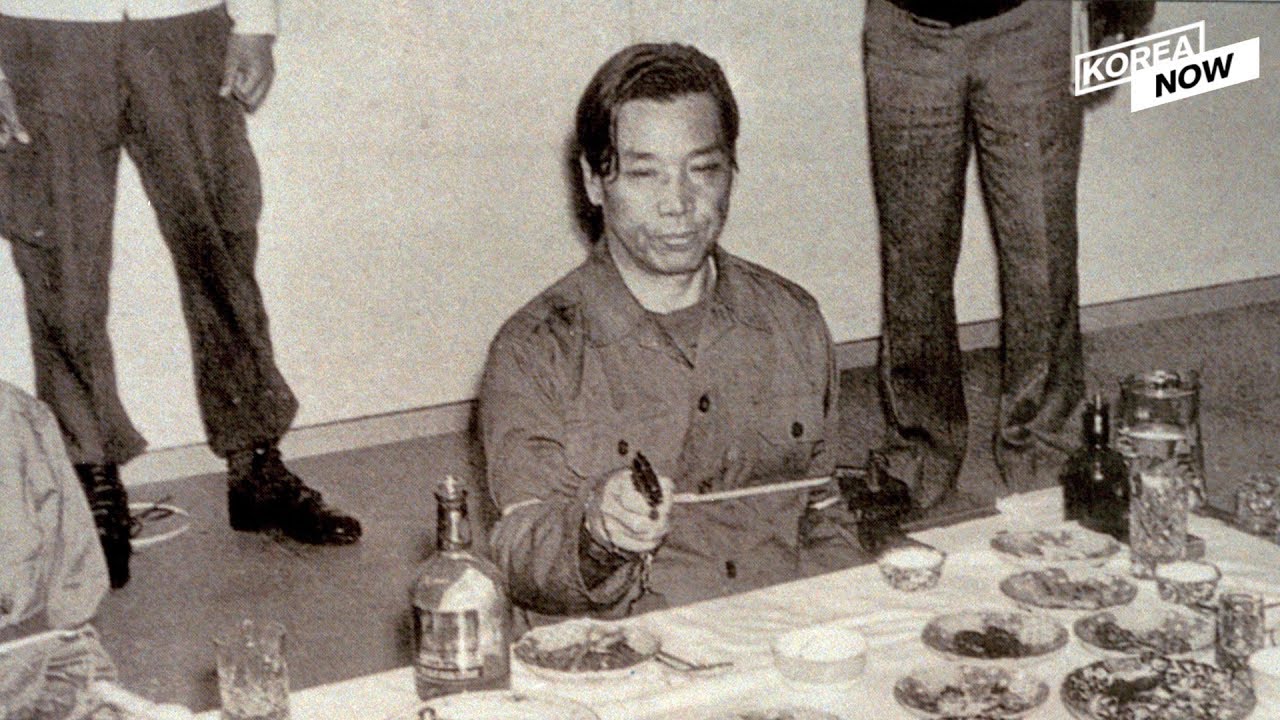
Kim later re-enacted part of the assassination during his trial.

As the firing broke out, Kim’s subordinates raced through the house. Seon-ho took two bodyguards at gunpoint, including a friend of his. He hoped to hold them prisoner, but one of the men made a dive for his gun. Seon-ho cut them both down. Meanwhile, Heung-ju stormed the kitchen with 2 other KCIA agents and killed the remaining bodyguard. Somewhere in all thsi crossfire, the presidential chauffeur outside was also killed, bringing the night’s bodycount to six. 

Kim, presumably slightly dazed by what he had just done, ran out of the room (leaving the terrified Sim and Shin cowering by the table). He ordered Chief Secretary Kim to secure the safe house (Kim obeyed more out of habit than anything else) and then raced to the nearby KCIA building. He found the Army Chief of Staff, Jeong Seung-hwa, there. Jeong, one of the highest ranking officers in the military, could be a powerful ally. Kim could place him on the throne as president, and rule from behind the scenes himself. It wasn’t like the KCIA director was spoiled for choice – having just shot dead the President, his bodyguard, and 4 other human beings in a fit of rage he would now either conquer or die. The President’s chair or the hangman’s noose were his only two options remaining.

Jeong Seung-hwa, ROKA Chief of Staff in 1979

 General Jeong had no idea what was happening. He had heard the gunshots, though, and as Kim, breathless, ran in through the door he demanded to know what was going on. Perhaps thinking it tactless to say “Well, I just murdered the man who has ruled our country for 18 years, plus, like, a lot of other people, including that bastard Cha,” Kim instead in a fit of understatement announced that an emergency situation had arisen. He urged Jeong to come with him to impose martial law and get a grip on things (before the ever-dastardly North Koreans invaded, of course).

Jeong, confused and hustled along by Kim, climbed into a car with him and the two sped off for KCIA headquarters. Kim’s base of power was there, and from that location, he could set in motion a quick coup to stabilize his control of Seoul and thereby the rest of the ROK. On the way, though, Kim told Jeong that Park had died, although he failed to mention exactly how that situation came to be (again, imagine how awkward that conversation would have been. Much best to wait, yes). 

And then the conspirators (for a conspirator Jeong was now, although he didn’t realize it yet) had to make a decision as their car sped through the nighttime streets of Seoul. Ahead and to the left lay Namsan district (today famous for Namsan tower, which dominates the Seoul skyline) and the KCIA headquarters where Kim usually laired. Further ahead and to the right was Yongsan, where the Korean armed forces were headquartered, Jeong’s usual base of operations. Jeong resisted going to KCIA headquarters – if martial law was declared (and it would have to be, with Park Chung-hee’s body presently cooling in a bloody dining room somewhere), he’d need to be in contact with his army units. The car should go to army headquarters.

Kim resisted, understandably. At KCIA, he’d be surrounded by his minions. Jeong would know exactly what Kim wanted him to know, and he’d have Jeong entirely in his power if the Chief of Staff needed persuading to see things the Director’s way. The opposite would be true at army headquarters – Jeong would be secure in his own power base, with access to his own sources of information, unable to be hustled the way Kim wanted him hustled. But Jeong was the only high-ranking member of the military Kim had access to that night, and if he coudln’t get the military to support or at least stay neutral, then his coup would fail (and he would hang). Kim begged, he pleaded, he even wheedled (a bit), but Jeong was firm. No army, no martial law. No martial law, no coup. So the car turned right and went to army headquarters and thereby Kim Jae-gyu’s fate was sealed.

Prime Minister Choi Kyu-hah, a previous non-entity whose surprising show of spine will one day play a decisive role in the history of his country. Not yet, though.

Chief Party Secretary Kim, meanwhile, had been left back at the safehouse with all the dead people (and two terrified college students) lying around. Secretary Kim, who had either done this sort of thing before or else possessed an admirable ability to keep his head in a crisis, organized a cleanup, quickly took the two surviving witnesses (besides himself) into custody, and sped the Presidents’ body to a nearby army hospital and ordered the doctors to save him at all costs. My sources note that he specifically did not reveal the man’s identity to the doctors, but it seems that would hardly be necessary. Then he raced to the Prime Minister’s office, Choi Kyu-ha, to tell him everything that he had seen. 

At Army Headquarters, Director Kim was busy spinning a thrilling tale of North Korean commandos, who had burst into the KCIA safehouse (no doubt casting serious doubt on the competency of the KCIA in the process) and gunned down President Park and Chief Bodyguard Cha*** before, er, vanishing into the night. Anyway, no time for questions, it was essential that Jeong declare martial law and control the city before the assassins escaped and the North took advantage of the confusion. Jeong would not be stampeded into anything, though, and he insisted on contacting the Prime Minister first, as the only real “civilian” authority left in the wake of the President’s death. 

Here things began to unravel for Director Kim. He may have trusted to Secretary Kim’s loyalty, or hoped to reach Kim later to tell him the “official” story, but his need to go after Jeong first, and then allowing Jeong to take him to army headquarters, had made that impossible. And by not murdering Secretary Kim along with everyone else, he had inadvertently allowed a narrative to escape that would challenge his own: namely, that Director Kim himself had murdered the President and Cha (and, it should not be forgotten, a bunch of other people!) in a fit of rage. But why would Director Kim have murdered Secretary Kim? His resentment and frustration were directed at Cha, and the way Cha had turned his old friend Park against him. He had no quarrel with the party. And thus the mercy of Kim proved his undoing.

The Chief of Staff left Kim at army headquarters and hurried to the side of Prime Minister Choi. There, an emergency meeting of the cabinet was convened. Jeong heard the entire story from the Prime Minister, and his face grew stiff, and cold, and he knew what he must do.

Kim had a strong base of power in the KCIA, which was the most feared organization in the ROK at that time as the primary enforcers of Park’s regime. But Kim was cut off from most of the KCIA, and vulnerable. Jeong asked Kim to meet with him at a secluded area, outside army headquarters. Kim still knew he needed Jeong’s support, and he, fatally, consented. When he arrived at the meeting spot, Kim found not the Army Chief of Staff waiting for him, but armed military police to take him into custody.

Jeong acted quickly to neutralize the power of the KCIA. He turned to the only other internal security apparatus the ROK had, the Security Command under Chun Doo-hwan, and ordered him to investigate the incident. 

This is the spark that eventually explodes in Gwangju, 9 months later.

Remember, Chun Doo-hwan was head of a clique of young officers fanatically loyal to Park. He was enraged at hsi mentor’s death, and he was ruthless in dismantling the KCIA. The Security Command, which you will also recall was the agency charged with keeping tabs on the military itself, was perfectly positioned to move efficiently through the upper reaches of power. Kim and his handful of minions were all swiftly arrested, tortured, and, ultimately, for most, executed. In so doing Chun Doo-hwan demolished the grip KCIA had over internal Korean politics, and at the same time established his own, new power base. While Chief of Staff Jeong moved tentatively toward civilian rule, Chun and his coterie found themselves with a sterling opportunity to preserve Park’s legacy and continue the rule of the military. 

As for Director Kim, he was imprisoned and tortured, naturally. Most of the information contained in this narrative emerged from the sensational trial of Kim Jae-gyu over the next six months.

Kim argued that he acted out of a hither-to unsuspected love of democracy in his trial. He claimed that many times he had attempted to or thought about arresting or murdering Park, but each time had backed down. He also revealed long-held contacts with opposition leaders (like his attempt to smooth things over iwth Kim Young-sam just before this crisis). He also claimed the American CIA had backed him, which is not as implausible as I would like.

Chun Doo-hwan, meanwhile, somehow kept a straight face as he declared that the assassination was clearly the product of a long-running conspiracy by Kim to murder the President and subvert democracy. He cheerfully ignored such objections as the fact that Kim clearly had no plan at all for after the assassination, the fact that he’d had to borrow a gun to carry it out, the fact that he vented his rage and resentment towards Cha aloud while shooting him, and the fact that he hadn’t even given his own agents like Park Seon-ho more than about 5 minutes’ warning. 

But it’s good to be the dictator, and dictator Chun Doo-hwan was. Kim and his fellow conspirators were quickly sentenced, one after another. Colonel Park heung-ju, Kim’s secretary, was easiest to deal with. As a member of the military he could be summarily convicted and executed by firing squad, which he was on March 6, 1980. The remaining conspirators – Director Kim, his agent Park Seon-ho, the driver Yoo Seong-ok, head of safehouse security Lee Ki-ju (convicted presumbly on the grounds that he was fucking terrible at his job), and Kim Tae-won, a security agent who tried to help the whole affair look like a Nork attack, were all hanged on May 24, 1980, neatly closing the affair.

Except that on May 24, 1980, the Chun administration had much, much larger problems on their minds – namely, the revolt against their rule that had broken out the week earlier in Gwangju, on May 18, 1980. We’ll get there.

As for the college students, Sim and Shin, both women were imprisoned for around a month while the authorities sorted out what the hell had happened (and what the hell they would tell the public, notably not the same thing). They were released more or less unharmed apart from the psychological trauma, but Sim was banned from television until 1984 (who knew what she might say if given a platform?). Her career nevertheless survived and she went on to modest fame and success. Forever and always, though, she is most well known as one of the most intimate witnesses of the end of the Winter Republic.****

As for Chief of Staff Jeong and Security Command chief Chun, the two men found themselves unexpectedly at the apex of Korean politics, a situation neither had dreamed of even a week before. Now they had to sort out the pecking order between them, and the fallout from their confrontation is the final, irrevocable step on the road to the Gwangju Uprising.

Next time: The War of the Stars!  


*There are only a few surnames in Korea. By far the most common are Kim, Park, and Lee. I apologize for any confusion which results. 

**No relation to each other or to the President. See previous note. 

***The fact that those just happened to be two people that Kim really fucking hated was purely a coincidence, of course. 

**** The events of October 26, 1979, were satirized in the Korean black comedy film The President’s Last Bang! from which I have of course drawn my title. It’s a good movie and fairly accurate to events – accurate enough that the maker won a defamation suit brought against him by the children of President Park. Here’s the trailer. I recommend it if you can find it:

5.18 Chapter Three: The Winter Republic

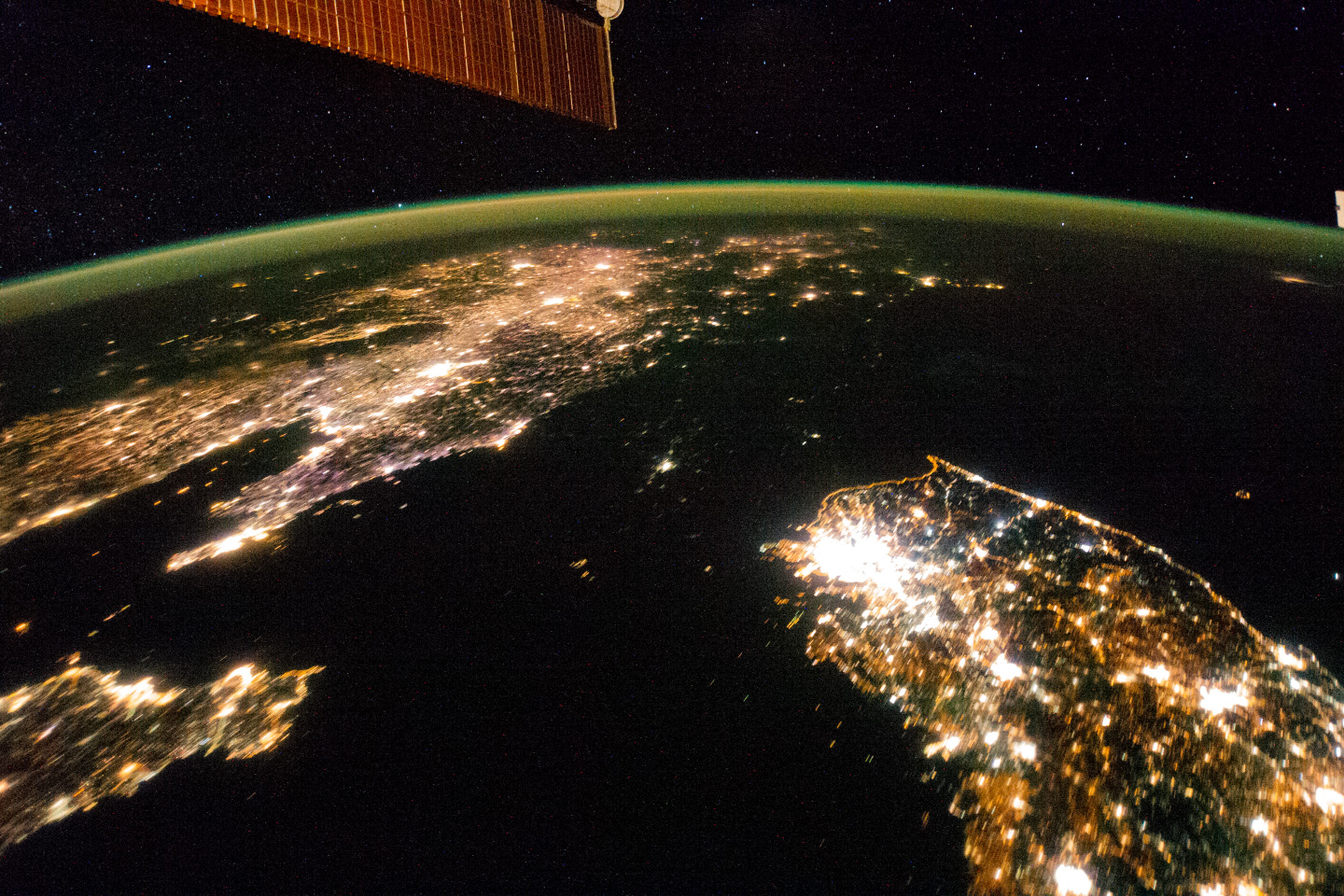
The Korean peninsula at night is one of the most powerful images most people have seen. 

In the north, from the Yalu all the way to the DMZ there is only blackness. Nearly 50,000 square miles of blackness, in a nation of 25 million people. Pyongyang alone is visible, a tiny point of light hunched defensively in the middle of the sea of dark, a stark illustration of the haves and the have-nots in the DPRK. 

But south of the DMZ…to the south, the Republic of Korea blazes forth. The warm glow of lights representing human enterprise and endeavor spread all over every inch of ground from the Imjin all the way to Busan. Even the most distant mountains are illuminated. And Seoul…Seoul is a shining beacon, almost blinding in its brilliance, representing light and life and energy, a chaotic burst of joy in defiance of the hulking monster to its north. There is no image that so profoundly illustrates the different courses the two Koreas have followed; no clearer example of the stark difference that human freedom can make for a people.

One thing that gets forgotten, though, is that it was not always this way. I don’t even mean that the two Koreas used to be similar (although they were). No, what is forgotten is that in the early years, North Korea was the richer of the two brothers. 

That’s right.*

In the years following Japan’s occupation, North Korea had the best industry (at Wonsan), a massive, modern hydroelectric infrastructure around its chilly northern reservoirs, some of the best ports in Korea (as at Hamhung), and a higher per capita income. The South was more rural and agrarian, outside of Seoul. Sure, it had a decent port at Busan, but that was about it. Following the war, and through Rhee’s years of corruption and mismanagement, the North, not the South, seemed to provide a vision of a future. 

It was the presidency of Park Chung-Hee that changed that. The Winter Republic.

President Park in 1963

In many ways, Park’s ‘presidency’ was the most transformative in the history of the nation. He would rule for 18 years and firmly establish his imprint on every facet of Korean life. He would restructure the Korean economy, morals, the government, the military – all of it. When he seized power in 1961, Korea was poor, backwards, and constantly under threat from the north. By the time of his murder in 1979, the nation was wealthy, with a rapidly developing technological industry, and even more rapidly outgrowing any real threat from beyond the 38th parallel. 

To analyze Park, you have to always keep in mind his two heroes: the emperors Napoleon and Meiji, of France and Japan, respectively. These two provided the model that Park based his own reign on. 

Napoleon, you will recall, was born a poor boy on Elba. He joined the military, and rose through the ranks in the chaos of revolution, making his name as a general of artillery in battles like the siege of Toulon and the attempted royalist coup of 1795 (the “whiff of grapeshot”). Given command of the poorly armed, poorly trained, and poorly supplied Army of Italy in 1796, Napoleon had risen like lightning, rapidly winning battle after battle, then war after war, until he was the master of nearly all Europe, and Emperor of France. 

But apart from his military genius, Napoleon was a reformer. It was he who at last broke down the tangled mess of France’s laws, a convoluted rat’s nest of regulations and decrees and ordinances from sources as diverse as the medieval French kings, the personal rule of Louis XIV, the Ancien Regime, and the myriad Revolutionary governments from over 400 years of history. Napoleon swept those aside and created the Napoleonic Code. He rationalized France’s provinces and administration, modernized the French army, and created a new glittering court in Paris to rival the days of the Bourbons. For the ten years of his rule he was the state of France. 

Meiji. Note that he appears in adopted European military-style uniform, not traditional Japanese court attire.

Meiji was similar. His reign became known to history as the Meiji Restoration. When Japan, medieval and backwards after years of self-imposed isolation by the Edo shogunate, was threatened by European expansionism, Meiji had become the first emperor in centuries to assert his personal authority, overthrowing the shogun, moving the imperial court and capital from Kyoto to Edo (known forever after as Tokyo), and initiating the most successful program of Westernization in the known world. Meiji’s son and grandson had allowed Japan to be dominated by its military, but the military continued the hard charge of modernization and authoritarian economic development – and it was this same military that had plucked Park from obscurity in the Korean countryside and molded him into a talented and ambitious officer.

It was said of Park:

“In the Imperial Japanese Army, there was the belief that Bushido would give Japanese soldiers enough “spirit” as to make them invincible in battle, as the Japanese regarded war as simply a matter of willpower with the side with the stronger will always prevailing. Reflecting his background as a man trained by Japanese officers, one of Park’s favorite sayings was “we can do anything if we try” as Park argued that all problems could be overcome by sheer willpower.

Eckert, Carter Park Chung Hee and Modern Korea The Roots of Militarism, Cambridge: Harvard University Press, 2016

You cannot understand Park without appreciating the impact his training as a Japanese officer had on him. He, and all his clique, had come up through the Japanese war academy in Manchuria. They had imbibed the bushido spirit the Japanese militarists instilled in all their soldiers: problems were all to be overcome with will. The surest path to national success was through the firm and decisive leadership of the military – the people needed to be led to the right way of belief.

The years the Japanese army had ruled Korea were brutal and hard for the Korean people, but they had also been a time of rapid development as the Japanese built railroads, telegraph wires, hydroelectric plants, and factories to fuel their further conquests on the Asian mainland. It had seen more Korean economic growth than any other period in the nation’s history, and Park, a fervent Japanophile (a rarity in Korea), remembered those days with fondness. The militarist system of centrally directed economic development would be the model for the Winter Republic.

Park maintained the veneer of democracy over his regime. Under pressure from the Kennedy administration, he had restored “free elections” in 1962 – only to promptly resign from his post as head of the Supreme Council for National Reconstruction and win election as President in 1963, then re-election in 1967, then an amendment to the Constitution to allow him to run for a third term in 1971, followed by a brand new Constitution in 1972.

Park argued that the Korean people were not ready for democracy. “Democracy cannot be realized without an economic revolution,” he said. With a shaky economy and a dangerous ideological enemy bent on their destruction, a strong hand at the tiller was needed to steer the ship of state. The North Korean threat wasn’t entirely imaginary, either – through the late 1960’s, border raids and skirmishes were common along the DMZ, with the most dramatic incident being a DPRK raid on Seoul itself, with a squad of commandos coming within a few blocks of the Blue House** before being repulsed. Park was a staunch anti-communist and gravely feared the threat of Communist agitation from within. 

To be fair, it seems likely that Park believed his own justifications for his dictatorship. Korea had been obviously mismanaged under Rhee and the Second Republic. His heroes, Napoleon and Meiji, had created strong, vibrant states that dominated their places and times.*** Park intended to do the same – and throughout his presidency, he worked hard to create the vision of Korea.

In the later years of the 20th century, it became fashionable to talk about the Four Asian Tigers: Singapore, Hong Kong, Taiwan, and Korea. These were four previously poor states that experienced some of the most dramatic economic growth of any nation in the world in those days. The Republic of Korea, in particular, exploded past its northern rival for the first time and never looked back.

Park immediately began his presidency in 1962 with the first of many Five Year Plans. Investment from the United States and Japan was ploughed into the economy, as he initiated large-scale infrastructure projects across the country for the first time since the Japanese occupation. Roads, railways, and airports spread across the nation from Seoul. Seoul itself became a boomtown, growing from a provincial, undistinguished city to one of the great metropolises of the world (the Seoul Olympics, in 1988, came less than 10 years after the Park regime). Corporations such as LG, Samsung, and Hyundai were founded in these days, and many began to refer to the “Miracle on the Han River.” 

As Korea grew rich on light industry, Park turned his attention to heavy industry, and as the ‘60s rolled into the ‘70s the next series of Five Year Plans attacked that problem. Relations were normalized with Japan, and a massive $800 million settlement from the country was poured into the effort to build Korea’s own industrial capacity. It was necessary to be able to supply their own army to defend from the North, Park argued, and obviously no labor strikes or protests from workers could be tolerated. Such strikes as did happen were ruthlessly broken up, and the Miracle on the Han continued. 

Korean per capita GNI more than tripled during Park’s presidency from 1962-1979

The boom was not confined just to the cities. As a boy, Park had despised the thatched roof of his Korean village. To him, the simple peasant homes symbolized his nation’s backwardness and poverty, especially compared with Japanese modernity. Now, he had the power to do something about it. The New Village Movement brought paved roads and running water to every village in the republic. Most especially, it brought electricity. The power lines spread from Seoul to a thousand tiny hamlets scattered around the rice paddies and mountain vailleys, and with the power lines came the lanterns. No longer would night enfold the peninsula, but the city streets would glow as brightly as daytime at all hours. Under President Park Chung-hee, South Korea became the glittering nation of light so starkly visible in those Internet photos. 

But this roaring economic growth came at a cost. Park emphasized Korean industry, science, and technology, yes, but he also believed that the Korean family model should extend to all areas of society. Park instituted strict morality laws, and censorship became the order of the day. Korean novels, poetry, TV, and movies were all held to high standards of “public decency.” Attire was tightly controlled, with a selection of approved haircuts available for men and women. Music, naturally, could not be left unregulated – who knows what the kids these days would listen to if left to their own devices? – creating a fussy, conservative operatic style of Korean music that is still popular with the ajummas and ajosshis today. 

Korean culture and art stagnated under President Park. Creative expression was discouraged, and what efforts still existed were held to tightly constrained channels. The result was what Korean historians would later call “the Winter Republic” – a nation barren of culture, of life and light and music. 

As the years of Park’s presidency dragged on, and the increasingly formal presidential elections rolled by, one after the other, opposition to the Korean Napoleon began to grow. Initially, Park had enjoyed the support of the people for his firm leadership after the corruption of Rhee and the incompetence of the Second Republic. But his heavy-handed tactics, his drive for economic efficiency at the expense of human rights, his constant excuse-making that the people just weren’t ready for democracy yet, were wearing thin. His Korean Central Intelligence Agency, the anti-coup KCIA he had created following his own seizure of power, was given a free hand to arrest anyone suspected of speaking against the government, with the usual beatings and torture to follow. Nevertheless, periodic protests, especially by college students, often unruly, occasionally violent, continued. 

Political opposition, never quite outlawed since Korea was a “democracy,” gained in power. After a comfortable Presidential win in 1967, Parks’ 1971 opponent, Kim Dae-jung, had the gall to actually run a semi-competitive race. Troubled by such an unexpected display of spine, Park declared a state of emergency that fall, then, citing the threat from the North, tossed out his own Constitution and created the Yushin constitution instead.

The new Constitution, after Park essentially launched a coup against his own government in October of 1972, centralized even more power in President Park’s hands. It abolished all term limits and extended presidential terms to six years. Further, the public – obviously not to be trusted any longer – no longer voted for the president, but instead for an electoral college, which was granted a slate of candidates to vote for. The maximum number of candidates allowed on the slate was, naturally, one. The old national assembly was dissolved and a new one elected in its place – with the president having the power to appoint ⅓ of the members. The constitution was termed the Yushin Constitution, or “Restoration Constitution” – an obvious allusion to the Meiji Restoration of Japan. 

The Yushin system swept away all trappings of democratic government in the Republic of Korea. Freedom of speech, of assembly, of the press, of association, of scholarship, of thought, of conscience, were nonexistent. Arrests and beatings were commonplace to maintain the authority of the regime. 

Park, center, and his wife in 1971

The Yushin years, though, were marked by growing instability as Park increasingly teetered on his throne. The economic growth slowed, the arrests and beatings picked up pace, and still he insisted that the Korean people could not handle democracy. Park himself was frequently the target of assassination attempts, most of which he blamed on the North Koreans. The worst moment, perhaps, of his Presidency, before the end, came on August 15, 1974 – the 29th anniversary of the Japanese surrender. Park was in the National Theater in Seoul to give a speech commemorating the occasion. Hundreds of people flooded in, most of the capital’s best and brightest. A dazzling array of dignitaries filled the stage, including, significantly, Yuk Young-soo, the First Lady and the love of Park’s life.

As the President began his speech, a man near the rear abruptly fired a pistol. The would-be assassin realized his cover was blown and charged down the aisle, firing wildly in the President’s direction. One of Park’s bodyguards responded quickly, returning fire. As the bullets flew back and forth, one – fired by the bodyguard – glanced off the wall and struck Jang Bong-hwa, a high school student. He did not survive.

Park ducked, but the assassin’s zeal exceeded his marksmanship and he was unhurt. But as he picked himself up off the floor and looked around, he saw the aftermath: a stray bullet had struck Young-soo. As his injured wife was taken off stage and rushed to a hospital, a shaken Park finished his speech hurriedly, then, grabbing his wife’s shoes and handbag, dashed off after her.

She died early the next morning.

Yuk Young-soo, 1925-1974

A year later, Park wrote in his diary,

I felt as though I had lost everything in the world. All things became a burden and I lost my courage and will. A year has passed since then. And during that year I have cried alone in secret too many times to count.

Don Oberdorfer, The Two Koreas, 1997, p. 56
The assassination attempt was caught on video. Content warning: Yuk Yeong-soo is seated at center and her mortal wounding is in the video.

At the same time, the usual petty rivalries, jealosies, and jockeying for power had increased among the men of Park’s court, and as the Korean Napoleon aged, the second-rankers of his administration began to increasingly think about the issues of succession. 

Soap box time. Feel free to skip: It’s difficult to evaluate the legacy of Park Chung-hee. There is, I think, a too-great demand for simple verdicts from the public on historical figures. The French Revolution – good thing or bad thing? Was the New Deal a good idea, or a bad idea? George W. Bush: Good president or bad president? I think the desire to slap a single label “good” or “bad”, to weigh the entire legacy of a person or event and reduce it to a single judgment, is misplaced, especially when it comes to judging human beings. Human beings are not simply good or simply bad. They are a complex knot of emotions, motivations, actions, triumphs, mistakes, moments of heroism and moments of cowardice. A man can be a devoted husband and loving father, and can casually order murder at work. A woman could be a brilliant CEO, guiding her corporation into a wonderful era of prosperity and stability, but have her own home life be a terrific mess.

World leaders do all manner of good things and bad things – they can start wars in the Middle East, but also deliver aid and comfort to millions in Africa. Do you weigh these in the scale, determine which side slightly (or overwhelmingly) outweighs the other, and pronounce “Good President!” or “Bad President!”? Well, maybe, but I never feel comfortable making such judgments. 

Park Chung-hee was an authoritarian despot. He seized power illegally and maintained it through steadily increasing brutality and oppression for nearly two decades. He tramped the rights of political opponents, of workers, of students, and of artists, and cared little for the human costs of his policies. But he also created modern Korea. He took an agrarian, impoverished country and set it on the road to being one of the wealthiest nations in the world by the turn of the millennium. Koreans have enough to eat, have roofs over the heads, and have the best utilities, Internet, and technological toys in the world due in no small part to President Park.

Even today, he is a controversial figure. Many Koreans remember his time with fondness – “Ah, those were the days!” His daughter, Park Guen-hye, whose mother was murdered that day in August 1974, rose to become President herself one day – and also fell from power in the largest political scandal in modern Korean history.

Was Park a loving family man, a strong leader doing what was best for his country, a petty tyrant clinging to his own power, or a brutal thug willing to do anything in pursuit of his own ends? All of these at once? Feel free to make your own judgment, but for my part, I will simply let my words here, uh, speak for themselves, if I can be permitted to mix a metaphor. 

– Brad’s thoughts on historical judgment

As the ‘70s entered their final year. Park was slouching towards retirement, perhaps – since the murder of his wife 5 years before he no longer had the same fire, the same drive that had animated him through the early years of his dictatorship. He still continued to issue “emergency decrees,” still had his opposition leaders arrested and tortured regularly, but his heart no longer seemed to be in it. 

Still, his regime was increasingly unstable. In the parliamentary elections, despite all that bribery and threats could achieve, his own party won 31% of the vote. All well and good- except Those Bastards in the opposition New Democratic Party won 32%.  In September of that year, as part of the ongoing political spat, he had his old opponent, Kim Dae-jung, chairman of the NDP, who had nearly beaten him in the last sort-of free election of 1971****, thrown out of Kim’s own political party. All 66 NDP members of parliament resigned in protest…and soon the protests became nationwide. Park didn’t know it, but he had inadvertently set in motion the chain of events that would lead to his own downfall, and, 9 months later, the bloody showdown in Gwangju. After 18 years, the end of the Winter Republic was at hand.

Next time: the President’s Last Bang!

*It’s another example of a strange phenomenon I’ve noticed the world over: Generally, the northern half of a country is more industrious and prosperous than the southern half. Compare northern Italy with southern Italy. One is the thriving industrial cities of the Po valley, the other is Naples and Sicily and the slow life of the countryside (and the Mafia. Lots and lots of Mafia). Northern Germany: Berlin, Hamburg, the hustle and bustle of modern commerce. Southern Germany: Bavaria, beer gardens, and the Alps. Northern Spain: Busy, thriving Catalonia and Barcelona. Southern Spain: Slower paced, calmer Andalucia. The pattern is true the world over: Northern Europe vs. Southern Europe. The Northern United States vs. the South. Northern China vs. Southern China. And, for a while, North Korea vs. South Korea. I don’t know why this pattern exists – if it’s related to the climate, the work of a strange wizard, or what. But it does seem real.

**The official residence of the President of Korea

***admittedly both states also wound up in disastrous expansionist wars against coalitions of all their neighbors that ultimately resulted in their own ruin and occupation. It is unknown what Park thought of those particular details. 

**** Kim had bounced in and out of exile, house arrest, and outright imprisonment in the intervening decade, but he stubbornly insisted on continuing his opposition to Park’s regime. Park apparently felt that the murder of such a prominent public figure would cost him too heavily in the public eye, so he contented himself with this (relatively) low-level harassment of Kim. He did take a shot at him once, in 1973, when he had the KCIA kidnap Kim, but the USA (and, according to Kim, a devout Christian, the Good Lord Himself) intervened and Kim fled to Japan for a few years instead. 

5.18 Chapter Two: The Korean Napoleon

Happy countries are all alike, but each unhappy country is unhappy in its own way. On the northern half of the Korean peninsula, the Democratic People’s Republic of Korea, Kim Il-Sung’s Stalinist dictatorship, was a cult of personality of mythic proportions. Freedom of assembly, freedom of speech, freedom of thought was not just unheard of but unthinkable for most. After all, the leader represented the will of the people – he essentially was the people, and how could the people criticize themselves? 

To the south, the Republic of Korea was also unhappy. The essential alliance with the United States required that the leaders of Korea pay lip service to the ideals of freedom and democracy (and most especially anti-communism), but the reality was of course, different. Free elections were nonexistent, and political repression, while not as total as in the North, was a constant fact of life. 

The April Revolution, 1960

Still, for a few months in the spring of 1960, that summer of hope when in the United States John Kennedy ushered in a new generation of political leadership, and the civil rights movement promised yet another birth of American freedom, it seemed like the ROK might become a republic in fact, and not just in name. The Second Republic was weak, and unsteady, yes, but it allowed political opposition, failed to murder or even beat protestors in the street – why, it even allowed opposing newspapers to print! 

But the most dangerous time for any new government is its first few months of existence, when it is vulnerable to all manner of opportunistic ambush predators. The Second Republic was vigilant and survived all efforts by the North to topple it. It was not so lucky against predation from within. Park Chung-hee saw to that, and in so doing inaugurated a series of military regimes that would remain power until 1993, maintaining themselves in command through increasingly bloody reprisals against the people. The bloodiest of all came in Gwangju, in May, 1980.

Park was born in 1917, in the Japanese-occupied countryside of Korea. I didn’t emphasize last time how thorough and oppressive the Japanese regime was, but it should not be overlooked, either: Korean culture and language was suppressed, while Japanese culture was propped up and Japanese history was glorified. The twisted Bushido warrior code, bearing only the faintest resemblance to the samurai codes that would have been familiar to Miyamoto Musashi, condemned the Koreans for being so weak as to allow themselves to be conquered. A truly worthy people would have resisted to the death. Thus, the fact of the Koreans’ oppression became self-justifying. The Koreans were a despised second-class race of citizens within their own country.

Park grew up in this environment. He was given a Japanese name, as most Korean boys his age were, and was brought up to revere Japan and the Japanese military. Repeatedly, he expressed admiration for Emperor Meiji and the dramatic fashion in which he had modernized Japan. The first emperor to rule with any authority in over a thousand years, Meiji had overthrown the Shogun (the military ruler of Japan for centuries), broken the power of the samurai, and remade the one-backwards island nation into the mirror of Western imperial powers the world over. Japan had become the sole Asian nation to defeat a European nation in open warfare (Russia, in 1905), and had eventually acquired an empire large to challenge the United States, Great Britain, and the Soviet Union simultaneously.* As Park grew up, Japan was undoubtedly the wealthiest, most modern country in Asia, and a model for good governance in his mind. 

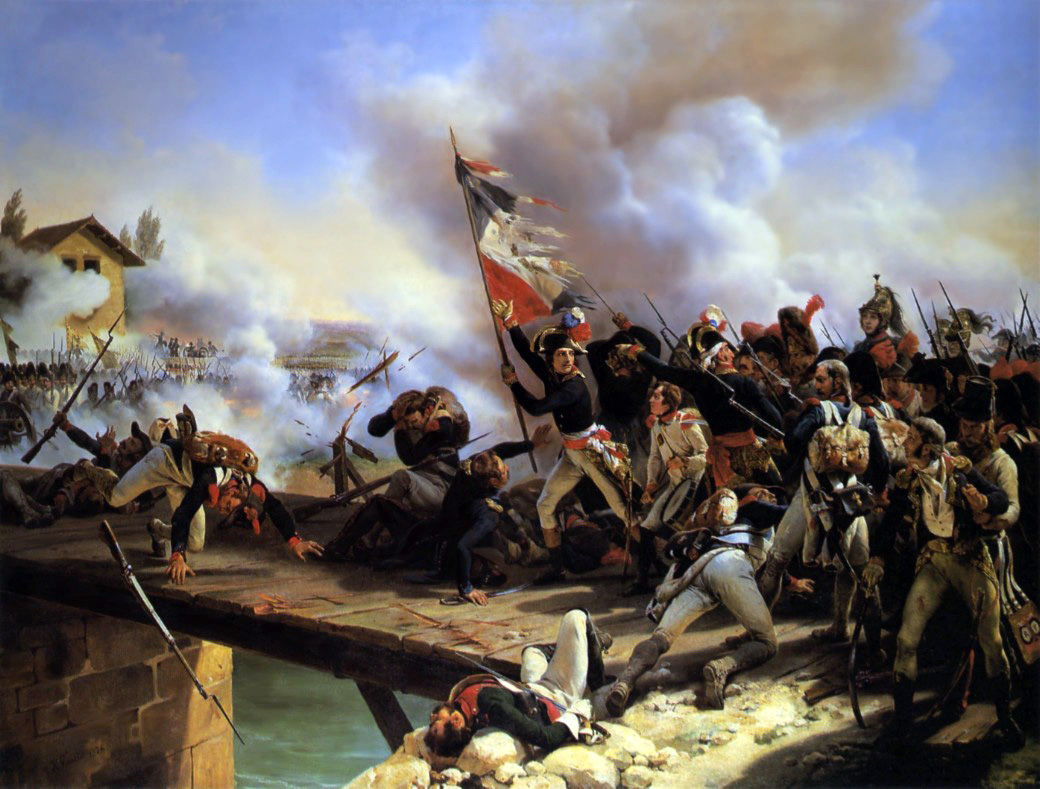
Le Petit Corporal, center, leads his men over the bridge at Arcole

The other model for Park, tellingly, was Napoleon. Napoleon had masterfully unified the military and civil governance of France, bringing a final end to the chaos of the Revolution and rising from obscurity to Emperor within 10 years through his political and military genius. His Napoleonic Code of laws still serves as the basis of law in countries all over Europe, and his soldiers exported the French Revolution to every major state on the Continent, and caused thrones to tremble from Madrid to Moscow. He was, without a doubt, the titan of his age.

Of course, he had also been unable to contain his ambition, and his overreach had eventually culminated in his overthrow by a coalition of every major power in Europe. He had been a despot and an authoritarian at home who betrayed the democratic ideals of the Revolution, one who cruelly used and abused his own loved ones in pursuit of his own ambition for glory. But details like that were irrelevant, in Park’s mind, compared to Napoleon’s masterful command of his time. Park’s only regret was that as a poor boy growing up in rural Korea, a backwater of a backwater, was that there was no outlet for his own genius and ambition. 

When Japan’s militarist clique pushed the nation into war with China, Park Chung-hee had his chance. He took his Japanese name, Takagi Masao, and enrolled at Changchun Military Academy. Talented and intelligent, his Japanese masters recommended him for staff training at the Imperial Japanese Army Academy. He graduated as a lieutenant in 1944 and served with the army in Manchuria. 

Escaping August Storm, Park returned to Korea, where he again commissioned as an officer in the embyronic ROK Army. A political difference of opinion with Rhee led to him getting the boot in 1948, but the war demanded every single able-bodied Korean and Park at last had a chance to show his quality. He returned to the ranks and quickly began to rise. A major in July 1950, he was a lieutenant colonel by September and a full colonel by April. War tends to sort out the wheat from the chaff, and the rapidly expanding Korean army needed any command talent it could get. By the time the war ended in 1953, Park was a brigadier general commanding artillery corps (his hero, Napoleon, had also got his start in the artillery). 

His wartime service had marked him as a man of talent, and he was sent to the United States for further training. He returned, headed up the Artillery School, commanded several divisions, then was made Chief of Staff of First Army, responsible for the defense of Seoul itself. It was up, up, up for General Park. By 1960, he had been made Chief of Staff of Operations for the whole Korean army. It was the perfect place for a man of ambition as Korea’s First Republic drew to an end in the April Revolution, Rhee was ousted, and the Second Republic began.

Park as a general, 1957

If this was to be the dawning of a new age of democracy and freedom for the Republic of Korea, it was, well, a bit disappointing. The liberal Democratic party, in the grand tradition of liberal parties** throughout history, couldn’t find its ass with both hands. The new president and prime minister, mostly non-entities whose names are unimportant, were caught between the conflicting demands of the student protestors who had largely been responsible for driving Rhee out of power, and the economy, which was basically in shambles after a decade of Rhee’s mismanagement and corruption. No liberal politician could truly command a majority of the House, the prime minister was elected by a razor-thin margin of 3 votes, he created his cabinet, then recreated it, then desperately recreated it a THIRD time in the space of a year as he scrambled to piece together some kind of powerbase, and the conservative military was skeptical of them all. 

While the government mostly tried to hold itself together, outside in the streets students regularly flooded out, demanding a wide range of social and economic reforms. The tight political controls of the Rhee government had been relaxed, and leftist and reformist groups took full advantage. No one trusted the police after the April Revolution, and public security deteriorated. Popular support for the Second Republic waned.

At the same time, the government’s footing was too shaky to eject the clique of what were called “liberation aristocrats” – Koreans who had ingratiated themselves with the United States military government and made their careers in the early years after independence, of whom Rhee was only the most significant example. They still infested most of the highest reaches of government and were viewed highly skeptically by most of the military. The military, most of whom, like Park, had been trained by the Japanese originally, remembered with fondness Korea’s economic development under Japan, and looked with envy at the “Japanese miracle” developing on the far side of Tsushima Strait. The conservative “liberation aristocrats”, by contrast, had kept the ROK’s economy agrarian and underdeveloped, with roughly the same per capita GDP as the Stalinist North. 

With no real legitimacy of its own, no popular support, facing harsh criticism from the conservative ruling elite and no real love from the military, the Second Republic was weak, tottering, and ready to topple at the slightest provocation. Park did not miss his chance.***

Park Chung-hee, just outside the topmost echelon of the military, was ideally positioned. The military brass were tainted by their association with Rhee’s long term, and a new cohort of reform-minded junior officers were rising. Park was at the top of this new wave. He shared with them ambiguous politics and a strong admiration for the Japanese model of authoritarian development, inculcated during his time in the Japanese military. While the Second Republic flailed ineffectually at its problems through 1960, Park quietly built a network of like-minded officers, many old friends from Manchuria, and laid the groundwork for his own Thermidor. He named his organization the Military Revolutionary Committee.

After several abortive attempts, on May 16, 1961, the plans were leaked to the central government, and the military moved to arrest the plotters. Park now seized the moment. In an eloquent speech to the 6th District Army headquarters, he persuaded the majority of the capital garrison to defect to his cause, arguing, “We have been waiting for the civilian government to bring back order to the country. The Prime Minister and Ministers, however, are mired in corruption, leading the country to the verge of collapse. We shall rise up against the government to save the country. We can accomplish our goals without bloodshed. Let us join in this Revolutionary Army to save the country.” Such was the force of his rhetoric that even the men sent to arrest the mutineers were swept up in the moment and defected. No doubt a voice from a far distant time and place, another failed arrest of a would-be coup, echoed quietly in the back of Park’s mind as he rode out towards the palace, “Soldiers, if you would shoot your emperor, here I am!”

General Park on May 16, 1961

The army quickly flooded out to occupy Seoul. The non-entity Prime Minister fled the city, while the President quietly accepted the coup and continued to serve as a figurehead. The Korean army initially prepared to respond and put down the uprising, but the threat of a North Korean invasion compelled them to remain in their positions at the DMZ. With the civilian government imploding and the military doing nothing to respond, soon more and more officials and soldiers began to switch sides. Within a week Park had fully twenty divisions backing him. Three days later, the Prime Minister and the entire cabinet emerged from hiding and resigned, ceding power to the Military Revolutionary Committee. 

Park moved to consolidate power quickly. He quickly isolated and removed any rivals, establishing himself at the head of the MRC, now renamed the Supreme Council for National Reconstruction. The thirty highest ranking Korean military officers were on the council, which held supreme civil and military power in the country – and Park sat at their head. Recognition from John Kennedy and the United States came within days of the coup. Finally, he formed the Korean Central Intelligence Agency, whose primary purpose would be to prevent any future coups. 

Within 2 months of seizing Seoul, Park had firmly established himself as the military dictator of the Republic of Korea. Sygnman Rhee had ruled for 12 years. The Second Republic had lasted less than 12 months. Park Chung-hee, who had risen from a poor boy to general of artillery to master of his nation, like his idol, Napoleon, would rule for 18 years. It was his murder that directly set in motion the chain of events leading to the Gwangju Uprising. 


*this was, of course, insane and Japan was in no way powerful enough to do this, as its crushing defeat in the Second World War should have shown. 

**Meant here in the classical sense. 

*** Let me outline my theory of Revolutions here. Feel free to ignore if you’re just here for the Korean history. Some day this will earn me my PhD.

I have come to believe that every revolution consists of, at minimum two waves. The fate of a country usually turns on the outcome of those waves – whether it enters a glorious new era of freedom and equality, or if it spirals into factional chaos and bloodshed. It all depends on the second wave.

The first wave of revolution is usually led by moderates and professional revolutionaries, established men of influence who use their influence to overturn the status quo. These usually have noble, high-minded ideals. These men are the Continental Congress in the United States, the members of the Third Estate who took the Tennis Court Oath in 1789 in France, the early liberationists in Latin America and in Haiti, the liberals who overthrew the Bourbons (again) in France in 1830, too many liberals to count in 1848, Francisco Madero in Mexico in 1910, Sun Yatsen in China, 1912, the February Revolution in Russia in 1917, and the initial moderates in the Arab Spring of 2010. 

Following the successful “revolution,” the moderates, as I term them, start to establish a government and build a new order. It’s usually light on revenge and heavy on the constitution writing. Forgiveness and moderation are the order of the day. But there’s a danger: legitimacy.

See, a successful revolution undermines the legitimacy of any government, and the new government needs time to rebuild that legitimacy. Legitimacy is a magic force which exists solely in the minds of men, that compels obedience to the authorities and respect for the law as written. Why do Americans not fear that the outgoing president will order the military to seize power and maintain him in office indefinitely? Because the American government has legitimacy, and because of that magic force such a coup is basically unthinkable. Why do the losers of elections not plot to ignore the results and seize the levers of government by force? Because of legitimacy. The legitimate government is respected.

But new revolutionary governments lack that legitimacy. They have just seized power extra-legally, after all, and various centers of power in society don’t yet know what the new heirarchy is and might be. Will the military support the new government? Will the people? The intelligentsia? Will party factions plot their own counter-revolutions, now that the door is open?

The result is that any successful revolution must navigate a period of danger after the revolution, when its resolve will be tested and various factions will attempt to seize power for themselves. If the government can survive this, gradually it will establish its own legitimacy and the danger of further revolution will cease. If it fails, then the legitimacy timer is reset and the country spirals into chaos and bloodshed. Thus, a successful revolution opens the door to further revolution.

This is the second wave. The moderates usually have broad popular support and so are able to successfully challenge the regime. The radicals, though, are usually not supported by the majority and could never achieve power on their own. Once the government is overthrown, though, well, suddenly the path to power is possible with a much narrower base of support. And so the second wave will inevitably be the “radical” revolution, much bloodier and more terrible than the first.* 

Let me illustrate by way of some historical examples, from which I derive the theory:

The American Revolution’s first wave is the one we learn about. The continental congress kicks out the British and writes the Articles of Confederation, but there is no widespread social or economic reform. The people in power after the Revolution – the Adams, Washingtons, Franklins – were largely men of influence and power before. Where is the second wave?


Well, remember why the Articles failed. Shay’s Rebellion, the Whiskey Rebellion, the conspiracy of Continental Officers to seize power from the ineffectual Congress? (I know, I blur the timelines). The young republic was repeatedly challenged by more radical elements and it could have fallen to a military coup, to a radical rural social rebellion, etc. Each time, largely through the force and influence of Gen. George Washington, the challenge  was defeated. The new Constitution was backed by Washington as the first President, and he gave the young nation the largest shot in the arm of legitimacy any young nation has ever received. We owe everything to George Washington, and that is why he is up there with Lincoln as the greatest President.

The French Revolution – 1789 sees the creation of a constitutional monarchy and slow, steady reform through the new national assembly. It is not until the coup of 1792 that the radical republicans seize power. There was no Washington figure in France, and the National Guard led by Lafayette was not up to the task of maintaining the government. The seat of power being in Paris and subject to the whims of whoever could control the city made it easy for radical factions in the second (and later) waves to seize power. It was these later waves that murdered King Louis, and these later waves htat initiated the Terror, and ultimately paved the way for Napoleon who was able to seize power and establish his own legitimacy through his military victories.

Haiti – initially the wealthy white planters kick out the French and establish independence, but in so doing open the way for the much weaker slaves to in turn topple the planter government and create the only successful example of a slave revolt in history. 

In Latin America – Bolivar and Iturbide liberate their respective nations, but are unable to maintain their governments in the force of a whirlwind of opposition from conservatives and liberals alike. Mexico and South America both descend into periodic civil wars, coups, and rule by caudillos. 

In France, in 1830, the moderates topple Charles XII. An attempt by radicals to restore the repubic is beaten back by the moderates, who swiftly move to place the house of Orleans on the throne. Louis Philippe has sufficient prestige that he is able to create a stable, if shaky, July Monarchy for a few decades. 

In 1848, the liberals are initially triumphant everywhere. The second wave is resisted in France, which becomes a republic. In most of the rest of Europe, the second wave of socialists and radicals sweeps in before the liberals can establish themselves. In the ensuing infighting conservative counterrevolution in turn rises up and crushes most of the revolutions. 

In Mexico, 1910, Maduro successfully topples the Porfiriato. But as he attempts to establish his government, he cannot make everyone happy, and leaves himself open to Huerta’s coup – the second wave. Huerta’s coup touches off revolts by the Villistas, Zapatistas, and other radicals. Mexico descends into anarchy and civil war for a decade. 

Sun Yatsen topples the Qing, but again, lacks his own legitimate support from the army and other centers of power. He is overthrown by a military coup (the second wave), and then radicals (the CCP) and others plunge China into 3 decades of civil war. 

In Russia, the February Revolution topples the tsar, but the liberal government is weak and shaky, lacking legitimacy. The second wave arrives in October, when the Bolsheviks seize power. The Russian civil war lasts 3 years. 

In the Arab Spring, the democratic reformers chase dictators out of power (or attempt to) in places from Tunisia to Bahrain. In some places, like Tunisia, they successfully stave off the second wave of more radical reformers (here Islamist radicals). In other places, they fail. In Syria, the revolution is unsuccessful but the second wave (ISIS) arrives anyway, and the Syrian civil war is ongoing 10 years later.

Basically, everything hinges on that second wave. If the government successfully beats it off, politically or militarily (usually both), then it will establish itself as the legitimate government of the state and gradually consolidate, as in the United States. If the second wave takes advantage of the weakened state to topple the government, most notably in Russia, France, and Mexico, then the Revolution will last for years and kill a lot more people than it otherwise would have. 

So when you see some dictator or something get overthrown in the news, don’t celebrate too early. Wait and see. The new government will almost inevitably face a serious challenge to itself within the next couple of years. The result of that challenge will determine the true future of the country.

There you have it – Brad’s two-wave theory of revolutions. Like I said, goin’ earn my PhD with this someday. 

*Note that I make no moral judgments when I use terms like “moderate” and “radical,” only relative political positions. Moderates don’t go as far and have support from more of the population, because they are nearer the political center. Radicals want more extreme reforms and have support from a smaller base, so they can’t strike at the initial government – but against the weaker revolutionary government, they have a chance. This says nothing about the respective justness or lack of justice of their causes – note that the white planters are the “moderates” in Haiti, and the slaves revolting for their freedom are the “radicals,” but you sure as hell know whose side I’m on.**

**Side? I am on nobody’s side – because nobody is on my side. This is my usual position. 

5.18 Chapter One: The Wrong Man for the Job

The hardest part of any story is beginning it. This is especially true of history. Did the French Revolution begin with Louis losing his head, or with the storming of the Bastille, or with the oath in the tennis court? Did the Cold War start with the Berlin blockade, with the surrender of Japan, or even earlier with the first Trinity Test? And the Gwangju uprising – do I begin with the students confronting the paratroopers in front of Chonnam University? With the military proclaiming martial law on May 17? With the December coup?

I suppose, if you want to be technical about it, we should start with Mireuk, without whom no one would have separated the earth from the sky by setting the sky on 4 copper pillars at the corners of the earth, and without whom no one would have created mankind (men from 5 golden insects, women from 5 silver), and where would we be then? 

Mireuk, creator deity of Korea.

But I will begin, I think, where almost all modern Korean history begins: with the fall of Japan.

Korea in August 1945 was an afterthought to, well, damn near everybody.

In the west, President Harry Truman was winging his way home from Potsdam, his mind full of the problems with the war against Japan, sorting out the defeated Germany, and, more than anything else, the looming threat of the Soviet Union and the implications of the new weapon he had tested out in the New Mexico desert the previous month.

In Europe, the continent was first starting to piece itself back together in the aftermath of the great war just ended. Refugees and displaced people flooded over every nation, everyone seeking loved ones, too few succeeding. Most of the continent lay in ruins, especially Germany, now divided, occupied, and dazedly trying to guess what a post-Nazi future for the country might look like – or maybe people were just trying to survive from one day to the next, like they had every day for most of the previous harrowing decade.

In Burma, Indonesia, and the Philippines, collapsing Japanese army units fought desperate, last-ditch stands against victorious Allied armies. Some men would vanish into the jungle to continue their fight there. Some would not re-emerge for thirty years. 

In Manchuria, the Red Army stormed forward in Operation August Storm, brushing aside the Japanese defenders like an NFL linemen rushing a toddler. The IJA was undersupplied, demoralized, and outnumbered – the Red Army was seasoned, well-trained, well-equipped, fresh from victory over the Wehrmacht and at the height of its power and glory. The communists smashed aside the paltry Japanese defenders and stormed south for the Yalu River.

And in the Central Pacific, the 509th Composite Group, operating from the modest North Field on the sunny island of Tinian, sent a small squadron of three B-29 Superfortresses on a strike mission to southern Japan. Their names were The Great Artiste, Necessary Evil, and Enola Gay. 

No one was thinking about Korea.

——-

After the destruction of Hiroshima and the surrender of Japan, the State Department in Foggy Bottom suddenly found themselves with a problem. Well, actually, they had many problems – maybe more problems than any State Department before or since has ever had to deal with. What do with defeated Germany? How to rebuild Western Europe? How many US troops shall we keep in uniform? What is our relationship with the Soviet Union? What about with every single “liberated” state in Eastern Europe? What of Greece, Turkey? What of the European empires in Africa and in Asia? What of the Nationalists and Communists in China? What of the former Japanese empire?

It was a rat’s nest of issues, old grudges, new opportunities, rivalries, hatreds, long-standing alliances now outdated, maps made obsolete…the old world had been shattered, and now it was up to Harry S. Truman, of Independence, Missouri, and the Department of State, to try and forge it anew. Letters and contacts poured in from all over the world. Greece, begging for aid in its civil war against Communist rebels. Poland, pleading not to be forgotten. The Soviet Union, wondering about the future of their wartime partnership. Some leftist nutter named Ho Chi Minh, asking for help booting the French out of their Indochinese possessions. Oh, yes, and what the hell do we do with the Empire of Japan and all its possessions?

Amidst this chaos, apparently no one had given forethought to the precise details of the disposition of the Japanese possessions outside the home islands. Korea had been discussed, but only in passing. On August 9, after Hiroshima, after August Storm, suddenly the surrender of Japan – something not previously thought to happen until late 1946, at the earliest – loomed as an imminent possibility. On the night of August 10, Allied military planners hurredly met to convene surrender procedures, to keep Soviets and Americans from accidentally (or not) murdering each other in the confusion.

As the official Army history puts it:

“Under pressure to produce a paper as quickly as possible, members of the Policy Section began work late at night on 10 August. They discussed possible surrender zones, the allocation of American, British, Chinese, and Russian occupation troops to accept the surrender in the zone most convenient to them, the means of actually taking the surrender of the widely scattered Japanese military forces, and the position of Russia in the Far East…

The Chief of the Policy Section, Col. Charles H. Bonesteel, had thirty minutes in which to dictate Paragraph 1 to a secretary, for the Joint Staff Planners and the State-War-Navy Coordinating Committee were impatiently awaiting the result of his work. Colonel Bonesteel thus somewhat hastily decided who would accept the Japanese surrender.

…At first Bonesteel had thought of surrender zones conforming to the provincial boundary lines. But the only map he had in his office was hardly adequate for this sort of distinction. The 38th Parallel, he noted, cut Korea approximately through the middle. If this line was agreeable to President Truman and to Generalissimo Stalin, it would place Seoul and a nearby prisoner of war camp in American hands. It would also leave enough land to be apportioned to the Chinese and British if some sort of quadripartite administration became necessary. Thus he decided to use the 38th Parallel as a hypothetical line dividing the zones within which Japanese forces in Korea would surrender to appointed American and Russian authorities.”

Policy and Direction, The First Year, 9.

The 38th parallel, decided upon by Charles Bonesteel, who was up too late on the night of August 10th, with inadequate coffee, a smarmy State Department aide joggling his elbow for him to finish, a rotten map, and only thirty minutes to work, has stood as the boundary between North and South Korea for 75 years. 

A second major problem – besides the fact that pretty much no one in the United States had ever heard of “Korea” – was that they had basically no plan in place for how to administer “their” sudden new occupation zone. The Soviets, perhaps cowed and cautious by the threat of the Bomb, placidly accepted the 38th parallel and set about converting their half of the peninsula into a glorious people’s republic. They plucked a suitable anti-Japanese guerrilla from obscurity, gave him a suitably heroic backstory, more or less made up out of whole cloth, and set him up as the Dear Leader of their new pet. Thus did Kim Il-Sung become the founding member of the present ruling house of North Korea. 

The United States had no such plan. They had no shadow government in place to assume the reins, they had no Korea desk at the State Department, hell, they didn’t even know how long they’d be in the country, let alone what they wanted to “do” with it. The Navy rapidly ferried a handful of confused soldiers up from the Philippines and flung them into Seoul, where they aimlessly milled around for a few months while the higher-ups tried to figure out what the hell they were doing. 

In the end, as is often the case with the United States, they settled on the first convenient man they ran across. And here is where the troubles began.

——

Korea, after quietly whiling away a sleepy couple of centuries under the Joseon dynasty, had fallen victim to early 20th century power politics. Initially a bone in the struggle between Qing China and Meiji Japan, Korea had first become a puppet, then an outright colony, of the island nation since 1910. But the Koreans had not taken the Japanese occupation lying down. Almost from the first, there was resistance, including in the peaceful southwestern city of Gwangju. 

Across the country, there were uprisings, protests, strikes, and riots. In the barren and frigid northern hills near the Yalu, bands of rebels roamed around bushwhacking isolated Japanese garrisons. In the cities, Koreans frequently engaged in strikes or other forms of passive resistance to their colonial occupiers. The college students did what college students do best and wrote various Statements and Declarations of Intent, and engaged in protest marches. The Japanese responded with all the grace and nuance Showa-Era Japan is famous for.

While the myriad arrests, beatings, exiles, and outright murders failed to fully pacify the peninsula (to say nothing of apolitical monstrosities like the practice of comfort women, or Unit 731’s horrors), they did serve to more or less keep a lid on things for Japan through 1945. Many groups found it too hot to stay in the peninsula itself, and exiled themselves to surrounding nations, mostly to China, which was merrily engaged in one of its regular periods of outright anarchy and civil war*. One of these groups somewhat self-importantly called itself the Korean Provisional Government in Exile, and their Representative to the United States was one Syngman Rhee. 

Rhee was born in 1875 and taught English by Methodist missionaries active in the country. He came of age just as the Japanese involvement in Korea was ramping up, and became strongly anti-Japan. In March of 1919, he joined with myriad others to instigate a gathering of students in Seoul, who proclaimed Korea’s independence. The Japanese were less amused by this than the students were, and to escape arrest, torture, and probable death, many fled to Shanghai, Rhee among them. There, his political acumen and intelligence quickly propelled him up the ranks.

Rhee’s English ability got him named Representative to the United States, and he lived there through most of the Thirties. Styling himself the Chairman of the Korean Commission to the United States, Rhee spent his days agitating against the Japanese and lobbying the American State Department for recognition and material support for Korean independence. Consumed with more important matters like the Second World War, the State Department spent most of its time, in turn, ignoring the little man from the backwater peninsula no one had ever heard of. 

Until fate intervened, and suddenly the United States found itself in possession of half of that backwater peninsula and not a clue in the world what to do with it.

“The British diplomat Roger Makins later recalled, “the American propensity to go for a man rather than a movement — Giraud among the French in 1942, Chiang Kai-shek in China. Americans have always liked the idea of dealing with a foreign leader who can be identified as ‘their man’. They are much less comfortable with movements.” Makins further added the same was the case with Rhee, as very few Americans were fluent in Korean in the 1940s or knew much about Korea, and it was simply far easier for the American occupation government to deal with Rhee than to try to understand Korea. Rhee was “acerbic, prickly, unpromising” and was regarded by the U.S. State Department, which long had dealings with him as “a dangerous mischief-maker”, but the American General John R. Hodge decided that Rhee was the best man for the Americans to back because of his fluent English and his ability to talk with authority to American officers about American subjects.”

– Max Hastings, the Korean War 

In other words, Rhee was an asshole, but he was an asshole who spoke English and, more importantly, he was available. So Syngman Rhee found himself shipped off from Washington and back to his home in Seoul for the first time in 25 years, where he became the primary liaison between the United States occupying authorities and the people of Korea. In essence, Rhee became the Korean government. 

August 15, 1948 – Korea’s first “free” elections

The years between 1945 and 1950 were the era of Translator Government in Korea. The Americans, fumbling around hopelessly in the dark, frequently leaned on former Japanese officials, who were after all fluent in the government and language of the peninsula. Understandably, this did not endear them to the people of “south” Korea, as the American half of the peninsula was coming to be known. People who could translate between English and Korean found themselves in positions of inordinate infuence, and Rhee, with his political acumen, quickly consolidated power behind himself, if not with American approval, at least with American indifference. America wanted nothing more than to be done with the funny little peninsula and get their boys back home. Its attention was always elsewhere – mostly on Berlin and Germany and the steadily growing showdown with the Ruskies. They gave half-hearted training to a South Korean “army,” which was mostly a police force meant to keep order in the peninsula and help Rhee hunt down his “Communist” opponents scattered around the South. Of course, Rhee was very generous with the term “communist” and arrests, torture, and imprisonment were par for the course for his government. Rhee also made frequent requests for heavy weapons like tanks, aircraft, and artillery, but the Americans, fearful that this “mischief-maker” would do something crazy like go haring off on an invasion of the Soviet zone to the north, refused. By 1949, all American troops were withdrawn from the peninsula, and the State Department was giving speeches suggesting that the American involvement in the little backwater of Korea was officially at end. 

Unfortunately, the North had not been idle during this time. While Rhee had been playing on his position as the middleman between the USA and the people of South Korea, Kim Il-Sung had been happily setting up his own private little kingdom in the North, with the full backing of the Soviet Union. He had built a fully modern and well-trained army, equipped with Soviet weapons, driving Soviet tanks, supported by Soviet planes. When the USA indicated that it was done with South Korea, and with Rhee corrupt, unpopular, and seemingly on shaky ground at home, Kim decideded the time was right, and on June 25, 1950, launched his shiny new army on an invasion of the south. 

——–

The Korean War is, of course, far too detailed to get into here. Suffice it to say that the United States hadn’t actually meant it was totally done with Korea, and intervened to save its newfound ally. The fighting raged down the peninsula to Busan, and up all the way to the Yalu River, and back again. Seoul changed hands 6 times. The United States carried out the longest retreat in its history, “attacked in a different direction” out of the Chosin Reservoir, and helped mold the South Korean army into a modern, effective fighting force. By the time the dust settled three years later, the battle lines were more or less right at Bonesteel’s 38th parallel and pretty much the entire peninsula lay in ruins. Oh, and Syngman Rhee now had an ironclad grip on power. 

Rhee unabashedly engaged in strong-arm and outright illegal political tactics. While he wasn’t as bad as Kim Il-Sung to the north, “not as bad as a literal Stalinist dictatorship” is a very low bar to clear. Opposition parties were harassed, their leaders frequently arrested, and at times politicians who became too prominent in opposition to Rhee were outright assassinated, such as Kim Gu. Under the pretext of resisting subversion from the north** Rhee severely curtailed political rights and elections, limiting the ability of opposition parties to dissent from his regime. At times, his security forces engaged in outright massacres, including an astonishing reported 14,000 deaths during the Jeju Uprising. (Tirman, John (2011). The Deaths of Others: The Fate of Civilians in America’s Wars. Oxford University Press. pp. 93–95. ISBN 978-0-19-538121-4. I have not investigated this claim myself). 

Through the 1950s, Rhee amended the Constitution as he willed and more or less ignored South Korea’s National Assembly, getting himself elected President 4 times. The United States grumbled over his strongarm tactics, but any instability in Korea risked opening a way for the North to invade. The threat of the North acts as a constant pressure in Korean politics, forcing unity and enabling strongmen to maintain a tight grip on power. Time and again it will be used to justify all manner of authoritarian actions, including, as we will see, in response to the May 18 Uprising. In so doing, Rhee set the model for a Korean dictator that would persevere for 40 years. South Korea was by no means a free state. It was better than the North, yes, but again – low bar. Opposing parties were allowed to exist, but certainly not to win elections. Writing an opposing newspaper might work for a while, but it would eventually get you arrested (but probably not executed). And as long as you kept your head down and ignored politics, you could live a more or less free life. 

Rhee’s ride on the tiger finally came to an end in 1960, in what would become another familiar model in Korean politics. In the spring of that year, Rhee staged yet another fraudulent election, and once again, surprise surprise, he was unexpectedly re-elected because he was so beloved by the Korean people as the father of his nation (in fact, Rhee won 100% of the vote after his main opponent died a few weeks before the election. As far as I can tell, the death was actually legitimate and not a shady assassination, surprisingly enough. Go figure). Yet again, people – mostly college and high school students, took to the streets to protest yet another sham election.*** 

A friendly difference of political opinion, Masan, March 1960

During the protests, in the southern city of Masan, the corpse of a high school student, Kim Ju-yul, was discovered. The regime announced that the boy had drowned, but autopsies revealed that his skull had been fractured by a tear gas grenade fired at point blank range. While the regime had been authoritarian and oppressive, it had never before stooped to the open murder of citizens in the streets. The Korean press widely publicized the incident, and the protests caught fire and spread through the entire country. Rhee proclaimed that it was all the work of communist agents, but the tired excuse worked no longer. Within a month, there were marches of hundreds of thousands in the streets of downtown Seoul, demanding Rhee’s resignation. Violent clashes were common, and it is estimated that more than 180 protestors died in confrontations with the police.

But the heart of the police forces weren’t really in it, and soon they began refusing orders to fire on the protestors, who no longer numbered just college students and dotty old professors but respectable Korean professionals and businessmen, too. Rhee proclaimed martial law, but the soldiers, too (no doubt noticing how badly they were outnumbered by the protestors) also refused to fire on the crowds. Left with no choice, Syngman Rhee resigned on April 26, 1960, and went into exile in sunny Hawaii. Thus ended the reign of the United States’ handpicked ruler of South Korea.

The road to the May 18 Uprising begins here, I think. Rhee came to power as a result of the inattention and lack of preparation by the United States for the role it found itself thrust into in Korea. He was emphatically the wrong man for the job. Even as Japan and Germany evolved into modern, multiparty parliamentary democracies, the Republic of Korea was a sham, ruled by an authoritarian strongman who had nothing but contempt for elections and the will of the “common people.” Rhee legitimately tried to rule wisely and well for Korea, and was constantly fearful of the threat from the north and from communists within, but his lack of respect for democratic norms and his cheerful disregard for human rights set a pattern for Korea that would persist for 30 years following his fall. It was in protest to a similar dictator that would lead to the bloody confrontation in Gwangju, 20 years after the fall of Syngman Rhee.


*”The Empire, long divided, must unite. Long united, must divide.” – Romance of the Three Kingdoms, published centuries ago and describing affairs in the 3rd century. Still true today – this line contains everything you need to know about Chinese history. 

**To be fair, for a number of years during and after the war, there were literal Communist guerrillas scattered around the mountains to the South. The threat of invasion from within wasn’t entirely made up by Rhee. He did exaggerate it and exploit it for his own purposes, though. 

***It is important to note that while South Korea is not a free nation at this time, it is not comparable to the North – imagine these protests in Pyongyang! There are degrees of freedom, and while I’m being hard on Korea here, I am emphatically not saying that North Korea and South Korea were basically interchangeable. One, while flawed, is definitely better than the other.

Prologue: https://gwangjulikeit.home.blog/2020/05/04/5-18-prologue-the-may-18-national-cemetery/

Chapter Two: [tbd]

Limbo

Not a planned post. This is actually a reddit comment I wrote that I decided, afterwards, is worth sharing.

The question was, “Who was the nicest or the worst football player you’ve ever met?” Well, I’ve only met one football player that I can recall in my life, but I think his story is worth sharing:

“This isn’t any great story, because I’ve only ever met one football player in my life: Limbo Parks. He wasn’t a greatest-of-all-time football player, but he is a very good man so I think I’ll share a little about him. Thread is old so this’ll get buried anyway, but what the hell.

Limbo was a guard for the Razerbacks back in the early ’80s. Even when I knew him in the early 2010s he was a huge, monster of a man – over six feet tall, hundreds of pounds of bulk – not fat, just sheer mass. Muscle and bone. He had an incredibly intense glare that he could use to cow any teenager with a mere glance. He earned All-American NCAA honors, but went undrafted after he graduated in 1987. By October, he was a delivery driver for Pizza Hut.

Well, in the 1987 season, the players went on strike after the 2nd game (this is what the film The Replacements was about), and Limbo got his chance. He signed with the San Francisco 49ers and for three weeks in October that year, he was a professional football player. He appeared in the three games the replacements played, all wins for the 49ers. Then the strike ended, Limbo was cut, and that was the end of his football career.

I met him 20 years later. He no longer worked for Pizza Hut, but was now my high school’s discipline specialist. I’m not sure what his exact title was, but his main job was to drive around the grounds in a golf cart and serve as the administration’s enforcer. No one acted up in detention with Limbo looming up at the front of the room. He could be seen patrolling the cafeteria regularly, or yanking miscreants out of class to come spend time with him in his little windowless office in a distant corner of the school.

As a student, I only crossed paths with him once. I was pulling into the school parking lot late on a Sunday afternoon in April, on my way to rehearsal. The lot was empty, and I was 17, so as I came up to the stop sign separating the student lot from the rear lot with the theater entrance I ignored it and blew right past. As I pulled into a spot near the theater door, the little golf cart wheeled to a stop behind me. I looked in my rearview mirror and paled, since Limbo was looking right at me, his angry eyes locked right on mine. He pointed at his eyes, pointed at me, then, scowling all the while, slowly shook his head. Then, without a word, he drove off.

I never ran that stop sign again.

Later, though, I got to know Limbo as a person. 7 years later, now sporting a shiny new master’s in education, I returned to my high school as a teacher, and he became one of my closest partners. As the new guy, I got all the “needy” classes – the slackers, hard cases, screwups, etc. They were all great kids and I loved them, but they were a challenge, and sometimes I tore my hair out trying to figure out how I was going to get all these kids over the graduation finish line.

No one worked harder at that, though, than Limbo. He met with me every day about a few students of special concern to him. Each morning he’d stick his head through my classroom door – most of his bulk still hidden out in the hallway. He’d fix me with his stare – still so intense.

“Hey. Did Cameron turn in his homework for this week?”

I’d flip through the records of one of our perennial project students. “…not yet, it seems.”

He would nod, gravely, a deep suspicion confirmed for him. “Well, if he don’t turn it in this afternoon, you send that boy straight to me, you hear?” Then he’d vanish to continue his prowl.

When I’d deliver the bad news to Cameron in 5th period that day, his eyes would grow as wide as dinner plates, but, helpless to resist, he would shuffle off to his fate.

And the next day the work would be turned in.

Cameron would pass. Lucas, a senior repeating freshman history, would pass, and would graduate. Sarah would pass, and Clinnon, and Chelsea, and Lauren, and a dozen other students, all of whom might have dropped out, might have given up, but instead graduated and earned diplomas because Limbo Parks would not let them fail. He spent the majority of his days running down students, staying on top of their assignments, keeping a close eye on dozens of students’ grades scattered across every class and year. He’d been doing it all along – he was so much more than an enforcer on a golf cart. For many students, Limbo Parks was the reason they graduated. Because he cared, as much or more than any of the classroom teachers. By now, I expect there are hundreds of students in the Kansas City metro area who owe their diplomas to his efforts.”

Limbo with a University of Arkansas recruit. He’s a big guy.

5.18 Prologue: The May 18 National Cemetery

It’s quiet at the May 18 National Cemetery. 

Oh, there’s the sound of running water, from the fountains that line the massive pavilion at the center. You can hear the sound of early spring birds on this bright clear day in April. The wind whispers gently through the trees on the hills looking down on the graves. But otherwise…tranquility. 

This is a rare thing, in Korea. 

In the United States, I think we take quiet for granted. There are places you can go without the sounds of people filling the streets, with no military jets flying overhead, without the constant buzz of moped delivery drivers racing down the streets and sidewalks. Sometimes, late at night, you don’t hear the engine noise, of the noraebangs and clubs blasting their music into the alleyways. The alarms of garage gates and traffic crossings, the deep rumble of bus engines, and the unending chatter and laughter of thousands of people out and about at all times – well, in the USA you can be free of that. 

Not so here. I don’t know about the Korean countryside, but in Gwangju, in Cheomdan, my neighborhood, the city does not sleep. Every hour of every day is filled with the noisy business of human life, as people hurry about their work, about their play, about their lives. You get used to it after a while, but you also forget what quiet sounds like. 

Unless you come out here, to the cemetery. 

It sits outside the city, this place of martyrs. A few miles from the heart of downtown, in the midst of the encircling mountains about Gwangju, a placid garden of serenity has been carved out of the landscape. It sits in a bowl, with most of the tombstones on the hillside (as is the Korean fashion). A few outbuildings and museums surround a massive central plaza, ringed in fountains that sparkle in the springtime sun. There are gardens, and trees, and flowers – not in bloom yet, but soon they will open up and this place will explode into color. 

 At the center of the plaza stands a large sculpted tower, twin spires gently compassing a bronze torch one hundred and thirty feet above the ground. To either side of the tower are carved reliefs of human figures – people holding signs, building barricades, gathered around a lone speaker standing atop a massive fountain – and some clutching rifles. Nearby is a statue of a jeep, of all things. Around and on the jeep stand more figures in bronze, young people in ordinary clothing, their fists upraised in defiance, flags and rifles held in their hands. Behind, carved messages in Korean English line a stone wall, proclaiming the story of these martyrs.

Beyond that lies the graves. 

There are hundreds of them, small barrows standing in neat lines along the hillside. Row upon row they wind back up the hill. They are covered in neatly trimmed grass, most with fresh flowers lying before them. Every barrow – dolmen, they’re called –  has a small gravestone in front of it. Printed neatly and humbly in Korean characters is a person’s name, and their place, and time of death. The dates are all similar – mid to late May, 1980. Many have crosses carved into them. Some have bowls of incense in front of them, and some of those are even lit. All are lovingly cared for. But the most powerful part, at least for me, are the photos. 

In front of nearly every dolmen there is a photo. Black and white, for the most part. Faces of every age and description smile out from them. Here a young college boy, his goofy grin framed by the long, tousled locks that were the style of the day. There a dignified professor sits in his carefully maintained serenity, in his best suit and his too-large glasses. A middle aged woman with a gentle smile and the calm, sensible hairstyle of her time. Every photo a snapshot of a place and time – Korea, in 1980. Every single one there to remind you that behind this tombstone is a person. A person with their own story, their likes and dislikes. Maybe a boy who had scarcely thought about what he would wear for his school photo that day. Here a young woman caught in the act of laughing with her friends – no official photo. Maybe this is the only one of her that survives? The only record of her left in this world, here, in this quiet little cemetery on this quiet little hill outside the big noisy city. 

Some of the graves, of course, have no photos at all. Just a name, perhaps a cross and a date.

They are just as well-cared for as the others. 

In total, there are 482 people who rest here. This was not their original location – the military dictatorship that murdered them would never allow such a place of honor for those who died battling their regime. No, this place was established in 1993, following the democratization of Korea. As the new government sought to atone for the sins of the past, the bodies of the honored dead were exhumed and brought out here, to be re-entombed and remembered forever. The entire May 18th National Cemetery stands as a memorial and a museum for those who gave their lives in the Gwangju Uprising of 1980. In Gwangju, it is a famous place. 

But not outside Korea, curiously enough. This cemetery, which preserves the mortal remains of more people than were killed in the Tiananmen Square massacre, is virtually unknown in the wider world. The West as a whole knows virtually nothing about the Gwangju Uprising – at least, I did not, and if you will permit me a small moment of egotism, I know a fair bit more about world history than the average Westerner. 

I’m not sure why that should be so. Korea itself hails the Uprising as the start on the country’s long road to democracy. At the time, reporters from all over the world gathered here to carry the news from the city to the wider world. But it has since been overshadowed by other revolutions – again, the best parallel I can think of is Tiananmen Square, where pro-democracy protestors were crushed by the Chinese regime. The same happened here, but the protestors were more successful – for a while. And more of them ultimately died. 

We forget, I think, because it is inconvenient, sometimes, to remember. It’s inconvenient that a US ally murdered hundreds of its own citizens in order to prop up a tinpot regime that seized power in the midst of a military coup. It’s inconvenient that the troops doing the murdering were there with the tacit approval and active complicity of the United States. At the time, it was easier to accept the regime’s narrative of “riots” and Communist agitators than to court a crisis with a key Cold War bastion, at a time when Russians were invading Afghanistan, when Iran had seized our embassy, and the entire country was undergoing a crisis of confidence. So, in the United States, and by proxy the rest of the West, there is almost no popular memory of a week in Gwangju 40 years ago, a sunny, warm May much like this one, when an entire city threw out a modern, well-trained army and kept them out for days. 

I had heard of the story when I came, and memories of the uprising are everywhere around the city, but I didn’t know the details. So, one day, to sate my curiosity, I made my way out here. I would learn, and hey, maybe it would make a good blog post one day. It wound up being much more than that.

The first thing I noticed, of course, was the quiet. That was rare, and it instantly impressed upon me a sense of peace that I hadn’t felt in months. Then, of course, you notice the pillars, and the sculpture. This is not the sort of monument you build to a mere riot. 

What struck me most, like I said, was the photos. It is easy, I think, to forget that the names in history books – if they make into history books at all, which most do not – are people. Row upon row, their faces gazed out at me across 40 years. Still young, still with those eyes full of hope, the infectious grins that I’ve seen on young people all over the world – I am young, and my whole life is in front of me, and this is a good time to be alive. College students, mostly, mixed in with their professors and other civilians. Going to school, working towards degrees, towards one day jobs, families of their own. The future. Most of them will always be young, now. Growing old – this is not their fate. 

And that was what got me. Because most of these people knew the risks they were taking. They knew that to protest the regime meant death, for many. Not even police dogs and firehoses, not tear gas, but actual bullets and grenades. It would be easy to keep your head down, to not join in, to preserve that entire bright shining future and just get on with your life. But the 482 people here, along with many others – the total numbers of the dead are not known, even today. The total numbers who participated in the uprising can never be known – made the choice to place those futures on the line, to stand up, take their chances, for the simple right to govern themselves. 

The same basic impulse that drove colonists in Boston and Virginia 250 years ago, the same that would sweep across the communist nations of Europe 10 years after the uprising – just the simple assertion that I will govern my own life, and no others. It’s a cause worth fighting for, to be sure, and these people did, and backed up their principles with their lives. 

And we have forgotten them.

In a few days, it will be the 40th anniversary of the May 18th Gwangju Uprising. The city here is being steadily engulfed in the preparations to mark the occasion. Many Koreans are working hard on art projects, on posters and films, on documentaries and essays and poems, to memorialize the dawn of their democratic movement. But I don’t know much of that will exist in English. There’s actually surprisingly little material in English to work with – a few poorly translated books, vague encyclopedia articles, and outdated (and misinformed) news reports from the time. 

Well, let this, then, be my small contribution to the history of Gwangju. I stood in front of the rows upon rows of dolmen, and I promised them that I, at least, would learn their story. And do my best to share it with others. For a brief while, perhaps, these happy young college kids and the ordinary people of 40 years ago can live again. And the sacrifice that they made so that others might live freely can – even if only in a small corner of the Internet – be remembered.

Chapter One: https://gwangjulikeit.home.blog/2020/05/18/5-18-chapter-one-the-thirty-year-prologue/

Korea in the Time of Corona

So I got wrapped up in my Japan trip and I never did talk about the last three months in Korea (it was only 2 months when I started writing, oops). 

By now, the coronavirus and Korea’s response to it has become old news around the world, but I think it might still be good to talk about my experience with it. It could be interesting from a historical perspective some day! I’m going to have a unique view, totally missing out on the common US cultural experience of the quarantine and the lockdown. 

I first heard of the scary reports coming out of Wuhan a week or two before my trip. This was around the time the city went into lockdown. Now, you know that reports of some terrible new disease in China are a dime a dozen, and most of them don’t ever amount to anything. But Wuhan was new – I’d never seen an entire city locked down before, and there were really interesting stories and blog posts coming out of people trapped in the city. You heard about people being welded into their apartments, about the CCP building entirely new hospitals in two weeks, about young, healthy doctors dying from the disease…I knew it was something to keep an eye on as I travelled. 

A man cross an empty highway road on February 3, 2020 in Wuhan, Hubei province, China.

In Japan, things weren’t bad. Lots of people were in masks, I noticed. Now, mask-wearing is pretty common in Asia – I found it strange at first but after months of living here it was totally normal to me. The air pollution, especially blowing across the Yellow Sea from China, is pretty bad most days, to the point that I have an app on my phone alerting me when it’s unsafe to go outside. Masks help fight that, so they’re almost a fashion accessory here. Thank God for the Clean Air Act, is all I can say. But masks, while not unheard of, were never especially common – I’d guess that between 1/10 to 1/5 people wore them. In Japan, it was closer to 1/3 to 1/2, which confused me for a while because the air in Japan was so much cleaner. I didn’t realize until a few days in that it was the virus. 

But it was still mostly confined to China, with only a handful of cases outside that country. Tourist attractions were all still open (thank goodness), planes were still flying (thank goodness), there was no panic. I left Tokyo less than two days before Diamond Princess docked in Yokohama (near battleship Mikasa!) and was immediately quarantined. In Seoul, there were infrared cameras at the airport measuring our temperature, and we were required to self-report any symptoms to customs agents. 
Even in Seoul, though, there was no concern yet. New arrivals were all screened, especially those from China, but everything was open and public gatherings were commonplace. I spent Saturday morning in Seoul, walking through the heart of the city to one of the ancient palaces. Down the main thoroughfare, there was a massive rally in support of “Donal Trump” and the United States, as the political opposition accused President Moon Jae-In of cozying up to North Korea and betraying Korea’s special relationship with the USA. The palace was overrun with tourists, too, and generally life was normal in the capital. 

This was the cherry on top of my Japan vacation.

I stayed home Monday to watch the Super Bowl, and for the next two weeks my time was split between planning for the upcoming semester, due to start February 28, and watching Super Bowl highlights, analysis, and reaction. Through this time, Korea had barely 30 new cases, although anyone who travelled outside the country was now subject to a (self-enforced) two-week home quarantine when they returned. 

It was February 17 that everything changed. The 31st patient with corona, a woman who had contact with someone newly arrived from Wuhan, I believe, traveled from Seoul to the southeastern city of Daegu. Daegu is a large city of 2.5 million people, the 4th largest in Korea. It served as temporary capital during the war and was (just barely) successfully defended from the North’s invasion. It’s a favorite destination of many English teachers who live in the surrounding countryside. Patient 31, as she became known, left Seoul, was involved in a minor car accident early in February, and checked herself into the hospital. While there, she developed flu-like symptoms, but her flu test came back negative. It was at this time that she went to church – twice. But not a little Catholic church like St. Mary’s.

Korea’s fastest growing religion is Christianity, in all forms. I have Mormon missionary friends, of course, but you have dozens of Protestant congregations growing quickly as well. There are tons of off-shoots and weird little sub-cults (ask me about the church of God the Mother sometime…) as different kinds of Christianity spread all over the peninsula like kudzu. This woman belonged to one such new church. She went to Shincheonji Church of Jesus, massive superchurch with more than 1,000 congregants, all of whom were now exposed. 

Shincheonji Church of Jesus. Yikes.

From Daegu, things exploded, as the congregants had scattered all over. The number of cases exploded from barely 30 to thousands over just a few days. Korea looked like it was going to slide into a nationwide pandemic, with the attendant death and suffering involved. It’s here, though, that the government really stepped up.

First, the new school year was due to start on February 24th for us (28th for most everyone else, I think). We’d have hundreds of students coming from all over the country to stay in our dorms and work in our small classrooms. Well, right away that was delayed for two weeks. Korea took the unprecedented step of cancelling the start of the school year nationwide for two weeks – and I’ve written before about how zealously Koreans view education. This should have been a huge warning bell to everyone watching, including in the USA, that this was serious. Church gatherings, sports leagues like KBO, concerts, and other public events quickly followed. 

Koreans queuing for more masks outside a department store. You look weird if you go out NOT in a mask here.

Second, mask-wearing became universal almost overnight. You couldn’t go into a bar or a restaurant without a mask – hell, you could barely go out in public without one. People queued by the hundreds to buy masks from any available outlet. The government quickly instituted a rationing system, based on your birthday – those whose birthdays fell on a day ending in 0 or 1 bought on Monday, 2 or 3 on Tuesday, etc. You couldn’t get a mask without an ID verifying your birthdate. Now, masks don’t do much to protect you individually, not unless they’re airtight. But if everyone is wearing one, then asymptomatic transmission becomes much, much more difficult. I resisted, at first, because I believed then (and still do) that a mask would do little to prevent the spread, but after a scolding from my principal I came to accept it, if nothing else to reassure my neighbors, and spent most of March and April masked up any time I went outside. 

Third, social distancing was a thing in Korea much more quickly than in the United States, and in many ways the nation was prepared for it. Food delivery was already ubiquitous in Korea – delivery drivers zipping around on mopeds is so common that I didn’t even think to mention it until now. Now it just became even more common. People didn’t go to bars or restaurants as often; if you did, you were only allowed in with a mask, and if you were allowed in, you had your temperature checked first. With most people masked up and distanced (although not locked into their apartments – I continued to see and hang out with friends, a bit), with new arrivals now being universally quarantined, most asymptomatic transmission was immediately cut down. 
That just left the Daegu cluster, and the government’s most important step, I think: Universal testing and contact tracing. I think this was the USA’s biggest screw up, and given the lead time the US had to prepare, this is pretty inexcusible. 

Korea immediately made cheap, plentiful, coronavirus testing kits. Overnight drive-through test centers sprang up all around the country. I walked by several daily on my way to and from work. You could go into a little tent, have a blood sample taken, and know your results within a few hours. This was either free at the point of use or incredibly cheap, like 20,000 won. So most people who had it knew very, very quickly. 

Meanwhile, the government dedicated huge amount of resources to running down those with the virus, starting with the Daegu supercluster. For weeks, anyone who had been to the church was contacted by the authorities, and their movements traced. Anyone they had come in contact with was also traced. People who tested negative were told to self-quarantine and otherwise let go. Those testing positive were universally quarantined, hospitalized if necessary, and their contacts traced. It took weeks to catch up, and Korea’s numbers skyrocketed from 30 to 10,000 over the next 6 weeks, but after peaking on February 29 at 909 new cases, the new daily infections gradually started to slow, then level off, then dropped to a trickle. Yesterday, there were 0 new domestic cases for the first time since early February. 4 new cases arrived from overseas, and that’s all. 

In the meantime, the rest of the world kind of forgot about Korea, as Iran, then Italy, then the USA itself fell victim one by one to the disease. The USA should have locked down far sooner than it did, with the voluntary social distancing and isolation that Korea did in the weeks before the Daegu outbreak. Mask-wearing should have become more widespread sooner – I assume cultural reasons are why it took so long to start in the first place – and the continued lack of testing and contact tracing is, as I said, inexcusable. 

But life here has been sort of normal the last 2 months since things exploded in late February. I wear a mask to go out and when I ride the bus, I get my temperature taken when I eat in a restaurant, my school has a thermal camera measuring my temperature when I walk in in the morning. School was delayed two weeks, then two more weeks, then two weeks again, but finally early in April we started teaching online via zoom, so I’ve been scrambling to learn how to do that and to adapt my curriculum. Gradually places like the public parks and hiking trails have filled up again, and my friends and I meet regularly on weekends to celebrate birthdays or just enjoy each other’s company. 

As a sign of how the Korean people feel, the day I was in Seoul, there were rallies and protests against President Moon, and his approval rating was underwater. On April 15, Korea had legislative elections – even in the midst of the pandemic. You had to wear a mask to vote, you were issued disposable gloves, and you had to stand at least 6 feet apart from everyone in the queues. But they had the elections nevertheless, and President Moon’s party won a landslide victory. Koreans have compared their governments’ response with the rest of the world’s, and been pretty satisfied. Understandably so – Korea more or less beat this thing, straight up. Korea has had less than 250 deaths, out of a population of more than 50 million. It should be viewed as a case study for decades to come on how to combat a pandemic. So now Koreans are full of patriotic pride, and are starting to, I think, get over a little bit of the historic inferiority complex they’ve had regarding the West. This was the front page of the country’s English language newspaper earlier this week:

Note Asia lighting the way forward. 

Life here is getting back to fully normal. With 0 new domestic cases, and total cases in the country dropping towards zero, there’s talk of reopening everything. KBO has restarted its preseason, and will start playing live games (without spectators) soon. Schools are projected to re-open possibly as early as next week, and the government has put together detailed plans for what reopening will look like and safety measures in place to prevent renewed outbreaks. The streets and public transport are busy again, and I have gone out the last few days into the spring air without a mask (although probably more than 50% of people are still wearing them). 

School keeps me busy, though. Rewriting my lessons to be taught online, actually teaching them, and grading the resulting work occupies most of my spare time during the week. On the weekends, I try to maximize my time with my friends here, since I know the time is soon coming when I shall return home, and I will probably never see most of them again. I read the news from the US, and I shake my head, but thankfully everyone in our family is safe and healthy. 

So, that’s my view of the corona pandemic from Korea. I didn’t have very many adventures, but that’s just a reflection of the competence of the government. No desperation, no near death experiences, hardly even a ripple in my daily routine. I lived in uninteresting times here. And that’s all that you can ask, I think.

May we all someday live in uninteresting times.