Japan, final January 31st -February 1, 2020

I want to finish my Japan narrative – school started last week and I’ve been busy. But I want to knock it out, then quickly sum up the last few weeks in Korea. 

So, I woke up Friday, pretty sad, because I knew I had to go home that day. My flight was at 7, so I should probably get to the airport at 5. But that still left me a solid 8 hours to wrap up my time in Japan, and I had a few suggestions. So, I’d check those items off my bucket list before bidding farewell. First, there was a really minor tourist attraction just a kilometer or two from my hotel.

The Japanese movie Your Name is one of the best movies I saw a few years ago. It’s animated, about a girl from the Japanese countryside and a boy from Tokyo. Every night when they go to sleep, they wake up the next morning in the other one’s body – like a constant Freaky Friday sort of thing. 

 The final scene of the movie takes place on an extremely distinctive staircase – here’s the last scene. 

 The whole movie lovingly reproduced Tokyo, with gorgeous animation and music, and honestly might be one of my top 10 movies ever. Anyway, the staircase was nearby, so on my last day I took a walk through a beautiful Tokyo morning. The day was bright and clear and cool – absolutely perfect weather. The streets were waking up with people hurrying to work. I walked along some pretty big boulevards, then into a small neighborhood fully of narrow, twisty alleyways. I came down one alley and turned into a temple courtyard, knowing it was the right place, but I didn’t see the stairs. There was an obvious hill next to the temple, though, and a staircase descending. I went down, then realized: duh, the staircase had to be somewhere on this hill! So I turned and walked parallel for a block or two, and there it was. 

I had to dodge couples taking photos on it, but I did get a few shots of it empty, too. I like this overview the best, though. 

From there, I wandered. I knew I was a few blocks away from a “national park,” but I didn’t know what that meant. Turns out, it was a massive city park in the heart of Tokyo that was a gift from the Imperial family. This would be my last Japanese garden, but I think the Japanese have the best gardens in the world (based on this trip), so I was all about that anyway. I walked the few blocks there, turned in, bought my ticket from a lonely guard sitting by himself at the gate (not many people there on a weekday morning, I guess), and explored for a few hours. 

My first stop was a greenhouse, which was heavenly. I liked the cool weather outside, but I also ahd sort of forgotten what heat felt like. The greenhouse was bright, warm, humid, and full of plants and water. It was honestly my favorite part of the park. I really liked the waterfall in the middle. When I’m a millionaire after inheriting my old man’s Powerball winnings, I’ll have a greenhouse in my mansion. 

Overall, I spent a good few hours at the park. Japanese parks usually go for a landscaped pond with a bridge and a teahouse somewhere overlooking the water – I saw it in Hiroshima, in Himeji, and in Kyoto before this, and now I see it in Tokyo, too. Universally they look like extremely pleasant places to relax. I can imagine sitting with a book and a cup of hot tea, watching the rain fall on the koi pond. Otherwise, they don’t really go for flowers, but more trees and bushes. Then again, it was late January, so it probably just wasn’t flower season. Still, if they look this good in the winter, can you imagine spring? Or summer? Or fall? Sometime you should go on a garden tour of Japan, is what I’m saying here, I think. 

About 11 or noonish, I headed out of the park (past the same greenhouse) and a few blocks to another subway station. I bought another 24-hour subway pass, and this time deciphering the map to figure out where in the tangled mass of spaghetti my next destination was was super easy – I had gotten pretty good at navigating Tokyo’s metro system, and am actually a huge fan of it now. I headed all the way across Tokyo, from the western suburbs of the city clear to the eastern suburbs, along the banks of the Sumida river (one of the reasons Tokyo was founded – it was a little fishing village along the riverbank). Asakusa district is a famous traditional Tokyo neighborhood, with many temples and older buildings. Of course, “older” in Tokyo means buildings dating from the ’50s and ’60s – Curtis LeMay’s tender attentions saw to that. 

Anyway, the first thing you see in Asakusa is the gate to the Senso-ji temple, which is one of the oldest and most famous Buddhist temples in Japan (albeit not as grand as the Kyoto temples I had seen on Tuesday):

finalgate.jpg

This was maybe the most crowded place I had been in Tokyo. Shoulder-to-shoulder masses everywhere. I had a group of schoolkids in front of me at one point, chattering away. They weren’t in my way or anything, I was mostly just gawking at stuff, but when they spotted the foreigner behind them they started apologizing profusely in English (“Sorry, sorry! Sorry sir!”), bowing, and clearing the way. It was kind of funny, honestly. I stood on the very edge of a busy street behind me to get this photo and still barely had room.

Beyond, it’s not much better:

finalcrowds.jpg
finalshopping.jpg

There’res a large shopping area with tons of tiny stalls, food stands, souvenir shops, tourist traps, all manner of stuff. And of course, shoulder to shoulder crowds. I elbowed my way through, eventually passing through another gate (visible in the distance in the second photo) and onto the temple grounds, which were overrun with tourists and schoolchildren on a field trip. The temple was crowded with burning incense and lots of washing stations (visible in the top photo, taken from the temple porch and looking back the way I came). 

I wandered in and out, and around the temple grounds, which has a number of traditional buildings and gardens, taking lots of photos. One thing, of course, loomed over the entire temple. About half a mile away was the Skytree.

finalskytree.jpg
What I saw when I emerged from the subway station at Asakusa.
finalskytreetemple.jpg
finalskytreetemplewide.jpg

I had no idea what the Skytree was before coming to Tokyo. The previous evening, at Tokyo Tower, it had been pointed out to me, but it wasn’t very prominent at night and so I paid little attention to it. Here, though, it very clearly loomed on the horizon – it’s the first thing I saw leaving the subway station, and no matter where you go, you can see it peeking over buildings. So, I decided that would be my final Tokyo destination. 

I crossed the street at about 1:00 and ate lunch at a classic ramen restaurant just opposite the main district gates. Squeezed in through the door – barely room for me and my backpack – printed an order slip from the machine in front, and handed it to one of apparently two employees – the barman and the chef. I managed to squeeze myself and all my belongings into a little seat at the bar, and had a delicious, hot ramen meal. Last thing I would eat in this country, probably. From there, it was off to the Skytree.

I opted not to check any maps – I could see the damn place after all – so it was a fun walk, and further than I thought, probably half a mile to a mile. I crossed a bridge over the river, headed through a plaza near some government offices (and a statue of some long-dead poet), then up and down alleyways, gradually working my way closer. Finally, I reached the base of the building and then couldn’t figure out how to get inside. There was a subway station in the basement, but how did you get in from the ground? I had to walk 3/4 of the way around before I found an escalator onto a 3rd floor terrace, which connected two separate buildings. One was a mall/ticket office, the other was the Skytree itself. It probably took an hour, but at last I was in an elevator and headed to the top. 

The top is nearly 500 meters above Tokyo – well, the highest floor is 481 meters, or 1,480 ft. The whole tower is 634 meters. By contrast, the CN Tower in Toronto is 553 meters. The Skytree is the tallest tower in the world, and the second-tallest free standing structure in the world after the Burj Khalifa in Dubai (which is, apparently, not a proper tower). I didn’t know this until long after the fact – at the time, I just thought, “Wow! This place is super tall!” 

finalskytreelower.jpg

I roamed the Skytree’s upper and lower decks for a few hours, gawking at the tourists and at Tokyo. I knew that once I left, it was time for the airport and back to Korea, not knowing when I’d return.  You could see the entire city from the top, of course. I looked back and I could see pretty much everything I’d explored, all the way to Mt. Fuji. I could see the Imperial Palace and knew that Tokyo Station and the Dai Ichi building (I forgot to mention walking past that – it was MacArthur’s headquarters while he ran Japan after the war, including during the Korean war…it wasn’t super interesting. Just a building) were close by. I could see Akibahara. I could make out, distantly, the national park from this morning, and the Tokyo Tower. I could easily see the temple district a half mile away, down to the individual buildings.

Looking back, you can see the temple area at dead center, and upper center, the imperial palace gardens. 

You can see the gate at center, and the temple at center-right. The street at left is the where I took the first picture of the crowds above from. 

Looking northwest. You can see the roof of the temple at center left.

All of Tokyo spread out below me, one last time. The top deck looped around itself once from the elevator, a gently sloping ramp that peaked at the 455ish meter mark (I don’t remember, I’m writing this email over multiple days!), and then sloping back down to a second elevator to take you down to the main deck. It was crowded with families and school kids, and it was bright and warm with all the sunlight streaming in through the windows. I wandered around, then went down to the main deck, about 100 meters lower, and wandered around some more. You had glass floors there where you could look straight down the tower – people were afraid to walk on them, as if the glass might shatter at any moment! I don’t get vertigo, so I didn’t mind them at all. There was also a cafe there, so as it got closer to 4:00 (when it would be time to depart, possibly forever), I got myself a green tea latte, perched on a stool, and looked out over the city one last time.

finalcoffee.jpg
I could almost tell my story of Japan in terms of drinks I had. From the New Year’s Sake celebration to the tea ceremony in Hiroshima to the beer with the animatronic engineers to this coffee, I had some good times. Maybe an article someday.

Finally, though, I had stalled long enough. I shrugged my backpack on again, hopped off the stool, and took the elevator down to the bottom floor. It took some doing, but I eventually found the subway station (I never did locate the main entrance, but I found an elevator on the street that took me down to it) and worked out how to get to Narita Airport, which is situated just outside Tokyo to the east (although it’s still part of the metro area – the urban footprint of Tokyo sprawls out over the entire plain – I think every flat part of Japan is built up at this point and only the mountains are left undeveloped). I was a bit concerned, because I couldn’t tell for certain if I was on the right train – this one had me getting off and transferring at a station about halfway there, and the signs were a bit confusing. I piled out at the station and had about 30 minutes to wait on the platform (little station) before the train arrived. I saw a trio of young white guys with suitcases nearby, speaking English in Australian accents. I wandered over and asked the Aussies if they were waiting for the train to the airport, too, which confirmed I was headed the right way. Nice guys, from Perth, travelling on winter break before heading back to college.  

I left the tower around 4, but the train ride was so long that I didn’t reach Narita until 6ish and it was fully dark when the train chugged into the underground station. There were hundreds of people pouring off the train and up through a labyrinth of tunnels and stairs into the airport departures lounge. It took long minutes of escalators and gates and tunnels before I finally made it into the airport proper, then up into the check-in area. Only one desk was working – corona was spreading around Asia now, and travel was starting to slow. Masks had become more and more widespread while I was in Japan, though I still didn’t think much of it. This was around February 1st, so the virus was newly out of Wuhan. I shuffled through the line, which was mostly full of Koreans since the route was Tokyo – Seoul, did the usual check in and whatnot (my Korean visa, though, meant there was much less scrutiny than when I was headed into Japan), and soon was winding through security. Lines were short, that late and with only one flight departing. I had a bottle of hand lotion I had bought as a favor for a friend alllll the way back in Hakata Station my first night in Japan confiscated – forgot the durned thing was in my bag, but of course you can’t take liquids on an airplane lest you attempt to murder everyone on board – but otherwise there were no issues. I had time to grab a quick dinner from an overpriced airport Vietnamese restaurant, and only waited about 30 minutes at the gate before it was time to end my time in Japan. I had a seat in the very last row of the airplane, entirely to myself. Safety instructions were given three times – first in Japanese, then in Korean, and finally in English – and then we lifted off. I stuck my phone against the window and took one final picture of the land of the Rising Sun before it vanished into the darkness below me.

finaljapan.jpg
Heading west, over Tokyo one last time.

The flight was short and uneventful. So were customs in Incheon – I came through the very same gate that I had 6 months earlier, in August, but this time it was much easier. My Korean was better, and I got to bypass pretty much all the foreigner lines by flashing my Alien Registration Card, which is as good as a Korean passport for getting through Korean customs. It took scant minutes before I was out in the main airport, with no baggage to claim. It was 11:00 at night, though, and I still needed to reach Seoul, where I’d stay the night. I flagged down a taxi driver, collapsed into the back of his cab, and prayed he wouldn’t murder me while I more or less napped on the 40 minute drive into the Korean capital. 

He did not take me to an isolated area and murder me, so that was nice. He let me out downtown, a few blocks from my last hostel. I wound through the streets a bit, but found it without too much trouble, thankfully – it was now nearly midnight. I went through a door (covered in signs scolding guests to please consider the neighbors and be quiet, also stop drinking in public) and descended into a basement, past a large metal door. Inside was a noisy, well-lit lounge, with beat-up, comfortable looking leather couches and armchairs scattered around a few TVs, while Korean hip-hop thumped through hte air. A pair of young Koreans sat behind the desk, a man and a woman. They ran through the welcome nonsense and led me to my room. It was small, compared to the big Japanese dorms, and not nearly as nice. No private bunks here with anything so fancy as curtains and private outlets – just a grim concrete room with cheap metal frame bunkbeds, no shelves. The bottom bunks were claimed by other travellers already, and one already held a sleeping form, so I had to settle for a top bunk. The entire damned bed swayed as I climbed in, and I was afraid it would topple over. 

A few minutes later, a large Slavic man entered the room. He looked, well, the very model of your stereotypical Russian – large, beefy frame, heavy brows over dark eyes, a large hooked nose, close-shaven skull, wearing a wife-beater and boxer shorts for bed. He spoke English well, with a thick Russian accent, and was a really friendly guy. 

“Hello, friend! What is, uh, what is name? Brad? Good to meet you, Brad! I am Yuri. You know where I am from? Yes, yes, Russia! How are you knowing? Good, good… I am from Yakutsk. You know Yakutsk?” I did. It’s a territory in Siberia in Risk. “Wow, you are smart guy! No one knows Yakutsk! What are you doing here, Brad from America?” 

Yuri was gregarious and warm, but he was also obviously lonely. He chattered away while I got ready for bed. He was from Yakutsk, but hadn’t lived there in years. He had an ex-wife, and a 4-year old daughter living in Moscow. He hadn’t seen her in more than a year, and missed her terribly, but he was trying to save up money to go home. He lived in Manila, where he taught English to people – hence why his English was so good (albeit heavily accented). He wondered if he would see his daughter soon – did I have a wife, a child? Not yet? Well, someday, Brad from America, someday! He liked meeting people in his travels, and liked Asia because it was so cheap. Someday, though, he would move to Moscow to be near his family. Yuri was perhaps too friendly for after midnight after the draining week I’d just had, but at the same time there was something a bit pathetic, perhaps a bit pitiful, about him that I couldn’t help but feel warmly towards him. I hope that he does fulfill his dream of moving to Moscow and living near his daughter.

Eventually, I drifted off to sleep, and when I woke up the next morning after an uncomfortable night, Yuri was snoring away contendedly in the bunk below mine. I slipped out of bed, headed alllll the way across the building to the lone male bathroom on the floor, squeezed into a tiny, concrete pillbox of a shower, and got myself more or less cleaned up. Then I dressed and checked out, while Yuri still slept, and that was the last I ever saw of Yuri from Yakutsk. 

I had a few hours in Seoul – I had scheduled more than a day, in fact – but I was so exhausted from everything that after a morning poking around the ancient palace of the Korean kings, I couldn’t really face a full day exploring the city, not with my comfy apartment just a short busride away. I’d return to Seoul, some day. So I found a subway station, made my way to the Seoul bus terminal, and by lunchtime was on a bus for Gwangju. I arrived in the city by 5ish, hopped on another city bus for home, and by 7 pm Saturday night had collapsed into bed. 

The day after that was Super Bowl Sunday, which I spent in a haze of giddy anticipation and anxiety (to be honest, I didn’t expect to win, but tried to tell myself I was happy just to be there). I was off Monday, too, so I woke up early and spent hte morning hunched in front of my laptop for Super Bowl LIV (which may have ended with me jumping up and down in my apartment and annoying the neighbors).

The next day, Korea imposed 2-week quarantines on anyone returning from abroad. 
Little Cat

I didn’t expect to be writing this when I woke up this morning. Hell, I didn’t expect to be writing it 5 hours ago. And I’m a mess, and really in no state to be writing at all. But I need to process, and this is the best way I know of to do that. So write I will.

Let me start at the beginning, I guess.

I emerged from my apartment this morning to head to work early, as I normally do on days where I teach first hour (spoilers: it’s all of them). I like to arrive early enough to settle in, check my email, and have a cup of coffee before I’m in front of students – I hate walking in and having to hit the ground running. It was a bright, clear morning, with cool temperatures and a nice breeze. The spring birds were singing, and most of the city was still asleep so the noise of people and traffic had faded. Apart from the birds, in fact, it was quiet.

So quiet, in fact, that I heard a weird chirping – it sounded like a really insistent bird, in fact. It was loud and sounded very close by. As I looked around, I saw, practically at my feet, a small orange blob crawling around in the street. It was easy to miss – it was less than the size of my hand – and even as I watched, a sedan raced by down the street, its tires coming within bare inches of striking the thing. Notwithstading that, the thing lurched even further out into the street, where the next car to come – at any moment – would surely spell its end. I came over, baffled, and squatted down to find – well, a kitten.

He was small, very small – again, he could fit in one palm. His eyes were closed, his legs didn’t really work yet, and he was still slick with afterbirth. In fact, he was so newly born that he still had an umbilical cord trailing off him (do cats have umbilical cords? I had never thought about it, but I guess they do. I’ve seen young kittens but never one this young). He was constantly mewling, small, tiny chirps demanding food, his mother, I don’t know. I dithered, momentarily – was it bad to touch a newborn kitten? Again, I wasn’t sure, but then a car rounded the corner on the end of the block and I decided. I certainly couldn’t leave him lying there in the street to be squished. He deserved a chance, at least.

I bent down and gently eased him onto one palm, keenly aware of how fragile he felt. I carried him only a short distance to a nearby bush. Cradling him in my palm, I patted out a small nest in the grass there under the branches, where he would be warm and safe, but still within a few feet of where I found him, so his mother could find him. Then I went searching for mom.

Now, I have a number of alley cats who live near my building, and I hear them every night brawling and singing alley cat songs. Naturally, this morning, there were none to be found. I paced around the entire block, peering into their usual hideyholes in the various nooks and crannies of a Korean apartment block, but finding nothing. I came back and examined where I had found hte little kitten, and while there was a small fluid trail showing his bold sally into the road, there were no other clues I could find to his mom’s location.

Well, I turned to my trusty old friend, Google. It seemed first, that kittens could survive several hours without their mother, even newborns. So, second, it was best to leave them where they were (provided that area was safe, so not the middle of a busy street), and wait for mom to return to find them. Only if after a few hours of no mom should you seek a vet and attempt to care for the cat itself.

Now, I have a small amount of experience with kitten litters myself, from brief trips out to the farm at Pierce City. I knew when cats had a new litter, they would frequently find a safe hiding place for their kittens, and mom would bring them there one at a time. Kitten hunts were a fun pasttime when we knew a cat was expecting. So, in all likelihood, Mom was away hiding this little one’s littermates, and she would be back. Well, if she was any kind of mom at all, she’d find him, as he continued to mew his tiny lungs out. As for a vet, I had no idea where a nearby Korean vet was, and I had no time – my early arrival to work was entirely vanished by now, and I had to leave 10 minutes ago even to make it to first hour on time. The cat would be safe enough under the bush, and I could re-evaluate after work.

I stumbled through work, teaching four classes today, grading a bunch of written assignments I had idiotically assigned thinking they’d help me (to be fair, they did), trying to write most of my final Japan post (and succeeding), and the myriad other minutiae of a day at the science high school. I flew out the door as soon as the final bell rang, bent on checking up on the little cat.

I hurried home, the 30 minute walk taking me only about 20 today, and as I came down the street to my apartment, I could breathe a sigh of relief. An adult cat, her markings matching those of the kitten more or less, looked up from the nest I had placed the little cat in. As soon as she saw me, her eyes narrowed and she sprinted a short way off, then glared at me from underneath a discarded cardboard box.

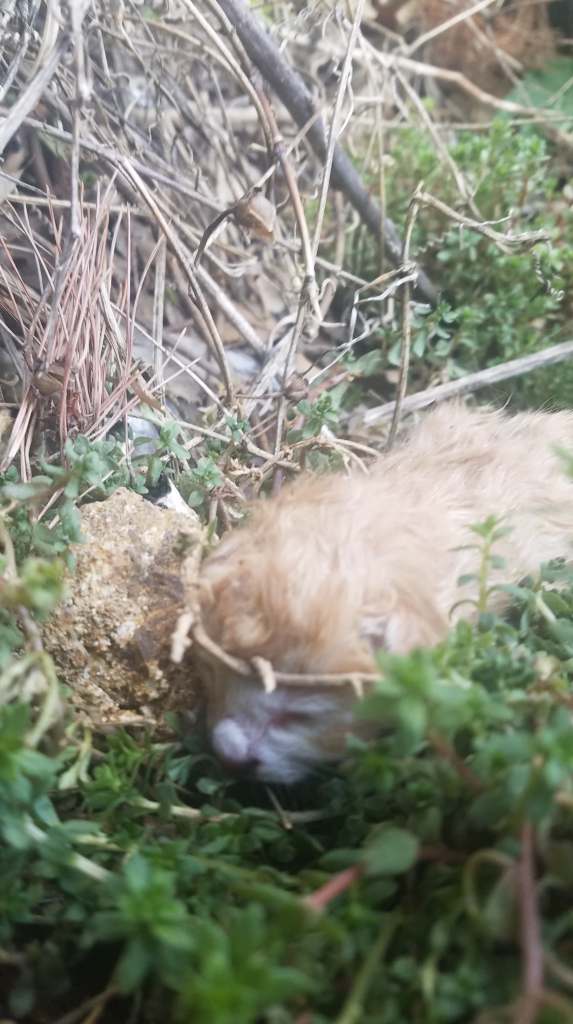
My reading had told me that this was normal behavior, and if left alone she would return to her kitten. I must have interrupted her while she was preparing to bring him to her own hideyhole. Well, mom being present was a huge relief, since it meant the cat would be taken care of and I didn’t need to find a vet. Plus, I wasn’t ready to become a father, and didn’t need the responsibility. I peeked into the nest to verify the kitten was still there and still alive, and indulged myself in a pair of photos for posterity. It’d be nice to remember him by.

I didn’t pet him, but left him alone and undisturbed there. After nodding to his lurking mother nearby, I made myself scarce so she could do her thing. I met with friends for dinner, but when I returned, I had a nagging sense. Before I would rest safely, I just wanted ot check in, and make sure that the nest was emptied. Beyond that, not my problem.

When I came to the nest, it was quiet. No more tiny mews, for the first time all day. I crouched down, and looked inside. Then reached inside to feel.

The little body inside was cold. A few hours, at least.

I don’t know why that hit me so hard. But it did. It hit really hard. I tried to save you, but I failed. I failed, and you died, and for that, I am sorry.

I’m sorry that you had less than 24 hours on this Earth. It’s not the best Earth ever, but it is a pretty good one, and I think you would have liked it here. I’m sorry that for that short time, all you had was me. I wouldn’t pick myself to be the only person you meet in a lifetime, but…well, I’m who you get, I guess. I’m sorry that you might have had a life, and now you will not, and part of the reason might be me.

I’m no stranger to animals dying. I have said goodbye to many pets over the years. But…they had full, long, and happy lives, for the most part. I was devastated when Sam left me two years ago, but Sam had the best life any dog could ask for, full of treats and warm beds and snuggles and love. This cat got a few moments with me, and a bush. And I know that young animals, especially strays like this one, die in droves every year. On the farm, the survival rate for litters is well below 50%. There is nothing surprising, or unexpected about this.

But dammit, for this one, I tried. But I wasn’t good enough, and for that, you get your brief life of 20 hours or so, before you join the tens of millions of other animals that die alone, unmourned, unloved, and unremembered.

But you’re not one of them. Even though it was just for a few hours, I knew you. I cared. I’m sorry you didn’t have a better savior. That you got someone who cared, but had a million other cares – finalizing the day’s lesson plan, making sure I got at least one class worth of grading done, making sure I had ingredients for the grilled cheese and Parasite night I was planning with my friends. Even the little attention you got was divided. And my attention was limited to a few Google searches, a few moments warm in my hand as I moved you to a safer space, and thoughts and prayers.

As things go, I make a somewhat shabby Messiah.

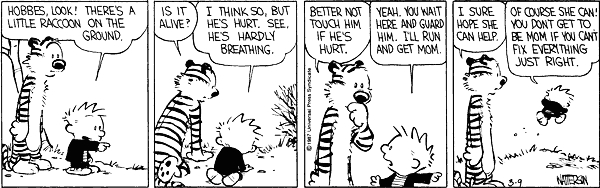
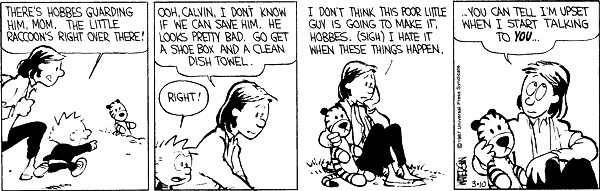
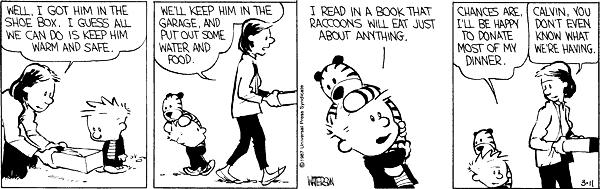
Growing up, one of my biggest influences was always Calvin and Hobbes. Calvin and Hobbes is one of those comic strips that has, I think, universal appeal – maybe the only comic strip with universal appeal. Everyone I know that has read it, loves it.

Because Calvin and Hobbes was always more than just a goofy strip to make you laugh. It was funny, yes, but Bill Waterson also had a masterful talent for making you feel, too. He could effortlessly weave his jokes in and around commentaries on modern politics, on commercialism, environmentalism, war and peace, love, the pains and joys of growing up, the importance of family and friendship, and yes, life and death.

Calvin and Hobbes helped me to grow and understand the world. It wasn’t just a newspaper strip -Waterson’s underlying personality, his worldview, built on a love of exploration and wonder in the world, a hatred of the stupid and asinine systems that corrupt us and attempt to control us, a simple joy in a well-thrown water balloon or artfully constructed snowman, largely came to be my philosophy and worldview.

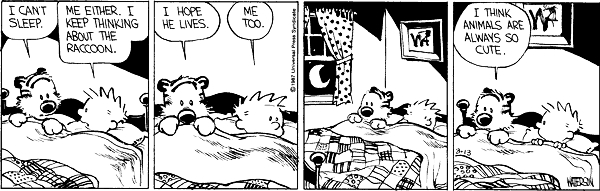
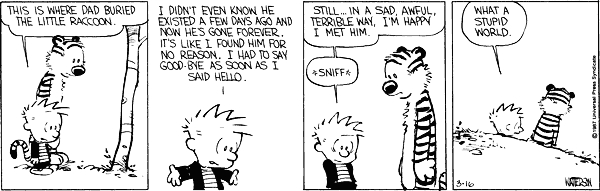
When I found that little body, knew that I had failed, and was plunged unexpectedly into grief for an animal that hadn’t even existed the day before, I instantly thought of Calvin and Hobbes. Calvin went through this, too.

I agree with him. Little cat, it wasn’t very grateful of you to break my heart.

And so, little cat, this is my farewell to you. Those two pictures I snapped, and a brief, 5-second video of some of your mews, are the only records of your existence that will ever exist in this world. I am the only person you will ever meet. I wish you had gotten a better deal. I wish you had grown up, and fought with other alley cats, and explored, and learned, and had lazy mornings in the sun and late night adventures in the rain and maybe made friends with the English teacher walking by on his way to work. Sometimes life give us a raw deal. Sometimes all we get is a few hours, a hand, and a bush.

But you won’t be unremembered, or unmourned. Even if it was just for a few hours, you were here, and you were important to someone. You were important to me.

I feel terrible right now, but I am blessed that I got to be the one to know you. It was a privilege, little cat. Goodbye.

What a stupid world we live in sometimes.

PS Hug your pets today.

Japan, pt. 7 – Tokyo January 30, 2020

Well, I’m just about wrapped up with Japan. Thursday and Friday were my last two days in the country, and I spent them both in Tokyo. 

I got up early, as I always do on vacation, and took some time on the roof of my hotel taking in the city. Tokyo is huge – it sprawls out over I think hundreds of square miles, covering basically every bit of land in north-central Japan that isn’t a mountain. It’s mostly dozens or even hundreds of neighborhoods and smaller cities knit together without any break in the urbanization. The only way to get around is via subway. So, that was my first stop. 

The view from the roof of UN Plan, my hotel.

I headed down into the subway station near my hotel, which was very near, thankfully – just a block or two. Once again, the morning was dominated with thousands of people hurrying to work. Crowds are everywhere in Japan – the only time I was ever alone was in Sekigahara. Otherwise there’s always at least a few dozen human beings in your immediate area. Trains are crowded, streets are crowded, etc. The nice thing, though, is that everyone is extremely polite and courteous to each other – I think the Japanese would have wound up killing each other off long ago if that wasn’t the case. Anyway, I squeezed down past the crowds and towards the line. I asked the guard at the gate if my rail pass would work on the subway, but unfortunately the metro system isn’t a Japan Rail line (the state company) and is instead run by a private company. He pointed me to a nearby ticket kiosk, though. I wandered over, selected the English option on the electronic menu, and paged through the confusing list of ticket options – single way tickets, round-trips, 24-hour passes, but only on certain lines, comprehensive passes, etc. When the guard didn’t see me go through the gate right away, he came out of his booth and hurried over to make sure I was okay. He was a very helpful and courteous fellow, and together we got a decent 48-hour pass, which would last me until it was time to fly home the next day. He also insisted I take a map of the metro, which included guides to various tourist attractions in Tokyo, which actually came in quite handy.

I rode the metro and transferred through several stations. That was a lot easier said than done, though – the Japanese subway system is a tangled spaghetti mess of practically a dozen different lines all looping back and forth on each other, and the stations are maze-like collections of stairs and halls and platforms and gates rambling on for several stories up and down and hundreds of yards lengthwise, all underground, and all filled with thousands of people. Thankfully the signage is very clear and comprehensive, and I was able to wander more or less in the right direction, purchasing a single-round trip ticket down to Yokosuka. Yokosuka is a harbor suburb on one of the peninsulas jutting out into Tokyo Bay south of the main city. It’s most notable as the home of the US naval base in Tokyo Bay and the headquarters of our Far East fleet. My interest, though, was in Mikasa.

Mikasa is an old Japanese battleship permanently preserved in Mikasa Naval Park, right next to the US base. She’s a famous ship, though, with a distinguished history. Mikasa is the only surviving predreadnought battleship in the world. 

See, steel battleships can be divided into two groups: predreadnoughts, and dreadnoughts. When the British launched HMS Dreadnought in 1905, they revolutionized warship design. Before Dreadnought, ships were a confused mess of designs as naval architects tried to figure out what worked and what didn’t work with the new technologies of steam and iron plating. Ships had hugely varied armaments, eclectic collections of guns, some even had rams, that kind of thing. No one had much of a clue. Dreadnought got rid of all the smaller guns, though, and radically went with a small number of big guns mounted in a few turrets. She also had fancy new turbine-based steam engines, instead of reciprocating engines. Her big guns could shoot further and more accurately than the guns on any other warship, and her fancy engines meant she could sail faster and for longer than any other warship, too. That meant that Dreadnought could defeat any other ship or even any other collection of ships afloat, because she could keep out of range of any ship that attacked her while pounding it into scrap metal. So, since Dreadnought, all battleships have followed her design of having a small number of big guns mounted in turrets, with a few smaller guns to ward off destroyers and small craft, and fast turbine engines, and are called dreadnoughts after the first ship. The Missouri, in Pearl, is a dreadnought. 

The pre-dreadnoughts have all disappeared, except Mikasa. She has 4 big 12-inch guns in 2 turrets, a huge assortment of 6-inch guns, and even more 3-inch guns crowded onto her deck. The ship was designed to fight in the old way of sailing up broadside to an enemy and pounding away with everything. She’s been preserved as a museum ship because she won the most famous naval victory in Japanese history – she was Admiral Togo’s flagship at Tsushima (the island I sailed past last Friday), where the Japanese fleet had almost literally blown the Russians out of the water. So I was eager to see her. 

I got to the Yokosuka train station at about 10:00 that morning. It was a bright, sunny day, absolutely gorgeous weather. Apart from the rainy day at Himeji, I had fantastic weather for the trip – I’m told it was unusually nice for the time of year, and that Japan isn’t always that nice. I walked a few blocks through the streets until I came to Mikasa park. There’s a big, grassy area, an open plaza. a statue of Admiral Togo, and, of course, the ship itself. She sits in a concrete drydock safely out of the water. I headed over to a little electronic ticket booth and got myself some museum tickets, poked my head into the giftshop (empty except for a pair of chattering employees, and nothing I particularly wanted to buy), then boarded the ship. 

The upper decks are mostly preserved as they were, with an English audio tour available. I had the ship to myself, it seemed, and I wandered up the portside, past the main gundeck, looked in on the radio room, bridge, con tower, and eventually over to the starboard and down into the main decks. Below, the ship has been converted itno a museum on the Russo-Japanese war and the rise of the Japanese Empire. You see here a lot of the pro-Japanese bias you had in Hiroshima. Lots of Japan heroically defending Asia from Russian & Western encroachment, not so much on Japanese colonialism itself. But the museum is well-done, with lots of artifacts, great exhibits on the course of the war, the battle of Tsushima, and Mikasa’s career (short, since even as she fought Tsushima in 1905 Dreadnought was making her obsolete on the other side of the world), and even a collection of models of every ship in the Imperial Japanese Navy (which I would have freaked out about if I hadn’t seen the same thing at the Yamato museum a few days earlier). There’s even VR simulations of standing on the bridge of the battleship during the fighting against the Russians. Towards the stern, you can tour the officer’s mess and quarters, the captain’s cabin, and the admiral’s cabin. I was a bit disappointed that you couldn’t go into the engine room, magazine, or any of the turrets, however. 

After a few hours of messing around, exploring the VR, playing with the fire director on the bridge, and walking around the park, I was ready to move on back to Tokyo. I tried to get back to the bus station without using Google Maps (which had been my lifeline in Japan since getting my Japanese SIM installed in Hakata – it tells you exactly which train to take and exactly which platform to be at, at what time). It was only a few blocks and I was sure I remembered the way. I did not remember the way. I got turned around several times, stumbled into hte gates of Yokosuka naval base once (the guard was American, so that was nice – actually Yokosuka has lots of Americans in the streets and lots of business had English signs, obviously catering to servicemen), and finally found myself in front of a streetside burrito truck. Well, it was near to noon at this point, and I hadn’t had lunch, so what the hell, I bought a chicken burrito. It was heavenly – like, unbelievably good. The tortilla was perfectly crisp and flaky, the chicken nice and hot, the seasoning perfect, the cheese perfect. I do believe that the best burrito I’ve ever had was from a food truck in Yokosuka, Japan. 

After my burrito, I DID find the train station again, without using Maps, and headed back to Tokyo Station. From there, it was the short walk to the imperial palace.

The palace grounds are an enormous park in the heart of Tokyo. Most of the living quarters of the imperial family are closed to the public (naturally) except on special tours, and the majority of the compound is behind ancient moats and high walls, with guards on all the gates. But you can still walk around some of the gardens, notably the East Gardens. I joined hundreds of other tourists and explored. The gardens are large, and crowded (as always), but not as nice, I felt, as the Hiroshima city garden or the Himeji castle gardens. They’re grander in scale, but don’t have as many little nooks and crannies to hide in, no tranquil gardens with a little stream, waterfall, or pond in the center, or secluded little teahouses. Even the old imperial gardens in Kyoto felt more intimate than these. Lots to see and gawk at, and it took me hours to explore all of them, but honestly I preferred the earlier ones to the imperial gardens. 

From there, I travelled to the nearby Akibahara District. Akibahara is a famous shopping district dedicated to anime – like a Mecca for anime fans. I’m not a huge anime fan, but I do like some shows and movies, so I thought I’d check it out. I emerged from the subway late in the afternoon, and walked a few blocks through the crowded streets. The first thing I noticed is was how…small…it was. Just a couple of city blocks – you can walk from one end to the other in minutes. There wasn’t a lot to tempt me, honestly – there were lots of shops selling merchandise, but it was all figurines and collectibles and other things I have no interest in. There were lots of girls dressed as anime maids or other characters trying to tempt me into cafes, or holding signs and waving them in the street, but I wasn’t really interested in that sort of thing, either. One news reporter did try to interview me for a story they were working on, until they learned I was American and not from a Commonwealth nation. On the whole, the entire place was kind of…lame. Oh, well, at least I can say I went.

As the sun started to dip towards the horizon, I wound back into the subway system and traveled the short journey to the Tokyo Tower. The Tower is a big orange Eiffel Tower-like construct in the heart of Tokyo, and I thought I’d explore it. I came out of the station a few blocks away, and I remember when I turned the corner onto the street the tower sits on – it’s enormous. You really have to crane your neck to see the top, and the sidewalk had like a dozen people all crouching down to try and take photos of the massive thing. I snapped my own, of course, and then walked over a short hill and then down onto the Tower grounds and into the lobby. 

Once inside, you can buy a pass to the top, of course, which I did. I was herded with a group of about 10 tourists (a Japanese family, a Japanese couple, and a Peruvian family – we chatted a bit in Spanish, which was a welcome relief from Japanese) onto an elevator, which quickly jumped up a few thousand feet (it felt like) to the main deck, which has the gift shop, cafe, and whatnot. Then it was another shuffle around the tower to a second elevator, and another ride to the very top observation deck. 

It was spectacular. The top deck itself is all polished mirrors and glass, with soft lighting steadily shifting between a variety of colors while dramatic music swells in the background. I arrived just as the sun was setting, and managed to get Mt. Fuji at sunset. We had been given special tablets which let us look out over the city while a nice-sounding man told us what we were looking at, which was basically all of Tokyo. The whole city lit up below me, and you could spot every major landmark – the Tokyo Dome, the parliament building, Tokyo Disney, Akibahara shopping district, Shinjuki Station, the scramble crossing, Tokyo Bay, you name it. There’s no earthly way for me to describe the experience with words, so I won’t even try. I spent I think more than hour up on the deck, just gazing at the city, which sprawled out below me. You could see the lights of tens of thousands of cars crawling around on the various streets and highways, the arteries of Tokyo. You could see the lights of hundreds of skyscrapers, each one of them tiny below you, but enormous if viewed from the ground. Eventually I mustered the will to travel back down to the main deck, where I just sat and stared into the city for a while. It was my last night in Japan, and I was feeling very sad. It had been an amazing trip – the best in my life, I think, because it was mine, and it was the greatest adventure I’d ever had – but all good things must come to an end. I knew, once I left the tower, it would be back to the hotel to sleep one last night. So I knew once I left this deck, I might never have this view again. I lingered.

Fuji at sunset. Grainy because my camera sucks.

Finally, I headed back to the elevator. On the way, I paused again and watched a lengthy video on the history of Tokyo and of the Tower, which was built to be a sign of hope and inspiration to the Japanese people as they rebuilt the city following its near total destruction in the war. Again, didn’t really mention how the war started. Ah, well. On a whim, I took the stairs down instead of the elevator – why rush? – and made my way through the cool nighttime air down 88 flights of steps back to the bottom. Still following my whims, I crossed the street to the Tower and found a fancy Italian restaurant. I felt a little awkward dining alone, but the wait staff said it was fine, so I settled into a table and treated myself on my last night in the country. I had some wonderful seafood pasta (crab), a gin and tonic, and nursed a cup of coffee while watching the dining room, which was lively with couples coming and going, mostly. The waitress and the host were very attentive to me, and made me feel welcome, even if I was somewhat scraggly and underdressed after a week living out of a backpack.

By 9:00, it was time to head home. I took the subway – the spaghetti mess of the map actually pretty easy for me to navigate by now – and a middle-aged Japanese woman actually sat next to me and talked to me. Japanese people never talk on public transit, and they certainly don’t talk to me, so I was pleasantly surprised! She had decent English, and wanted to make sure I was getting on all right in the country. 

The ride was short (I never took the subway longer than a half hour, no matter where I was going. Compared to my 45-90 minute bus rides in Gwangju, it’s spectacularly efficient), and I staggered back to the hotel, pretty wore out. I don’t remember hardly anything of the walk back or of falling into bed there. Just one night to go. 

Japan, pt 6: Osaka, Sekigahara, and Tokyo – January 29, 2020

I really do want to finish this Japan trip, because I’m saving it in my blog, too. Just using emails to you as an excuse to write and hold myself accountable.

So, on Tuesday, I went to Kyoto, and ended the night by being chased by boars off the mountain. Wednesday I was finally moving on to my final stop in Japan, the big one: Tokyo itself. However, I had all day to get there, and I had all day Thursday and Friday to explore the city before my flight Friday evening.


I woke up in my hostel Wednesday morning and packed up to go. I guess I’d like to pause and talk about what Japanese hostels are like. The one in Osaka was especially unusual. Like I mentioned before, you entered through a small coffee shop/restaurant on the ground floor. The shop was tucked away in a narrow alleyway, with lots of private homes crowding all around. People had their laundry out on lines to dry, stray dogs and cats, the works. Once inside, you removed your shoes and left them in a cubby in a small waiting area before heading upstairs. This is normal everywhere I went – shoes just aren’t worn indoors at all. Upstairs, there were several big dorm rooms – lots of places have mixed gender and female-only rooms, very rarely are there male-only rooms.


Inside the dorm, there’s typically some lockers and hangars for things like coats and bags, then lots of beds. The beds are stacked two high with only the ends facing the main area, and come with curtains to give privacy. Inside, you have your bed, a small shelf or cubby to house some things, and typically a lamp or an outlet. Space is small, but as long as you don’t expect too much they’re quite cozy and comfy. Bathroom facilities are communal, with a bunch of sinks and mirrors in a common space and then a few shower stalls with an attached changing room. The showers are small and the heads honestly a little low for me. It’s hard to be tall in Asia. On the whole, they’re not luxurious, but they’re very comfortable if you’re travelling light and alone, like I was. 

So before I left Osaka, I had one last destination: Osaka Castle. Yes, my third castle, but this one had the most historical significance! See, during Japan’s warring states period, Osaka was the capital of one of the last great lords of the period, Toyotomi. Whoever held Osaka could dominate Kyoto (just 40 miles away, remember), and whoever dominates Kyoto dominates the Emperor (the Emperor was/is widely respected as the “ruler” of Japan, but he didn’t make any actual decisions and entire wars were fought in the country with each side claiming to be the true servants of the emperor). In the final days of the wars, 1615, the head of the Emperor’s military forces, the shogun Ieyasu Tokugawa, led a siege of Osaka castle to overthrow Toyotomi and remove the last obstacle to his rule. In those days, the shogun was the true ruler of the country. Osaka was besieged, there was a massive battle fought just outside the castle, and in the end Toyotomi committed suicide. The shogun Tokugawa united the country and moved the capital to his home in the city of Edo, far to the east. His descendents ruled Japan from 1615 all the way to 1870, when the Emperor reclaimed authority and moved to Edo, renaming the city Toyko (the Tom Cruise movie The Last Samurai is a highly fictionalized version of those events). 

I took the subway from near my hostel a mile or two and emerged near another one of those massive glass-and-steel office towers that dominates modern architecture. Everyone around me was a businessman hurrying to work, it seemed. It was still early, not even 9:00, and the day was clear and cool. Just to the south of me I could see the castle sitting in its park.

Osaka castle, viewed from the north.

I had to wind around several moats and walls to approach the main keep. There weren’t many people around, ebcause I was coming in the back way, from the north. The museum was piping martial Japanese music over some hidden speakers, lots of war drums pounding steadily. I passed various old gates and walls, looked out over Osaka, and came to the site where Lord Toyotomi committed suicide after losing the battle of Osaka. That was neat. 

The suicide site of Lord Hideyori Toyotomi

Once I got up to the castle itself, there were hundreds of people around – tons of tour groups, including children on field trips. I bought my tickets and headed in. The castle interior has been filled with a museum on the Warring States period, the life of Lord Hideyori Toyotomi, and the final siege of Osaka. Each floor has a theme and dozens of exhibits, artifacts from the time, historical documents, some pretty cool dioramas, videos (entirely in Japanese, sadly), and on to the usual observation deck to look out at the city. I spent a few hours poking around. 

Now, my plan had been to head straight from Osaka to Tokyo, maybe pausing at Fuji town on the way or something. But then I realized…this might be the only time I’m in Japan, and it’ll certainly be the only time I’m in Japan by myself. If there was ever a time to have my own independent adventures, this was it. So as I made my way back down the 5 stories of the castle, I pulled up my maps and started looking for a specific town, one I’d read about years ago but never dreamed I’d visit. And sure enough, it was a few hours away by train…but not totally out of my way. I could visit and still be in Tokyo this evening. 

So I decided to go to Sekigahara. 

I had to wind back out of the park, again, heading south this time, over the old battlefield. I got stopped by one Japanese man on my way out, who was very eager to practice his English. He used to work on an American military base, and had very good English. He was a very friendly guy. For some reason I remember his teeth clearly, even now, more than two months later – he had two gold teeth. Funny, the things that stick out about people. 

Heading into the countryside. Lake Biwa is in the far distance.

Anyway, it took me damn near 40 minutes to walk back to the train station from the castle, but from there I started hopping on regional trains and headed north, past Kyoto, and into the Japanese countryside. We chugged along the shore of Lake Biwa, passing increasingly small country towns as I went. A few hours later, about 1 in the afternoon, my train chugged into a tiny platform in a sleepy country town called Sekigahara. I mean, tiny – Hakata, Hiroshima, and Osaka stations all had more than 25 train platforms each. This one had 2, and a tiny station building with a single ticket gate. There was absolutely no one around – for the first time since coming to Japan, there were no crowds.

My view after the train departed.

Sekigahara is small, with a population of only 7,000 – tiny by Japanese standards. It’s a handful of houses and shops clustered around the crossroads and the train station. You can walk from one end of town to the other in 20 minutes. Otherwise it’s surrounded by fields and farms, woods and mountains. Overall, it reminds me a lot of Pierce City. So imagine a random Japanese tourist showing up in the middle of downtown Pierce City – that’s about what I was doing here.

Just fields and farms.

So why come?

Well, Sekigahara is basically the Gettysburg of Japan. I mentioned earlier Ieyasu Tokugawa, the shogun or military dictator of Japan, in 1615. Tokugawa became Shogun because in the year 1600 he won the Battle of Sekigahara, here in this sleepy crossroads town.

See, Tokugawa was clashing with a fellow by the name of Mitsunari Ishida. Ishida served the emperor and was resisting Tokugawa’s ambition to become shogun. The two jostled and sparred politically in Kyoto for years, until eventually things came to a head and Tokugawa withdrew to his lands in Edo, to the east. Ishida declared Tokugawa an outlaw and began gathering an army to overthrow him, while Tokugawa gathered his own supporters to march on Kyoto.

Sekigahara sits in the middle of one of the best passes between Kyoto and Edo (today Tokyo), so Ishida prepared to meet Tokugawa here. He drew up his Western armies in an ambush on the hills that surround the town, and Tokugawa’s Eastern army marched right into the trap. Unfortunately for Ishida, Tokugawa had been in secret contact with many of the Western nobles, and had promised great rewards in land and wealth if they switched sides and helped make him shogun. So half of the Western army either refused to fight or outright joined hte East. Ishida and his most loyal generals were surrounded and killed. Tokugawa marched on to Kyoto and had the emperor declare him shogun, executing a lot of the surviving Western nobles in the river bed I had crossed over the day before when I was in Kyoto. (There’s a Japanese drama made in 2017, called Sekigahara,n about the battle, that I thought was pretty well done, but I think it might be confusing to people who don’t already know the story). 

Trailer for the film. It’s all in Japanese, but there are subtitled versions online.

So today, Sekigahara is filled with memories of the battle. There are huge painted murals on the walls outside the train station of most of the major players, and lots of maps and signs pointing you to key locations from the battle. I walked around for hours in the mostly-empty fields, going to this skirmish or that camp, and mostly just being amazed that I was actually standing in Sekigahara – it’s so far from anything that I never dreamed I’d make it here one day! There’s no tours and I couldn’t find a convenient museum, but there’s lots of good signs, including English ones. I seemed to be the only visitor that day – indeed, I was almost the only living soul in the town, it felt like. 

Finally, I headed back to the tiny train station and tried to decide which of the two platforms was the right one to wait for the next train. It wasn’t due for another hour – trains not as frequent out here as in Osaka or Hiroshima. I eventually found a kindly Japanese woman (ultimately there were 4 of us waiting for the train) and she assured me I was in the right spot. I hopped on the train, which took me the rest of hte way through the mountains and into Nayoga (another huge city sprawling over most of central Japan), where I transferred to shinkansen bullet train one last time. 

Last look at Sekigahara while waiting for my train.

The bullet train raced along the southern Japanese coast for Tokyo. It was filled with people – I remember a particularly lively group of 5 students across the aisle from me who were all playing a card game together in the middle of their cluster of seats. The best part of the trip, though, was at sunset, as we came around into Fuji town. There, looming across the valley, I could see Mt. Fuji itself, its upper slopes all snowy and golden in the late evening light. Fuji town, in the valley between the train tracks and the mountain, was already starting to settle in for the night and there were lights twinkling there. The train was so fast that the whole panorama was in view for only about three minutes, but I was able to snap a single picture before it vanished forever. 

We rolled into Tokyo Station about 7:00 that evening. It was full dark by now, but in Tokyo that doesn’t matter. I think it’s the largest metro area in the world and I was right in the heart of downtown. Forget thousands of people, it felt like there were tens of thousands of people hurrying aroudn the train station and the surrounding plaza. The station was smaller than I expected, but built in a beautiful classic brick style – it dates back to 1870 and fronts directly on the Imperial Palace. When the Emperor moved here he had it built so he could easily travel his country. It was destroyed in the war, of course, but has been rebuilt and restored to its former glory. 

All around the station were massive skyscrapers, their lights glittering in the nighttime air. I had another good walk through the city ahead of me, and everywhere I went there was light and people. Dozens of people were walking or jogging around the moats that surround the palace complex, every crosswalk had hundreds of people waiting to go, and traffic was unceasing. I walked through big business districts with massive boulevards, along shopping areas with tons of streetside restaurants and cafes, up and down hills, through narrow alleyways (crowded with people), and gradually worked my way to my last hostel. 

This one was bigger than any I’d stayed in yet, with a large ground floor and a hip, modern style of architecture with lots of exposed brick and concrete. By the time I checked in and had had dinner, it was past 9:00, so I decided to settle in for the night. I uploaded my pictures for the day in my cozy little bed, and then downloaded Sekigahara so I could watch a movie about the battle. 

The next day was my last full day in Japan. 

Japan trip pt 5: Kyoto January 28, 2020

Hiya, Dad –

I hope everything is going well there. Heard that Missouri finally locked down – thank goodness. The sooner people stop going outside and isolate for two weeks, the sooner this can be got under control and we can go back to our normal lives. I hope you and everyone in the family is being smart & safe. 

Taking a break from lesson planning to write about my trip on Tuesday. I heard back from Wydown and I’m in the second round of interviews – I need to put together a lesson on the origins of the Cold War. They sent me the email last Tuesday, but I somehow missed it, so now I have to have everything together by the end of today! D: At the same time, I’ve got to get my lessons for this week in Korea in by the end of the day today, as well, so it’s busy, but I need a break to refocus my mind. 

So, I left off my narrative having arrived in Osaka Monday night. It was cold, wet, and rainy, but Himeji was spectacular – one of the highlights of the trip, for sure. I recommend it to anyone who visits Japan. 

Tuesday I had no specific plans, other than “Kyoto,” the ancient imperial capital (Tokyo wasn’t the official capital of Japan until the 1870’s). What exactly was in Kyoto? I didn’t really know, but I figured I’d play things by ear when I got there. So, I made my way through the streets back to the train station.

Osaka is a lot busier than Hiroshima. For one, it was a weekday, and no longer a holiday, so the streets were crowded with people hurrying to work. For another, it’s the second largest city in Japan, I believe, so there were people everywhere! Furthermore, the Kyoto-Osaka line is one of the most important in Japan – the two cities are only 40 miles apart, and plenty of people live in one but work in the other. Thankfully, that means there’s tons of trains, of course. 

So, safely ensconced on the train, I flipped through the Internet to figure out what to do in Kyoto. The answer was pretty obvious, though – the old Imperial Palace is open to visitors! So naturally I’d go there first. 

The station is in the south of town, and like all other stations, is huge. Just outside of it is a model of the old Rashomon gate, which used to stand there as the southern entrance to the city. It’s famous as the place where the Akira Kurosawa Rashomon takes place – if you’ve never seen it you should definitely give it a watch, it’s one of my favorite movies. The imperial palace is a two-mile walk north, a straight shot. So I paused at a coffee shop to get get a drink and set off. 

It’s wonderful walking through a new city. You get to see the people, the buildings, the traffic, and really get to know a place. I walked by old Buddhist temple complexes side by side with modern glass and steel skyscrapers. It took an hour or so, but at last I reached the palace grounds.

When Kyoto was the capital, the area around the palace was filled with living compounds of dozens of court nobles, living near the Emperor and jostling with each other for power and position. There were all sorts of intrigues and power struggles, assassinations, raids, sometimes even open warfare in the streets of the city. When the Emperor moved to Tokyo, though, the nobility went with him, and today the old noble quarter has been turned into a wonderfully large park in the heart of the city. I came in through a side gate, not really grasping where the main entrance was, and explored some old preserved noble houses set aside as museums. Japanese houses are generally a series of rooms set around an open courtyard, with covered patios and sliding walls everywhere. Not bad places to live, honestly. The park is filled with ponds and trees and wildlife, including lots of cranes, which was cool to see. 

Eventually, I wandered up to the palace itself. There are two villas – one was used for retired emperors, the other was the actual palace the sitting emperor lived in. It was about 10 am, and sign-ups had just opened up for walking tours of the retired emperor’s villa. You can’t get in without a tour, and tours fill up pretty quick, so I was lucky to get there so early. I put my name down for the 1 pm tour and headed to the other villa, which is just next door. 

Only a certain amount of people are allowed into the palace at any one time. They give you a number as you enter, which you have to return when you leave (so they can keep track of how many people are in), but then you get an audio guide and you’re free to wander. The palace is mostly a set of living chambers and audience rooms, depending on if the emperor was feeling public or private that day. The public rooms include waiting areas, a carriage porch, and the famous throne room where audiences with the emperor were held. The private areas are bedrooms, living areas, places for scholars, and of course extensive, beautiful gardens. The Japanese love a good garden. I wandered around with other tourists for a few hours, taking hundreds of pictures, seeing everything. Lots of signs like “This tree is where such-and-such samurai was assassinated by Lord So-and-So during the Boshin War of 1493,” “here is where Emperor Meiji’s scholars drafted the proclamation overthrowing the shogun in 1870,” and so on. Nice place to live, though, if you can avoid being murdered by a political rival.

At noon, I grabbed some lunch right outside the palace compound. There’s an Irish pub right across the street proudly proclaiming “It’s five o’clock somewhere!” (I believe it was 5 pm in New York at the time), so I like to imagine the Emperor and his retinue ate there sometimes when out and about in the city. I rejoined my tour group at 1. Most of them were Japanese, of course, but 3 of the 50 us were foreigners – myself, clutching an English audio tour, and a French couple on their honeymoon. We were led all around the villa’s gardens, which are huge, and beautifully put together. Kyoto might have the most gardens per square mile of any place in the world, and they’re all wonderful. 

As the afternoon wore on, I walked back twoards the train station. The temples I passed earlier in the day, this time I explored. They’re UNESCO World Heritage sites, and some of the largest wooden buildings in the world (I heard claimed the largest wooden structures in the world, but can’t verify that). Each temple has a large compound surrounding the enormous main buildings themselves. I was free to walk and explore to my heart’s content (removing my shoes before setting foot on the polished wooden porches or going inside, of course). There are a pair of sites, about a quarter mile of each other, so I got to explore some of Kyoto’s back alleys on my way from one to the other. 

By the time I finished, it was only about 5:00, and I didn’t feel like going to Osaka yet. So I headed south from the station, again walking through some obscure and out of the way back alleyways, through small neighborhoods, past school kids hurrying home, just a regular day in Kyoto. I passed a river where the survivors of Sekigahara were executed (more on that tomorrow), but my goal was a large park/mountain just outside town, Fushimi. 

Fushimi is a large Shinto complex famous for having hundreds upon hundreds of the famous torii gates. Wealthy Japanese, to get blessings for themselves, have a tradition of donating torii to the shrine, so they’ve been set up in long, winding tunnels and paths all up and down the mountain. I thought the park was a few acres at most, so I’d explore it before dinner, then head back. 

It was overrun with thousands of people, vendors, police – the busiest tourist area I’d seen since Itsukushima Shrine back in Hiroshima on Saturday. The long tunnels of torii were filled with people, every last one of them posing for a classic photo to upload on social media to rave reviews later. Finding a deserted patch to do my own social media photo was almost impossible. You had to snatch moments of a few seconds when no one was around, because inevitably another gaggle would be coming down the path in just a moment. I did grab one resigned selfie at one point. 

As I wound further and further up the mountain, I started to realize that this park sprawled over miles, not acres. I had gone in maybe a mile, it was dark now, and the rain, absent all day, had returned and was gently falling. I got high enough on the mountain to look over Kyoto, and STILL the torii wound away into the darkness, snaking back and forth up the mountain side. The few maps I could find were in Japanese and totally incomprehensible, and all the other tourists had vanished. In fact, by about 6 pm, I was the only soul around, it seemed. I was high up the mountain, alone, in a graveyard (lots of those in the park), in the rain and the night, and I heard rustling in the bushes. Well, no large predators in Japan, I should be fine, right? 

Well, I happened to glance at a sign at that point: Wild boars sighted at night in this area! Please keep your distance!” Nope! I decided I had seen enough of Fushimi park and turned around right there. Never did make it to the top. 

It took me about an hour to make my way back through the tunnels of torii and to the entrance to the park. Happily there was a subway station right across the street from the entrance, so I didn’t have to walk back to Kyoto station. I hopped on the train, rode back, and then bid farewell to Kyoto and caught my train back to Osaka.

In Osaka, it was late, but I had had a buddy who lived here for a few years after graduation, and he told me of a great dongatsu place I had to try. Dongatsu is beef and egg and noodle stew, almost like ramen. It’s buttery and garlicky and delicious. I walked into the tiny little alleyways of Osaka and found this place. It was a small hole in the wall – only seats at the counter for like 8 people. Right as I stepped through the door, in front of me were a pair of Americans, a middle aged white guy and a black guy about my age, arguing about what to get. In lots of Japanese restaurants, you order at a sort of vending machine near the door. It gives you a ticket with your selections, which you hand to the man behind the counter and he gives it to the chef. 

I sat with the Americans as we waited for our dongatsu and got to talking. They were animatronic engineers, of all thigns, and were in Osaka for work. They build the funny robots that you see at amusement parks, like the characters in It’s a Small World at Disneyland. One guy had on a sweatshirt proclaiming himself a member of the Gringotts crew – he built the goblins at the Harry Potter park in Orlando. The young fella was new to the trade and was apprenticing under the older guy. They told me stories about the industry and characters they met – my favorite was “Volcano Dave,” who as you might guess is a guy who specializes in volcanoes. If you want a volcano at your park, Dave’s the guy you go to. If you remember our pool in Kauai – of course you remember that pool – it’s possible Dave did the volcano in the middle of it. They were a fun pair. 

Dinner was finished late, nearly 10 pm after my long day, so I walked back to my hotel, which was just a few miles away. Back through the dining room (curry again wafting through the air) and upstairs to my little bunk bed. The next day I’d have a few more sights in Osaka, then it was off to the big one: Tokyo. 

Japan, pt. 4: Himeji Castle January 27, 2020

Okay, so today I’ll bring you from Japan to Osaka, and we’ll be nearly halfway done with my Japan trip. 

Monday wasn’t as nice as the previous two days – it was a bit chilly and drizzly all day. I woke up early, as usual, and headed out for the train station. It was my last walk through the peace park and through Hiroshima’s streets – I was surprised at how much I would miss the city. It’s a really peaceful, quiet city for how large it is. A little house on the outskirts, maybe up on one of the mountains overlooking the bay, would be an incredibly pleasant place to live. 

Anyway, I walked past the castle one last time and through the busy streets near the train station, for the first time entering through the front doors instead of the underground shopping mall. Again, the train station was crowded with hundreds of people, lights and noise from trains everywhere, but at this point I was getting pretty good at navigating. I found the same train to Kure I took the day before, and I was on my way back to the city. 

I went straight to the JMSDF museum and was one of the first people through the doors. The museum itself was neatly put together, but a little limited, I felt. Most of it was about the JMSDF’s history of minesweeping, which was a really important task following WWII – the Allies had dropped hundreds of thousands of sea mines around Japan in the final months of the war, and it took decades to get them all cleared up. You’d still hear about a fishing boat blundering into a mine and getting its entire crew blown up late into the ’50s, for example. There were lots of artifacts and examples of mines and mine-disposal equipment, but the real draw of the museum is the submarine.

Once the JMSDF expanded beyond minesweeping, it bought a bunch of old subs from the US in order to protect Japan’s sea lanes from the Ruskies and Chinese. You can board and explore a few of the crew and command areas in one of these subs, which I did. It was extremely tight quarters – my elbows were frequently brushing the walls, and I had my backpack with all my luggage with me since I wasn’t returning to the hotel, so I was really having to squeeze. There was an old Japanese sailor serving as a tour guide on the bridge, and he was explaining all the instruments and control surfaces to a couple there before me, but he kindly showed me how to work the periscope. I was able to look out at the bay and over at the Yamato museum across the street. 

bridgecramped.jpg
The passage to the bridge. Super cramped! Blurry because I had people coming behind me.
bridgeperiscope.jpg
This man spoke no English, but I gathered that he used to be a sailor and now spends his days volunteering for the museum. He showed me how to work the periscope.

After an hour or two at the museum, it was time to hit the road. My ultimate destination was Osaka, about halfway between Hiroshima and Tokyo, but along the way I wanted to stop in Himeji and see Himeji Castle, one of the most famous and elaborate castles in all Japan. I walked back to the department store in the light rain and bought some donuts, and munched on them back at the train station. From there, it was back to Hiroshima, and then back into the shinkansen area to catch the bullet train. I felt a pang as I left the city for the last time – I didn’t expect to love Hiroshima as much as I did, and I knew I’d miss the city. I took one last photo as my train departed to remember it by.

hiroshimalast.jpg
Last view of Hiroshima, looking south as the train rolls out. I’ll miss this place – but I promise someday I’ll be back.

The ride is pretty uneventful. The train is smooth, and most of the time the view is either of the ocean to the south, or of tunnel walls as you dive into one of the hundreds of Japanese mountains. By the time I reached Himeji, it was raining steadily, and the air was pretty chilled. I had packed an umbrella, naturally, so I was fine. From the platform, I could glimpse the castle looming about a mile away in the distance. If you remember the James Bond film You Only Live Twice, at one point Bond visits a “ninja school” – that was shot at Himeji. 

himejitrain.jpg

The walk there was cold and wet, and main road ran straight from the station to the castle. The castle grounds are enormous, sprawling over many acres, and the castle itself is fiendishly intricate, with dozens of walls, courtyards, towers, and buildings all making a labyrinth around the main keep. The idea is that any attackers would get confused and lost and give the defenders more time to murder them with arrows from above. 

The area immediately inside the moat. Bond’s “ninja school” is here.
The intricate interior. The western complex is home to the Long Gallery, mentioned below. It’s the wall running along the southern and western sides of the castle.

There were hundreds of other tourists there, but the castle is large enough that everyone spreads out and I felt like I had the place to myself a lot of the time. I made my way from gate to gate, courtyard to courtyard, winding around through the outer areas, through a massive western addition, through the “Long Gallery” – in Japanese castles the walls are hollow and people lived in them. The Long Gallery is the entire southern and western wall of the compound, and was the living quarters for the castle’s ladies-in-waiting. The inside is all polished wood and the typical sliding walls. You had to remove your shoes and carry them with you in a plastic bag (as would be true of the main keep). 

himejigallery.jpg
Even though there were lots of people, I was frequently alone, especially in the Long Gallery.

Eventually I reached the keep itself, and started climbing it. Inside the castle, most floors are very open, with lots of supporting pillars being the only thing to break it up. Historically, the floors would have been divided by sliding paper walls and have had lots of furniture, but today everything is bare. Each floor is smaller than the one below it, so as you climb the stairs get narrower and steeper, and the available space gets smaller, until the top floor is only the size of a typical bedroom. Again, great views of the surrounding city. 

himejiinterior.jpg
You can still see the old mounts for the sliding walls. Imagine this with carpets, furniture, and lamps for how it appeared as a living castle.
himejistairs.jpg
See how narrow and steep the stairs are? Half of them were added in later renovations, but are just as difficult as the original, especially if you have a backpack like I did.
Looking south from the top floor. In the foreground is the massive courtyard pictured above. At top center, at the end of the road, is the train station where I took the earlier picture of the castle.

I made my way down and back out through the grounds. It had taken more than three hours to explore the castle and I took about 500 pictures. Next door were the castle gardens, and I had naturally bought a joint ticket because it was so cheap (everything in Japan was really affordable! My hotels were between $20 – $40 a night, the rail pass was $200, meals $5-$10 twice a day, and most museums less than $10 – the majority were free! All told, I spent less than $1000 for everything, with the vast majority of it being the ship, train, and plane tickets). The rain was intermittent now, so I walked through the gardens with only a handful of other people. The gardens are divided into a series of courtyards by walls, and each courtyard had a theme. Most of them have running water and lots of sculpted hills and trees. Honestly, Japan has some of the best gardens I’ve ever explored – every one of them was serene and tranquil, the sort of place you can easily imagine an ancient lord kicking back and relaxing. 

Soon enough, I had exhausted the gardens, and by this point I was pretty tired from a long day – it was getting on to 5 in the afternoon and I’d really only eaten those donuts that morning. Should have had lunch at some point. Oh, well. I paused in front of the castle to try to take a selfie that didn’t look awful, which failed – I have no idea how to smile for photos and always look insane. Then it was back, a brief wait for the next shinkansen, and on to Osaka. 

himejiselfie.jpg
Yikes. Maybe someday I’ll figure it out.

Osaka was big, flashy, and busy, much more lively than Hiroshima had been. Right outside the station traffic was crazy, but there were elevated walkways and plenty of traffic signals. Japan is a very orderly, well-organized place and it’s really easy to be a pedestrian…although sometimes I would get frustrated at waiting for the walk signal at a 10-foot wide road with no traffic in sight. I headed for my hotel about a mile away, again, walking, to get a feel for the city. I walked past dozens of big, flashy hotels, through a random city park underneath a highway overpass, and finally into some narrow back alleyways. Finally, I came to a little coffeeshop in a traditional neighborhood – all one or two story buildings, winding, twisty alleyways, no major roads. It looked wrong, but my map said it was the place, so I went in. 

Inside was lots of heavy wood architecture, dim lighting, and a wonderful smell of curry (I still hadn’t eaten dinner). A young Japanese man at one of the tables smiled at me and hurried over, asking if I was there for the hostel (spotting the backpack, no doubt). It turned out the hotel was on the second floor of the restaurant, so he led me upstairs, past a lounge where an Australian guy was hitting on an American girl, and into the dorm. I was tired and wet from the journey and the rain, but the curry smelled so good that I ventured back downstairs and had a great curry dinner – a late one at about 8:00, but that just made it better. I wasn’t about to go out and explore Osaka feeling as I did, so instead I bought a coffee, sat in the warm restaurant, and just watched hte people come in. 

The lounge area was incredibly cozy. The whole hostel was.

Next day’s plan was to head to the ancient capital of Japan, Kyoto, a short train ride away. 

Japan, pt 3: Hiroshima & Kure January 26, 2020

So day three in Japan:

I woke up early that morning in my hotel and digested the news about Kobe Bryant’s helicopter crash, which was all anyone on the Internet was talking about. But I had a lot I wanted to do that day, so I got up and was out of the door by 8. I walked back across the river and into the peace park. It was another bright, clear day, and pretty warm for late January – apparently Hiroshima has a very mild climate. It’s the type of city I wouldn’t mind living in. Lots of water, lots of green, lots of mild temperatures. I went straight to the bomb museum, which is pretty well done. It has lots of really great before and after photos of the city, and since they’re all of the places that you can see in the modern day all around you, it’s very relatable. There’s a ton of artifacts from victims and survivors of the bomb, and of course hundreds of personal stories. It does a good job giving the Japanese perspective.

The museum the night before. The entrance is on the ground floor on the left. The museum is on the second floor, which you wind across and then back again, ending where you began on the left.

However, it is definitely the Japanese perspective. There’s no mention at all made of how the United States and Japan came to be at war, or of the atrocities Japanese soldiers had done and were continuing to do throughout Asia, or of the Japanese’ fanatical determination not to surrender in places like Iwo Jima and Okinawa. So, while I do feel sorry for the victims, most of whom were innocent women and children, I don’t regret the bombing still. Had to be done. *

The museum is two floors, and ends with a massive room about the history of nuclear weapons and a nuclear non-proliferation campaign. A lot of good information in there, most of which I already knew. I poked through the gift shop and got some small souvenirs that I could carry with me, some of which I’ll send along to you to remember Hiroshima by. After a couple hours in the museum I went back into the city. 

Today I had a goal: Near Hiroshima is Kure, an old Japanese naval arsenal. That was why Hiroshima was targetted, because it’s such an important naval base, and you can really see why when you’re there. Hiroshima Bay is beautiful, and calm, and a great place to train sailors and keep your navy. Very similar to Pearl Harbor. Today, Kure has a couple of museums – the Yamato museum is dedicated to the Imperial Japanese Navy, and the Japanese Maritime Self-Defense Force Museum next door to the modern Japanese navy. I really wanted to visit both those places. So, I started walking back to the train station.

I walked everywhere I couldn’t take a train. It was about a mile between my hotel, right next to the peace park in downtown Hiroshima, and Hiroshima Station, which is northeast of the old city (right on the edge of the blast zone – soldiers on the steps of the station were killed by the bomb). So it’s about a 40-minute walk through the streets, but I had some sights I wanted to see along the way. Walking is a great way to explore a new place, you really get a feel for everything. Taking a bus or a train leaves you disconnected. So, I walked north, then down into a huge underground shopping area (the same one that connects with the train station, in fact – you can walk underground the entire way if you wanted to), and a few blocks later came to Hiroshima Castle.

Note the boats. The boatmen are quick to offer a ride around the moat.

Hiroshima Castle was built during Japan’s feudal era 400 years ago, when samurai and warlords battled each other for control of the country. It was never besieged, but is a great example of traditional castle architecture. During imperial era it was an army headquarters, and had lots of modern military buildings and bunkers built on the grounds, but most of that was leveled by the bomb and it’s been rebuilt in the classical style since. I walked up to the castle and the moat, fended off a guy trying to sell me a boat ride along hte moat, and went inside. There’s an open space just behind the gates, for gathering troops, and you can go and walk inside the walls. The man behind the desk didn’t trust me to take off my own shoes properly for the polished wooden floors. 

Further inside, in the inner keep, there was some kind of church service or festival – this was Sunday morning, after all. There’s a huge open area inside the castle now that’s mostly gardens. I explored the grounds, eventually making my way to the main building, which is about 5 stories tall. It’s very cramped inside, but it’s been turned into a museum on the history of the castle, samurai, Hiroshima, etc. No pictures allowed, sadly. I got to hold a katana, a traditional samurai sword, which was cool – it weighs about as much as a baseball bat. Not heavy at all. The top floor of the castle is an observation deck and I was able to look out over most of the city. 

Miyajima, the island shrine I visited yesterday, is visible at center in the far distance.

After a few hours at the castle museum, I left by the rear gate headed east for the train station. It was a gorgeous day for a walk, as I dodged streetcars and other traffic along the way. I passed by Hiroshima city garden and decided, what the heck, I’ll duck in for an hour or so and do a quick tour. The garden was designed by a famous imperial landscape artist back in the 1700s, and it was a sight to see. 

But while I was there, a trio of old women suddenly stepped into my path before I could really get started and shoved a piece of paper into my hands. They didn’t speak a word of English and I only know about 5 words of Japanese, but eventually we worked out that they were giving me a gift. They flagged down a young woman walking by with her husband – she had taken English in high school and was pretty good at it. I learned that they wanted me to come to a traditional Japanese tea ceremony with them. We went and waited in a nearby courtyard for a while, then I shuffled in with them and about 100 other people into a tea house. It was crowded, as everyone packed into a room about the size of our kitchen and living room combined. The architecture was traditional – sliding paper walls, tatami mats on the floor, almost no furniture. I sat down in the front row and watched as a woman in a traditional kimono came out and started preparing the tea in front of us. 

They had a bunch of other guys out back making tea by the barrelful, though, and soon enough the wall next to me slid back and a guy started passing me tea cups to pass along to people inside. Everyone got a cup and some rice cake. The tea was thick, sludgy, and green, and looked really strange, but it tasted amazing. Best cup of tea I’ve ever had, in fact. During the ceremony, a narrator explained the significance of all the ritual, but it was entirely in Japanese so I have no idea what anything meant. The whole affair took about two hours, then we all shuffled out. I thanked the women, took a picture with the woman and her husband who had been my interpreter, and then finally took my walk around the garden, which is gorgeous. You’d really like it, Dad – it’s the sort of place you’d really have fun designing and taking care of. Winding paths, landscaped bushes and trees, water features and quirky bridges, sculpted hills, lanterns, shrines, tons of koi fish in the pond. It was wonderful. Finally, about 2 in the afternoon, way behind schedule, I headed back out for the train station.

The ride down to Kure was pleasant, right along the bay. We passed fishing ships and docks, markets, boat sheds,  marinas – all the things you need to support life on the water. We rolled into Kure itself not an hour later, which just had a little 2-platform station (Hiroshima Station has more than 24 platforms). Lots of signs pointed me straight to the Yamato museum, and I took an elevated skybridge direct from the train station through a department store and to the museum. Outside the museum there’s a massive life-sized deck replicating half the Yamato (the largest battleship ever built, quite a bit larger than our Iowa class), and across the street at the JMSDF Museum there’s an old submarine. I had lots of fun poking around the replica, which has children and dogs playing around it, then went inside. 

Inside, the museum’s centerpiece is a massive 1:20 model of Yamato, but it has tons of rooms dedicated to the history of the Japanese navy. There was an exhibit on Yamato and Musashi’s last voyages (the two sister ships were the biggest battleships ever built, specifically designed to be able to beat anything the Americans could send through the Panama canal. Musashi was sunk at Leyte Gulf, Yamato at Okinawa, both by carrier planes. Oops), dozens of models of famous Japanese warships, and a room with a real Zero, midget submarine, and human torpedo inside. I spent hours wandering around looking at all the ships…just a bit too long, in fact. At 4:40 I went across the street (after buying some more souvenirs, including a shirt, from the shop) to the JMSDF museum…to find out that its last admission was at 4:30. Bummer. 

kureyamato.jpg
The Wind Rises is a great animated movie about the creation of the Zero.
kurezero.jpg
Isn’t she beautiful? Look at the people for scale. The secondary batteries at the center of the ship are all shielded, because the blast from the main guns was so powerful. Instant way to recognize the Yamato.

So instead I went on an adventure. I ate dinner at a little restaurant in the department store, then hit the streets of Kure. I read that there’s great views of the city at night from the mountains outside town, so as the sun was setting I started walking. The further I got from the train station, the less busy the streets got, and the smaller the buildings. Soon, as it was getting dark I was off the beaten path and into little neighborboods, with narrow, winding streets and traditional Japanese homes all around me. I kept having to duck off the road to avoid traffic, since there was no sidewalk. And I was constantly going up, up, and up as I climbed the mountains that are everywhere in Japan. Soon, the last house was behind me, and even the last streetlight. By now it was full dark and I could barely see the road, but I was walking next to a good-sized creek that let me know I was on the right path. My main worry was getting hit by a car in the darkness, but there was seriously nothing out there. Finally, at about 7, I made it to a good sized ridge and could turn and look back at the city, which lay below me all lit up. I could see a good ways out to sea, too, which was, of course, mostly dark.

It was a fun exploration, but it was late and I was tired, so I walked the long, long way back into the neighborhoods and wound through them until I made it back to the main roads, then back to the train station and home to Hiroshima. I got there about 9, then walked some more (past the castle at night now) and hit my hotel by 10, where I was pretty quickly asleep. It was my last night in Hiroshima – the destination for Monday was Osaka. 

But first I planned to go back to Kure and hit the museum that I missed. I’d never get another chance, so why not? 

* This text is drawn from an email to my father, who had asked me to give up an update in email form on what I’d been up. We’ve talked WW2 and the Bomb many times, so I’m skipping over the argument in favor of using atomic weapons. If you want to have that discussion with me, feel free to message me, or better yet, join me over a cup of coffee some day when I’m home and the pandemic is past.