“Heeeeeey! English! Over here! Hellooooo!”
I paused in the middle of the stream of people and glanced around. Scores of Koreans in their best mountain gear flowed around me – mostly middle-aged and elderly men and women, clad in sleek climbing gear, visors, hats, and gloves, in many cases masks, too, so that only a few inches of skin peaked out around their eyes – Koreans greatly fear the sun and go to extreme lengths to avoid exposing themselves to it. True story. They all were heavily equipped in backpacks, water bottles, and walking sticks, looking more suited to an expedition scaling the Matterhorn than an afternoon’s hike on Mudeungsan.
Except, that is, for one man.
He was short, bald, and round – in fact, his whole body from his little bald head down to his expansive waste seemed to be mostly a series of spheres. His head was round, and bare, only a few wispy strands of once-black hair laying limply across the crown. Little black eyes, glittering with humor and good cheer, squinted out from beneath heavy brows, framed by his ears which stuck out just a bit from his head. His cheeks, naturally, were round and seemingly perpetually stuck in laughter. A pair of chins hung over his body, which, again, resembled nothing so much as a globe.
Actually, he looked like one of those classic laughing Buddha statues, come to life and now wandering around Mudeungsan ambushing foreign travelers.
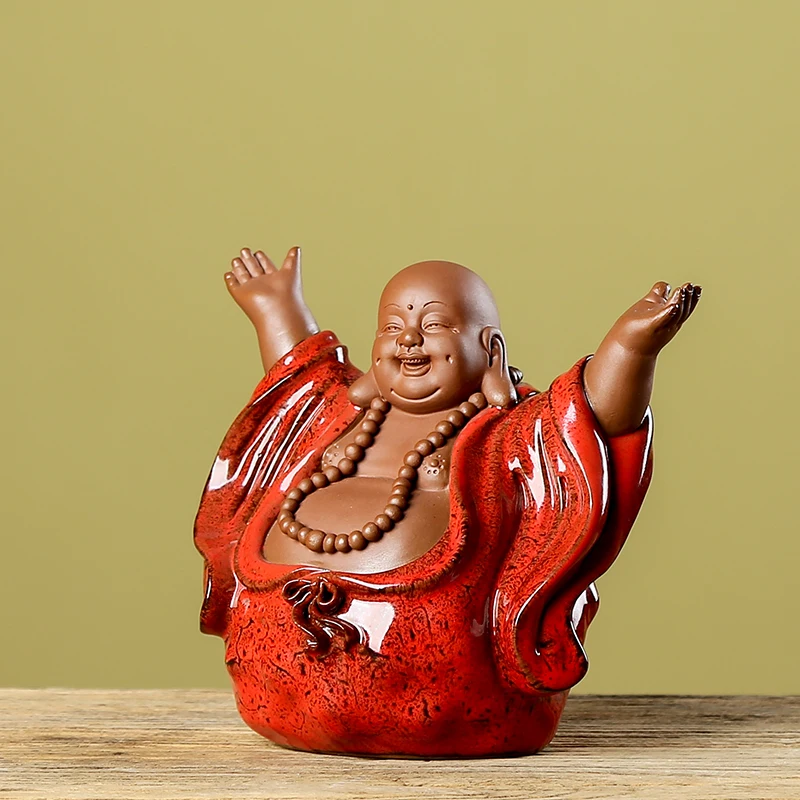
He wore the same track suit that other Koreans did for exercise, but that was about the only way he resembled them. Most Koreans are stern and grave in public, especially seniors. This man was – well, the only way to describe him was jolly.
He came bouncing up to me, seeming amused as hell to see me on the mountain. “You English? Yeah? English?”
I nodded. “Yep. I speak English.”
“Oh! Good! Where from, where from?”
“America – Missouri, if you know where that is.”
“You guess where I from! How my English? I practice with you! You guess where I from!” The man’s words came out in a mad rush, as if each was eager to be the first to reach my ears, so that they were tripping over each other and getting in each other’s way, all kind of just stumbling in at once.
I looked him over. I mean, he looked Korean, more or less – a bit rounder than most, a lot happier than most. But if he was Korean, why would he ask me to guess?
“You’re not Korean?”
“Nope! Guess again!” He grinned widely at me (well, more widely).
Well, he’s obviously Asian, so let’s play balance of probabilities here.
“Then you must be Chinese?”
“Yes! Good! Good! You good guesser!” He doubled over, laughing. “How my English?”
“Not bad,” I said, not untruthfully I felt. But he insisted I was a liar, and that his English was horrible, but he wanted to practice.
The laughing round man and I stood for perhaps 20 minutes there, on the path up the mountain, while the crowds flowed around us. Our conversation – interrupted by his frequent bouts of hilarity – was generally sufficient for me to learn this:
1)His name was Kim Cheong-wan.
2)”I bet you didn’t expect me to have Korean name!”
3)Turns out he was born to Korean parents in northern China – Dalian, to be precise, the former Mukden/Port Arthur during the days of Russian and Japanese domination.
4)His parents had met after the war – mom was from the North, dad from the South, but due to the war neither one of them could go home. So they made a life in China.
5)Cheong-wan loved to travel, loved to learn new languages.
6)Did I speak Chinese?
7)Wow, my Chinese was very good!*
8)Cheong-wan’s English, despite my insistence, was terrible.
9)”You tell me I make mistake! You tell me, yes?”
10)Of course I would tell him.
He had lived in China most of his life, but had moved to Gwangju to retire about a decade before, living near his father’s family. He liked to come out and hike every day – important to stay healthy, you know? He also liked meeting new people (I hadn’t noticed), especially foreigners (so he could practice his English).
Eventually, we parted, me headed up, him headed down, to the bus stop. I summited, scrambled down the mountain (not without difficulty – a story for tomorrow, perhaps), and staggered into the bus stop a good two hours later. I found a handy bench to wait for the next 09 bus to take me home, when a hand fell on my shoulder.
“Heeeeeeey! American! Remember me!?” How could I forget? Our reunion prompted renewed hilarity from Cheong-wan. His bus was late, so he was having to hang around the bus stop. He didn’t seem to particularly mind, as he wandered from person to person and chatted animatedly with everyone.
His English was – well, not great. Neither was my Korean. But nevertheless, we talked for perhaps an hour there, waiting for the bus. And at the end of it, I think I had made another friend. All because he wanted to practice his English.
In other words – sometimes the language barrier is no barrier at all to communication. Instead, it promotes it.
Glad to know you, Kim Cheong-wan.
*My Chinese is not very good. I got out “ni hao” and “xie xie” and a handful of other basic phrases.
 Gwangju Dreaming