Today is the last day I’m talking about the Wild Card Game. Even if you haven’t been following along, thanks for letting me take the time here (of course you had to let me, it’s my blog!) Even if you think baseball is boring and incomprehensible – you might just surprise yourself. I also thought baseball was boring and incomprehensible, but now I have been enlightened.
I have one more post to come about why all this is so important to me, and then we’re back to Korea. Thanks for your indulgence.
———–
“Once Roberts got to Boston, he mostly sat. And sat. The manager kept an eye on him but didn’t call his name very often. It was as if Roberts had changed from a ballplayer into some kind of glass-front box with the words break in case of need for stolen base stenciled on the front. But Epstein’s orthodoxy, reinforced by special adviser, Bill James, the creator of the whole analytical business that had debunked stolen bases in the first place, held that if you built the right kind of team, Roberts’s skills set would be largely extraneous. Except – and this was the key part of it, the flexible part of it that most people didn’t get – except when it was necessary.
– from the prologue to Mind Game: How the Boston Red Sox Got Smart, Won a World Series, and Created a New Blueprint for Winning.
And so here Roberts was, glass broken, standing on first base with Bill Mueller at the plate, the only potential run of the year that mattered anymore. It was a desperate moment, but nonetheless a moment that had been planned for. That was the difference between this time around and 1949, 1978, 2003, and all the other disappointments of the last century. God was in the details, and so were playoff victories. And the Red Sox were finally looking after the details.
Rivera threw over to first. Once. Twice. Roberts got back to the bag. Every problem is a lock looking for a key. The Red Sox had spent decades half-asleep, oblivious to the locks, never mind looking for the keys.
Rivera returned his focus to the man at the plate. Roberts took his lead – not an inch shorter than before, maybe half an inch longer now. Rivera got set in the stretch, looked once more at Roberts, then committed to home plate with a barely perceptible transfer of weight to his right foot, his left foot now rising off the mound.
But Roberts was already gone, digging toward second, erasing the past with every step.”
“I remember Maury Wills on the backfield in Vero Beach,” said Roberts. “He said, ‘DR, one of these days you’re going to have to steal an important base when everyone in the ballpark knows you’re gonna steal, but you’ve got to steal that base and you can’t be afraid to steal that base.’ So, just kind of trotting out on to the field that night, I was thinking about him. So he was on one side telling me ‘this was your opportunity’. And the other side of my brain is saying, ‘You’re going to get thrown out, don’t get thrown out.’ Fortunately Maury’s voice won out in my head.”
– Dave Roberts.
Dave Roberts’ steal against Mariano Rivera in Game 4 of the 2004 ALCS, with the Red Sox down a run in the 9th inning and 3 games to 0 in the series, is unquestionably the greatest steal in baseball history.
But what’s the second-greatest steal in baseball history?
Maybe it came in the 9th inning that night, September 30th, 2014.
The Royals, fighting for their lives, had in a single inning closed a 7-3 gap to a single run. But they were down to the last three outs of their season, with Sean Doolittle, Oakland’s powerful closing pitcher, taking the mound. Due up to hit was Mike Moustakas, the third baseman of the Process who had struggled all year. Moustakas hit only .172/.241/.313 against lefties like Doolittle.
Now, baseball typically presents batting statistics in three numbers – your slashline. The first number is the hitter’s batting average – how often does he actually get a hit, per at bat? Moustakas successfully hit only 17% of the time, a wretched number when the league average is closer to 25%. The second number is the most important – your On Base Percentage, or how often do you reach base safely per at bat? This includes walks, and can be thought of as your probability of not making an out. Moustakas only reached safely 24 times out of a hundred – so he has a 76% chance of giving away one of the Royals’ precious three final outs. Finally, the last number is your slugging percentage – how many bases do you typically gain per at bat? Home runs are worth 4, triples 3, etc. Moustakas was only gaining roughly a third of a base per at bat – in a league where the top players, like Mike Trout, can have numbers above 1.
So Ned Yost needed another option. Sitting on his bench was that option: Josh Willingham, a recent acquisition, a veteran player who was in his first postseason ever. Yost activated Willingham and sent him in to pitch hit.
Willingham hadn’t had a base hit since September 10. Doolittle was allowing opposing batters only a paltry .169/.197/.262 off him. When Willingham fell behind in the count 1-2, it looked like the curtain was starting to fall on the Royals.
But then Doolittle left a 94-mile fastball just a hair too far over the plate – and Willingham was swinging – the bat caught the ball and sent it to right – and the A’s outfield was shaded just a little too far to the left, meaning that Reddick wouldn’t reach the ball in time – and suddenly the tying run was on first base again. And the Royals had one more pinch running weapon in their holster. Terrance Gore, the Fastest Man in Baseball, had already been spent. But Jarrod Dyson was quite possibly the Second Fastest Man in baseball, and he was even now trotting out of the dugout ot replace Willingham.
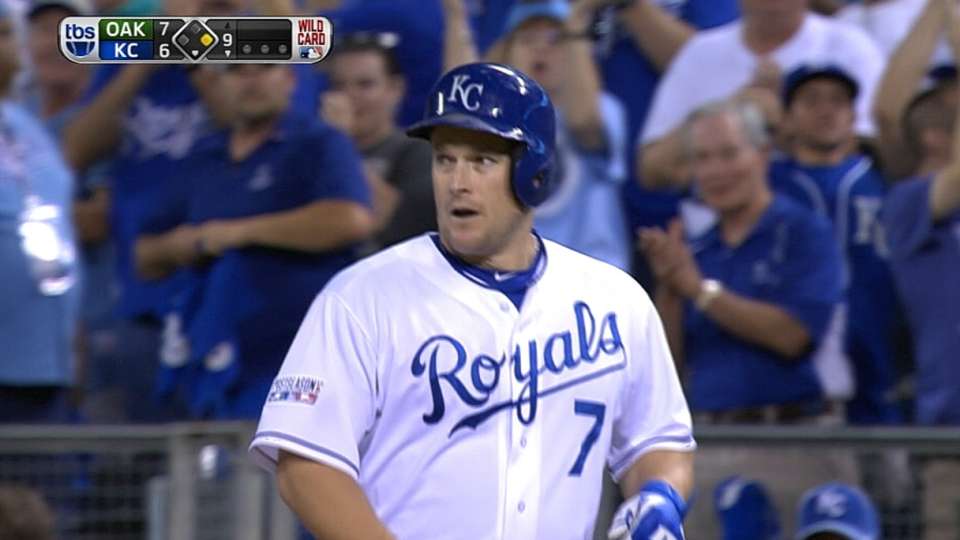
Between innings, with Lester out of the game, the Royals coaches met in the dugout to discuss whether to keep running now that Lester was out of the game. Outs were precious, so perhaps the team should try to slow down and look for the long ball. “Heck no!” the Royals’ improbably named first base coach, Rusty Kuntz, shouted. “We’ve got to go.” The formula remained the same: Put the ball in play. Get on base. Run like hell.
But it’s hard to run on lefties like Sean Doolittle. The lefthanded pitcher faces toward first base as he winds up for his pitch – so he knows exactly where the runner is. If the runner takes too great a lead, the leftie can easily pick him off. Too small a lead, and he can’t beat the catcher’s throw to second. Dyson couldn’t run.
So instead, Alcides Escobar sacrificed him over. He dropped a bunt perfectly, the ball slowly rolling towards the pitcher while Escobar took off for first. Doolittle scooped it up and fired to first, easily bagging Escobar – but Dyson was safe at second. Now, Doolittle couldn’t keep an eye on him. Now, he could steal the base that everyone in the ballpark knew he had come in the game to steal.
Doolittle and Dyson engaged in a battle of wits. Doolittle lifted his leg to throw home – then spun to face second. Dyson was already there, not having bought the ruse. Dyson played possum, his posture slack, his whole attitude conveying relaxation. He carefully studied the A’s pitcher as he threw a ball past Nori Aoki, the batter. Another fake pickoff, again Dyson already safe at the base.
But Dyson had Doolittle’s tell. It would be picked up after the game, but when Doolittle turned towards home and lifted his leg at the same time, he was going home, not going to second. Doolittle turned and lifted – and Dyson was gone.
Norris scooped up the low fastball and fired to third in a heartbeat – but no catcher alive could have caught Jarrod Dyson that night. The Royals’ baserunner was sliding safely across the base even as A’s third baseman Josh Donaldson fielded the ball. The tying run was 90 feet away – and Nori Aoki, the man with the lowest strikeout rate on the team, was at the plate.
Dyson glanced at the dugout, at the crowd and then – with the Royals two outs from elimination – he revved the engines of his motorcycle.
As Rany Jayazerli would later write,
“If you want a single image to sum up the never-say-die attitude of the 2014-2015 Kansas City Royals, that’s the one. The Royals were still two outs away from elimination – and Dyson is revving the engines at third base, with complete confidence in himself and without an ounce of fear for the situation. It was if he was saying, “Nervous? Why would we be nervous?” We were losing our minds in the stands, but out on the field, Dyson didn’t have a care in the world. He was a 50th-round pick, a guy who was drafted despite not really knowing how to hit a baseball, who by sheer force of self-confidence and his God-given tools surpassed far more heralded prospects through the farm system, reached the major leagues when he was 26 years old, and has been one of the game’s best fourth outfielders ever since. That’s what speed – and a relentless belief in yourself – do.”
Quote:
On the next pitch, Aoki lifted a high fly ball to right field. Reddick was there to make the catch – but Jarrod Dyson, the Second Fastest Man in Baseball, had tagged at third base and was already on his way home. The Royals had gone to the glass box, “break in need of stolen base,” and there, ready to answer the call, was Jarrod Dyson.
It was the bottom of the 9th inning. The Royals had one out left – and the score was 7-7.
======
Brandon Finnegan had come a long way in four months. He was a young man, only 21, sporting a scruffy beard in a vain attempt to make himself look less boyish. He was slightly stocky, with long brown hair curling out from under his cap as he sat in the Royals’ bullpen, watching the team carry out one of the largest comebacks in baseball history. Four months earlier, he had been a senior at TCU, pitching for his team in the College World Series. The Royals had drafted him that June – at #17, not even in the top half – and then Finnegan had caught fire, quickly working his way through the minor leagues. In September, the Royals had called him up.
“How the f*** do I know what I’m going to do with Finnegan if we make the playoffs?” Yost had commented at the time, when reporters pressed. Now, it was the 10th inning of the wild card game, and Yost needed a pitcher. Shields was done. Ventura was done. Herrera had pitched 2 innings already, Davis had covered the 8th, and Holland had covered the 9th, but not before using 23 pitches and loading the bases before escaping. Yost was almost out of pitchers. He knew now how he’d use Finnegan.
There have been easier assignments. Finnegan was up against the A’s explosive offense, which had already chastened James Shields, Yordano Ventura, and Kelvin Herrera with 7 runs – all pitchers with supposedly more talent and a lot more experience than the kid. Now, it was extra innings, and Finnegan had to be essentially flawless – any run the A’s scored could be the winning run.
And flawless he was.
In the 10th, he got Freiman to fly out. He put away Norris with a weak grounder on the first pitch. And then, getting ahead of Punto 1-2, he scorched a 96 mph fastball by him. Finnegan pounded his fist in his glove like a madman as he walked off the mound after the 1-2-3 inning.
/cdn.vox-cdn.com/uploads/chorus_image/image/63927840/456432154.jpg.0.jpg)
In the 11th, after the Royals squandered a leadoff hit in the bottom of the 10th, Finnegan did it again. He struck out Coco Crisp. Sam Fuld tried to bunt his way on, but Finnegan fielded the bunt himself – a tricky play for a young pitcher, without fielding instincts yet – and cut him down at first. Josh Donaldson – who would be the AL MVP the following season – singled, bringing up Brandon Moss, who had already homered twice, with 5 RBI, in the game. The 21-year old faced down the man who had been killing the Royals all night, working the count to 2-2 – then fired a fastball just through the outside corner. Moss was fooled and struck out looking. Finnegan couldn’t resist a mini-fist pump as he walked off the mound.
In the 12th, though, the young pitcher’s stamina started to falter. He walked Reddick on 5 pitches, then Lowrie bunted him over to second to put the go-ahead run in scoring position. Yost came out to pull Finnegan, but the damage was done – Jason Frasor, the last pitcher the Royals had, threw a wild pitch to put the runner on third, and then yielded a single to Alberto Callaspo that let Reddick dart home. It was 8-7 Oakland in the 12th, and Finnegan’s heroic effort was destined ot end in a loss.
The Royals had already come back twice in this game, from being down 2 runs and down 4 runs – now they would need to do it a third time, down only a single run this time, but with only a single inning to do it in. 3 outs to go.
Which quickly became 2 outs as Lorenzo Cain grounded out weakly. He walked back to the dugout dejectedly, convinced the game was over, passing Eric Hosmer on the way.
The Royals’ win expectancy now stood at 11% – stratospherically higher than the 3% they had had in the bottom of the 8th, but still not great. 9 out of 10 teams in the same situation would lose.
A year later, Hosmer would review the at-bat:
Eric Hosmer sidled into the dugout at Fenway Park one day this past August. He peered down at an iPad screen replaying his last at-bat from that night. He did not require much visual aid. He watched this encounter countless times during the winter.
Quote:
Hosmer had hit only nine homers during the regular season, but he wanted what all power hitters desire in these situations: a fastball up in the zone to drive out of the ballpark. The duel with Otero lasted six pitches. As he watched himself 11 months later, Hosmer pinpointed the fourth pitch as the most critical one. Hosmer had just fouled off two fastballs and was furious about missing them. Then Otero threw a slider in the dirt.
“After that slider, you can tell,” Hosmer said. “He threw that, and didn’t feel too comfortable about it. From that point there, after fouling off two heaters, especially in hitter’s counts, you’ve got a good feeling that a fastball’s coming.”
Hosmer sprayed another fastball foul. He planned to cheat on the next pitch, starting his swing early to generate as much power as possible. As the 2-2 fastball approached, Hosmer leaned his face closer to the iPad’s screen.
“There it is!” he shouted.
The ball leapt off Hosmer’s bat, speeding for the gap in left-center field. Every head in the ballpark turned to watch it. Rany Jayazerli put his arms around both his neighbor’s shoulders, chanting, “It’s not going out, it’s not going out…” to keep from getting his hopes up. Outfielders Jonny Gomes and Sam Fuld were both racing towards the wall as the ball hung suspended in the air. The bar where Taylor Fritz and his dad were watching was dead silent, as everyone watched.
Gomes reached the wall, leapt to catch the fly – and Fuld was there too, also lunging desperately – and the ball was bouncing off the wall, back towards the infield – the two outfielders had hit the ground in a tangle, and now here came Gomes pushing himself to his feet and dashing after the ball – Hosmer was around second – and when the dust had lifted, Hosmer was standing safe at third, exuberant. There were only two outs to go (again), but the Royals were still alive. They were still in the game.
COming to the plate was yet another young player, Christian Colon. Billy Butler, recall, had been batting behind Hosmer, but he was lifted in the 8th for pinch-runner Terrance Gore. One thing the Fastest Man in Baseball is NOT, however, is a good hitter, and so Colon was put in Gore’s place to hit. He came to the plate needing to get the ball out of the infield to score Hosmer.
A’s pitcher Dan Otero got unlucky. He tried to blow a 92-mph fastball by Colon, with a nasty late sink to it that SHOULD have seen it smoothly dart past Colon’s bat. But instead, Colon desperately clipped the top of the ball. The ball shot straight down in front him – bounced off home plate – and into the infield. Colon took off for first – and down the third base line came Hosmer. Put the ball in play. Run like hell.
“High chopper!” the broadcaster, Ron Darling, exclaimed. “They’ll never get him! Tie game!”
8-8.
Otero got Gordon to pop out for the second out of hte inning, then was lifted for the A’s final pitcher, Jason Hammel. Coming to the plate was Salvador Perez, the young Venezuelan with a gigantic smile, who had been signed for $65,000 as a kid in 2006. Perez was a notoriously impatient hitter, offering at pitches nowhere near the Zone. Hammel quickly got him to 2 strikes.
Over at first base, Rusty Kuntz (heh) had told Colon that if Perez got to 2 strikes, Colon had to run. Unfortunately for Colon, the A’s knew he was going to run, too. On the next pitch, Colon took off – and the A’s pitched out.
A pitch-out is when the pitcher and catcher mutually agree to throw a ball far outside the strike zone. The pitcher will get it to the catcher as fast as he can, and the catcher can catch the ball already coming to his feet and firing to second base. It’s a play designed to foil steal attempts, and it’s almost never done – the A’s had pitched out only 16 times in 162 regular season games in 2014. But now they pitched out in the 12th inning of a tied double-elimination game – and they guessed right. Colon was dead to rights.
Except…
Except Derek Norris is not Gary Soto. He’s a fantastic bat, but a poor defender. His eyes were on Colon, not on the ball coming in – and it clipped off his glove. He missed the catch and the ball fell harmlessly to the dirt while Colon skidded safely into second.
Over at third base, Josh Donaldson shaded over towards second to help protect outfielder Jonny Gomes’s arm.
On the next pitch, Hammel through a slider. It wasn’t a great slider, but it was 6 inches outside. It was the 385th pitch of the game, and the time was 11:52 – 8 minutes to October. Perez lunged desperately for it. There were 2 strikes – if he missed, the inning was over and the game was going 13 innings, with the Royals pitching running on fumes.
But he did not miss.
The ball skipped down the third base line. Josh Donaldson hurled himself towards the ball, diving to stop it. He got close:
![[Image: Salvy%2Bsingle.JPG]](https://gwangjulikeit.home.blog/wp-content/uploads/2019/10/0c61b-salvy2bsingle.jpg)
One inch from preventing history.
But Donaldson did not catch it. The ball skipped past – and Perez was running to second – and here came Colon around third and the crowd was erupting.
9-8, Royals.
“The noise felt volcanic. The stadium shook. In the stands, strangers embraced. Fans jumped on their seats. Beer and water rained down upon them. Inside Moore’s suite, George Brett, the legend who predicted victory when the situation seemed most dire, clasped his hands on his forehead and shouted. A mosh pit formed around Perez. The group somehow stayed upright, their momentum propelling them into center field. The stadium blared Archie Eversole’s “We Ready,” the song that became the team’s anthem en route to the World Series. After the celebration, Hosmer received a request from a team official to do a television interview on the field. “I literally told him I had to wait two minutes,” Hosmer said. “Because I felt like I was going to throw up.”
– From The Night KC Baseball Came Back To Life
Inside the broadcast booth, Darling shook hands with Ripken and Johnson after they went off the air. Darling knew, already, it was one of the greatest games he had ever called. “My reaction, after the game, is unprintable,” Darling said. “It was ‘Holy (expletive). Can you believe what we just saw?’ I wish I could have said that on the air.” He walked back into the parking lot, which teemed with fans. To Darling, the group looked ecstatic. And exhausted. “It was almost like ‘The Walking Dead,’ ” Darling said. “The fans were walking around, zombie-like. Like they were kids who had too much sugar. Or adults who had too much coffee.”
Abby Elmer and her parents struggled to reach their car because of the crowd surrounding Joel Goldberg and Jeff Montgomery’s stage for Fox Sports Kansas City’s postgame show. For the drive back across the state, Seth Atkins listened to Josh Vernier on 610 Sports Radio. He lost the signal near Columbia, so he put the show on his phone.
At his home in Overland Park, Kent Swanson watched highlights until 3 a.m. When he heard Ryan Lefevbre’s radio call of the final hit, as the night baseball returned to Kansas City drifted toward the morning, he burst into tears.”
Three times, the Royals had trailed. Three times, they had come back. They had overcome the largest deficit of any team in an elimination game in history. They gotten lucky, skated on the edge of disaster, they had been brilliant – and in the end, they had won. The most important game in Kansas City in 29 years ahd also turned into the best game in 29 years. The celebration throughout the city was universal.
 Gwangju Dreaming