Gonna do something a little unusual here. No Korean adventures (although I do have some more to share), no poetry, no philosophy. Instead, for the next coupla days, we’re talking baseball.
See, today marks the 5th year anniversary of one of the greatest games of baseball ever played: The 2014 American League Wild Card game. A single play-in game between the Moneyball Oakland A’s, and the hapless, hard-luck Royals, who were hoping to make the playoffs and snap their 29 years of not making it, the longest playoff drought of any professional team in North American sports. For some personal reasons, the game is and always will be special to me. What follows is mostly a repost, from my telling the tale of the game elsewhere.
If you’re interested in reading Brad tell baseball stories, welcome! If not, I highly recommend that you at least watch the video to follow. If neither of those interests you, well, thanks for stopping by, glad to have you! I’ll do this every day for a couple of days, just as my own way of observing the anniversary and celebrating hte arrival of the baseball playoffs (hoping the Brewers/Twins go all the way – it won’t happen, though.  )
)
To recap: The Royals spent 29 years being the worst team in baseball, the butt of every joke in the league. They had gone longer without a playoff appearance than any other professional franchise in all of North America, and Kansas City as a whole had not won a single playoff game in any sport in 20 years. On September 30th, 2014, after decades of false starts, the Royals finally had a shot to make the postseason. But first, they had to win the wild card. One single game to determine their fate – win, and get the chance to play in the real playoffs. Lose, and go home. Just like every other year for almost thirty years.
What follows is the story of that single game.
Now, our biggest fear, going into the wild card, was that the Royals would fall behind quickly and their playoff hopes would expire 15 minutes after the first pitch was thrown. This was not an idle fear – remember, the Chiefs, the other franchise in town, had repeatedly appeared in the playoffs since 1985, and they had lost every single game. One-and-done was the order of the day, and it was quite possible that Royals fans would not even receive the illusion of being in a competitive playoff game.
Their opponents could not have been more perfect, narrative-wise: The Oakland Athletics (A’s). The Athletics had once been the Kansas City A’s, but had moved on to the west coast after failing to win anything here. Out in California, they had revolutionized the game of baseball. With one of the smallest payrolls in the sport, the A’s had consistently put together winning team after winning team. In the fiercely competitive AL West division, they had won 100 games time and again – in seasons with division opponents like the Mariners, who had set the single-season record for wins (2001) or the World Series-winning Angels (2002). The A’s had ignored traditional scouting reports on players and instead found undervalued statistics like on-base percentage (OBP, the amount of times a player reaches base safely per at bat) and home run power, picking up secret stars on the cheap. Their process was made famous in the book and later movie Moneyball. At the climax of the book, and the film, the A’s are on the brink of a 22-game win streak, a record in modern times. However, the team blows an 11-run lead, only to win the game in the ninth. The A’s hapless opponent in the film (and book, and reality)? The 2002 Kansas City Royals, mired in the first of what would be 4 100-loss seasons.
12 years later, in 2014, the A’s still built their team around walks and home runs. Their players would work pitchers, taking lots of borderline pitches and drawing walks, while punishing pitches inside the strikezone for home runs (which would also drive in all those guys who walked earlier). They discouraged risky moves on base, running conservatively, avoiding making outs, and waiting for a homer to drive them in. Their defense was modest but not spectacular, their starting pitching was very good, and they had a decent but not great bullpen. By contrast, the 2014 Royals were built, as I said, on a brilliant defense and unhittable bullpen. But they were not a great offensive team. They had to scratch and claw for every run. Their offense was free-swinging, aggressively attacking any pitch the Royals thought they could hit. Once on base, they would aggressively take extra bases, stretching singles into doubles, going first-to-third any chance they got, and leading the league in stolen bases. They struck out the least of any team in baseball – but also had no power and no walks, dead last in both walks and home runs.
To sum up: Put the ball in play. Get on base. Run like hell.
In other words, the Royals and the A’s had polar opposite baseball philosophies. For decades, the A’s had won while the Royals had struggled. The A’s showed the way of the future, the Royals were mired in the past. The A’s got the dramatic Hollywood movies made about their fortunes – and the Royals were reduced to the roles of the foolish losers. The A’s became the team most identified with sabermetrics, spawned the most influential sports book of the generation, and entering the 2014 had advanced to the playoffs seven times in the last 14 years. The Royals became the team most identified with old-school thinking and lost 100 games four times in a five-year span.
The Royals’ failures became as much a testament to the value of sabermetrics as did the A’s success. To paraphrase Voltaire: If the Royals hadn’t existed, we would have had to invent them. But we didn’t have to invent them. They existed, and I knew this because they were my team. For two decades, my grandpa’s heart was attached to a franchise that my grandpa’s brain would have sat on the porch, shotgun in hand, to keep away. Tonight would be the first time the two franchises had ever had a face-to-face showdown in the playoffs.
A generation of fans, my friends, many of them, who had never experienced playoff baseball flocked to the park. Seth Atkins, a 26-year-old from Olathe, took the day off work from the high school where he taught, outside St. Louis. He arrived at Kauffman Stadium when the gates opened.
Taylor Fritz, a 21-year old from Lee’s Summit, arrived at the ballpark early with his dad. They had seats just behind the right field wall, and settled in, hoping to catch a home run.
Kent Swanson, a 26-year-old from Overland Park, bought a ticket at face value that morning. When he and a friend settled into their seats in the upper deck, he felt the tension. “There was just 29 years of aggression and angst and excitement in that building.”
Abby Elmer, a 21-year-old from Brookside, finished her classes that morning at the University of Missouri and drove from Columbia to attend the game with her parents. Growing up, the trio shared season tickets. She had never seen Kauffman Stadium like this. “I just could not believe how loud it was. How insane it was. You could not hear the person next to you, it was so loud.”
Starting for the Royals was James “Big Game” Shields, the centerpiece of a trade 2 years earlier that had seen the Royals give away their biggest young talent, Wil Myers, in return for the steady starting pitcher. Shields was in the last year of his contract – so this game was everything for him. If the Royals lost, Shields would leave and they would have given away a generational talent in return for – nothing.
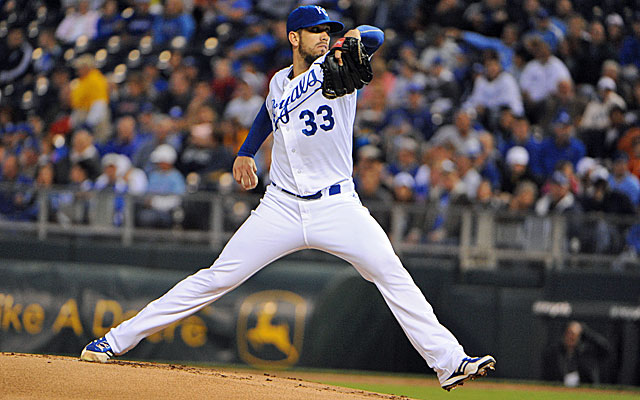
But as the game started, it looked like Royals’ fans worst nightmares were coming true. James Shields issued a walk to the A’s leadoff hitter. He seemed to steady himself with a flyout and a strikeout – but then he fell behind Brandon Moss. A few pitches later, he left a ball hanging just above Moss’s thighs – and the A’s batter demolished it, blasting the ball far out of the park. 2 runs scored and the Royals were losing before they had even had a chance to bat. The raucous crowd quieted. So it would be another Chiefs game after all. One and done.
But then, in the bottom of the first, Alcides Escobar singled. A’s starter Jon Lester got 2 outs fairly easily, but then after a walk he gave up a single to the Royal’s chubby DH Billy Butler. Suddenly Kauffman was buzzing again – it was 2 to 1, and there were runners at first and third! The Royals might lose this game, but at least they would put up a fight.
However, the rally ended on a muffed play.
See, it wasn’t common knowledge yet, but the A’s pitcher Jon Lester had the yips. Specifically, he was unable to throw the ball to first base. Any time he tried, the ball sailed off into the stands or the dugout. And so, quietly, not drawing attention to it, he had stopped throwing to first entirely in the last few seasons – meaning he could not hold even the slowest runner on the base, because he’d have to win a footrace with the baserunner in order to have a chance to get him out. Which, in turn, meant that baserunners could take a huge lead off Lester and steal second easily. No one had noticed yet – except the Royals’ scouts.
Butler was quietly told to steal second. The slowest player on the team, Butler thought that the coaches were out of their minds. But while Lester chased Butler, it would give Eric Hosmer, standing on third, the chance to scamper home and tie the game. Shaking his head, Butler stepped off first…
…and it was a fiasco. Lester awkwardly stepped off the mound and scooted towards Butler – and Hosmer froze. He just couldn’t believe that a major league pitcher could not make that throw. Belatedly, he shook off his amazement and darted for home – but it was too late. Lester had gotten close enough to another player to awkwardly shovel him the ball, and the A’s shortstop whipped the ball home just ahead of Hosmer. The Royals’ first baseman dived in a desperation move, colliding with A’s catcher Gary Soto, but no good – he was out and the inning was over.
As a minor consequence of the play, Gary Soto injured his thumb in the collision. The A’s catcher came out of the game and was replaced by Derek Norris. Norris was a much better hitter than Soto – but a far worse defender. The main job of a catcher is to throw out base runners attempting to steal. Norris was far, far worse at that than Soto.
The Royals didn’t know it, but they had just had their first big break of the night.




 Gwangju Dreaming